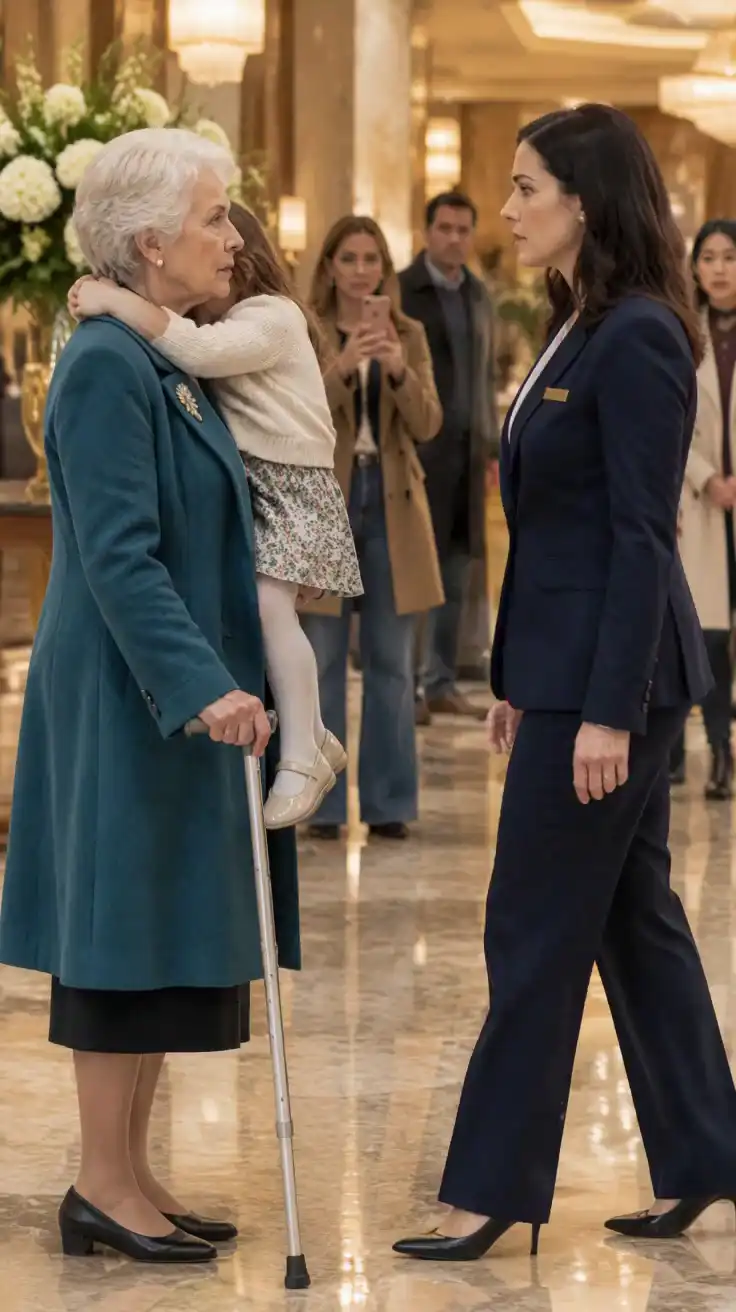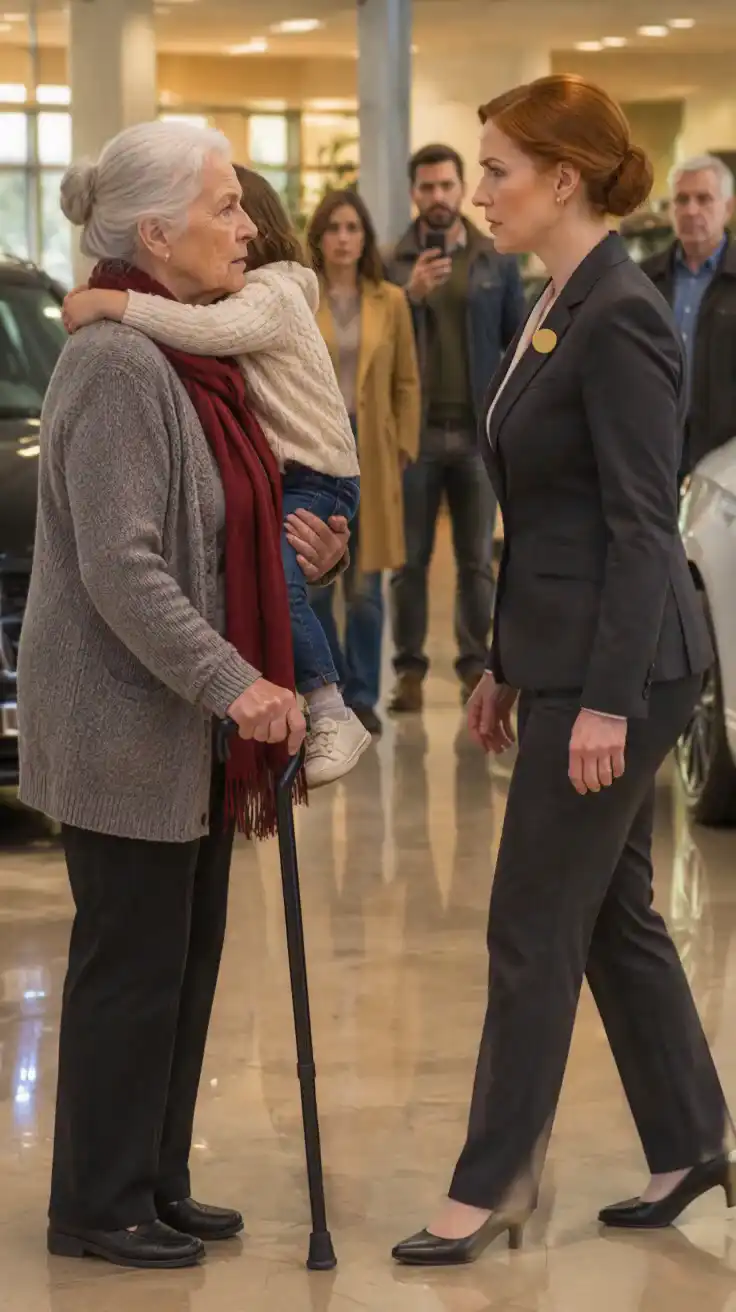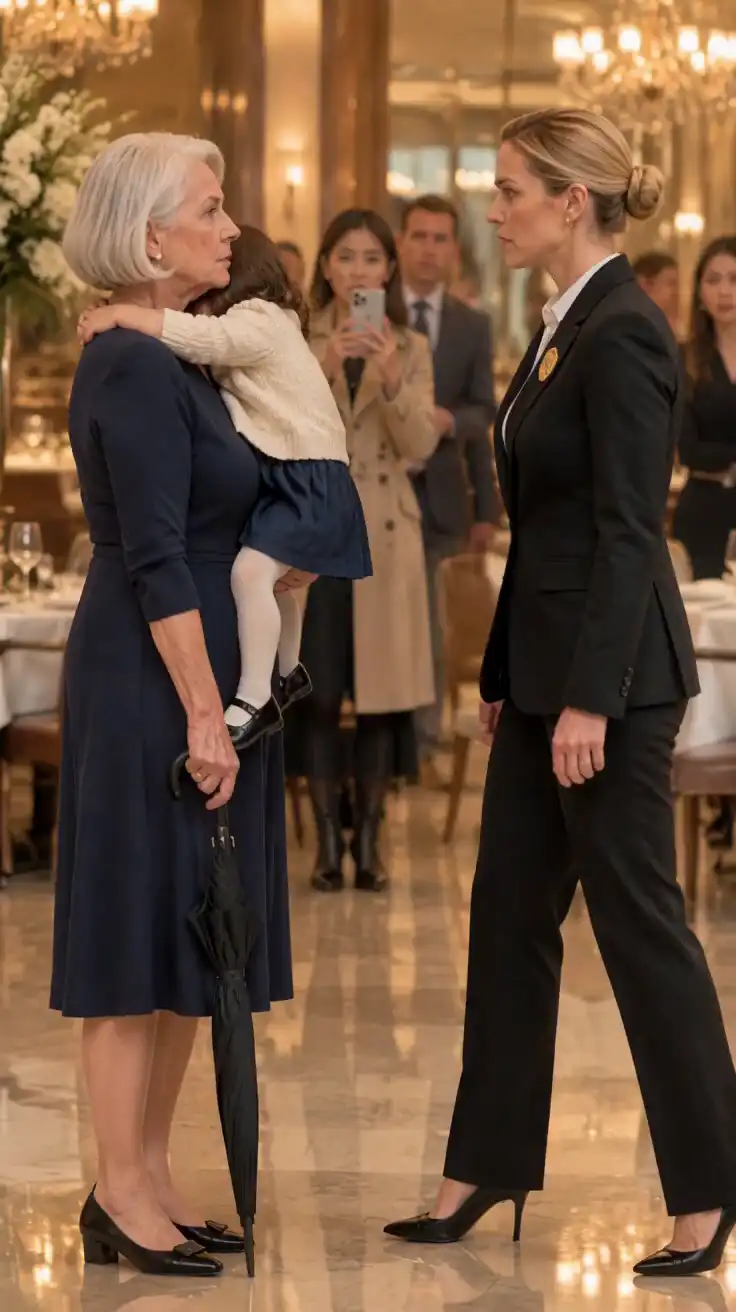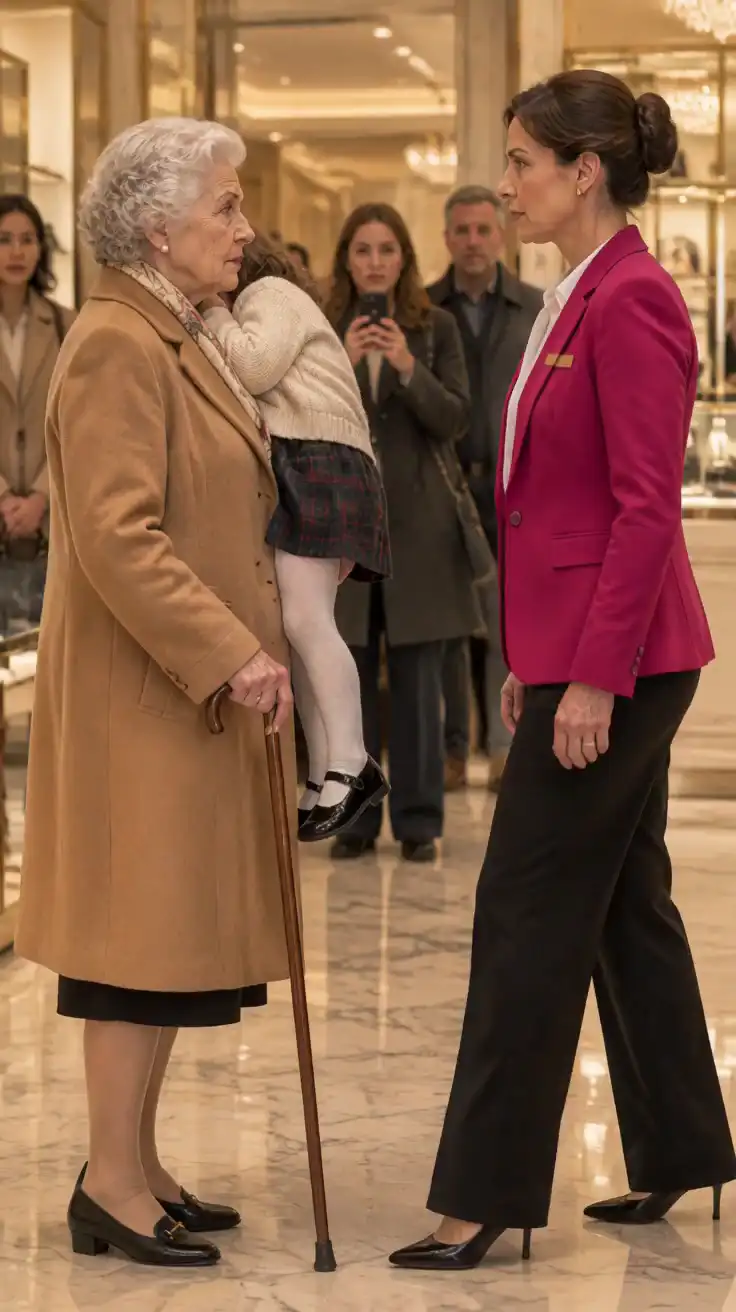
The branch manager slapped my cheek and ordered his guard to drag me away from my late husband's safe deposit box, but as he reached to snatch my phone, my son shoved the front doors open.
Heat spread beneath my skin, and the metal chair scraped backward as I caught myself against the counter. The envelope inside my coat pressed against my ribs, stiff with the papers my husband had left behind.
“Get her out,” the branch manager said.
A guard stepped between us. His hand closed around my elbow, not hard enough to bruise yet, but hard enough to make the room understand whose side he had chosen. Customers turned in their chairs. Someone near the elevators lifted a phone, then lowered it when the manager looked over.
“I have an appointment,” I said.
The manager snatched the folder from the counter and flipped through the pages without reading them. He glanced at the small brass key in my hand, then pushed both away.
“Your access has been frozen,” he said. “You are not opening that box today.”
The guard pulled me toward the lobby. My shoes slid over the polished floor. The envelope shifted under my coat, and I pressed one palm against it, feeling the hard corners of the papers through the fabric.
“Call whoever you need,” the manager said. “No one is changing this.”
I reached for my phone. The manager saw the movement and stepped close again, his sleeve brushing my shoulder.
“Don’t make this worse.”
I dialed without looking at the screen. The call rang once, twice. Around me, the bank’s quiet broke into small sounds: a chair leg dragging, a child asking a question, the guard breathing through his nose.
When the call connected, I said only, “They won’t let me take your father’s papers.”
The manager’s face tightened.
“Hang up,” he ordered.
I kept the phone to my ear. A voice answered from the other end, low and suddenly alert. The manager heard it too. He reached toward my phone, then stopped himself.
“Who are you talking to?” he demanded.
Before I could answer, the front doors slammed open.
A young man stood there, one hand still on the handle. The manager’s hand remained suspended in the air.
THE PAPERS HE CAME TO TAKE
Richard stepped inside, and the manager’s hand dropped as recognition drained the color from his face.
“Mr. Vale,” he said.
My son didn’t look at him first. He looked at me.
“Mom.”
“I’m all right,” I said.
He crossed the lobby in three strides. His eyes went to my cheek, then to the guard’s hand still around my elbow.
“Let her go.”
The guard released me. He took a step back, his gaze moving from Richard to the manager as if he had just realized the people in the room might remember what he had done.
Richard put one arm around my shoulders. He didn’t squeeze. He just stood close enough that I could lean against him if I chose to.
“Did he hit you?” he asked.
“Yes.”
The manager recovered his voice. “This is a misunderstanding. Mrs. Vale was becoming disruptive, and we were trying to—”
“You struck my mother,” Richard said.
“I was attempting to prevent an incident.”
“That isn’t what I asked.”
The manager pressed his lips together. On the counter behind him, my folder lay open, its pages bent where he had handled them. The brass key rested beside it.
Richard noticed both.
“Is that the paperwork Dad left you?”
“It is.”
“Then we’ll deal with the box first.”
The manager straightened his jacket. “The box is frozen. We can’t provide access.”
“Why was it frozen?”
“Standard procedure.”
“Whose procedure?”
The manager’s eyes shifted toward the customers. Several had not gone back to their chairs. A woman with a canvas grocery bag stood beside the waiting-area table, holding its strap in both hands. The person near the elevators had their phone out again, pointed down at their own shoes.
Richard kept his voice level.
“Let’s go somewhere private.”
“No,” I said.
He turned toward me.
“I want them to hear what happens next.”
The manager’s jaw moved. “There’s no need to make a scene.”
“You made one when you slapped me.”
A silence opened around us. I could hear the lobby clock ticking over the soft hiss of the heating vent.
Richard pulled out a chair for me at the nearest consultation table. He waited until I sat, then took the chair beside mine rather than the one across from the manager. It wasn’t a courtroom, but I didn’t feel alone at the table.
“Bring the folder,” he said.
The manager hesitated.
Richard looked at him. “Now.”
The guard fetched the folder from the counter and set it on the table. He placed the key beside it, careful not to meet my eyes.
I opened the folder myself. The first page was the safe deposit agreement, the original contract my husband and I had signed when we rented the box. The bank had given us a copy then, but Martin insisted on keeping the original in his desk at home. When he died, I found it in the bottom drawer with the key, a stack of old photographs, and a note in his precise handwriting: Bring this with you. Don’t let anyone tell you the box belongs to them.
The manager had glanced through those pages and pushed them away. He hadn’t read far enough to see my name.
I placed the contract on the table and turned it so he could read the first page.
“Read it,” I said.
He didn’t move.
“Mrs. Vale, we can review the issue in my office.”
“You already reviewed it in your office. You froze the box last week. Read the contract here.”
Richard leaned back. “She’s asking you to read the document that gives her access to the box.”
The manager’s eyes flicked toward the guard.
The guard looked at the floor.
A branch employee came out from behind the counter, a woman in a gray cardigan with a bank badge clipped to her collar. I had seen her when I arrived. She had checked my appointment and gone to ask the manager for approval. She was the one who had returned saying there was a problem with my access.
“I can bring the account file,” she said.
The manager turned on her. “You don’t need to.”
“I should get it,” she said. Her hands were clasped in front of her, but her shoulders had stiffened.
“Please,” Richard said. “Bring the file and the access log.”
She looked at the manager, then at me. I nodded.
She went back through the secured door.
The manager lowered his voice. “Mr. Vale, you’re a board member. You understand the need to protect the institution from exposure.”
“I understand that a bank has to follow its own procedures.”
“This involves sensitive records.”
“Then explain the procedure.”
The manager’s eyes came back to me. He had spoken as though the problem began and ended with my presence. Now the room was waiting for him to put a reason to his decision.
He tapped one finger against the table.
“The box was placed under temporary administrative restriction after a compliance review.”
“Who requested the restriction?” Richard asked.
“I can’t discuss an internal review with a customer.”
“I’m not asking you to disclose another customer’s information. I’m asking why my mother’s box was restricted.”
“She is the customer,” I said. “Ask me what you need to ask.”
He shifted his weight.
“Your husband was involved in transactions we’re reviewing.”
“Martin died four months ago.”
“That doesn’t resolve the matter.”
“No. But it does mean you can’t ask him questions.”
The woman in the cardigan returned carrying a thick file and a computer tablet. She had also brought a printed access log. The manager’s face tightened when he saw the pages.
“Put those in my office,” he said.
“They’re the branch record,” she replied.
“They’re restricted.”
“They concern Mrs. Vale’s box.”
She set the file down in front of me.
Richard didn’t touch it. “Would you read the contract first?”
The manager looked around the lobby again. No one had moved. The canvas-bag woman had taken a seat, but she was still facing us. A man near the entrance had stopped pretending to check his watch.
The manager picked up the contract.
He scanned the first page. His eyes paused, then traveled back to the top.
“Mrs. Vale is listed as the sole box holder,” he said.
“Read the name,” I said.
“Eleanor Vale.”
“And?”
He turned the page. “There are no other authorized holders.”
“That’s correct.”
Richard’s thumb pressed against the side of his chair. “So the bank has no basis to treat her as an unauthorized visitor.”
“The restriction isn’t about ownership.”
“Then what is it about?” I asked.
He put the contract down as though it had become inconvenient to hold.
“That’s what we’re trying to determine.”
“You froze the box before determining it.”
“It was a precaution.”
“Against what?”
“I can’t speak to details until the review is complete.”
“What details did you have last week?” Richard asked. “You made the decision to block access. What were you trying to prevent?”
The manager’s eyes hardened.
“I’m not required to explain an active security hold in the lobby.”
“You are required to explain a decision that affects her access to her own property,” Richard said. “And you’re required to explain why you put your hands on her.”
The manager looked toward the guard. “I did not put my hands on her.”
The guard’s breath caught.
I turned to him. “You were standing there.”
He didn’t answer.
Richard did not raise his voice. “You saw it.”
The guard swallowed. “I saw the manager strike her.”
The manager stared at him.
The guard’s fingers flexed against his uniform trousers. “I was told to remove her. I didn’t see her threaten anyone.”
“You grabbed my arm,” I said.
“I’m sorry, ma’am.”
“You can be sorry after you tell the truth.”
He looked at the manager again. This time he didn’t look away.
“She asked to see her box. The manager slapped her. Then I tried to escort her out.”
“Did you hear a threat?” Richard asked.
“No.”
“Did she touch anyone?”
“No.”
“Did she damage anything?”
“No.”
The manager’s voice sharpened. “That’s enough.”
The guard stepped back, but he didn’t retract what he had said.
The bank employee opened the file and turned the printed pages toward us. “The restriction entry is on the second page.”
The manager reached for the papers.
“Don’t,” she said.
He froze, his fingers just short of the edge.
“I’m responsible for the branch records.”
“The file is controlled by operations. I printed it from the authorized system.”
Richard looked from her to the manager. “Who entered the restriction?”
She ran her finger down the page, stopping at a row near the top.
“Branch manager authorization. It was entered last Tuesday at 4:18 p.m.”
“By you?” Richard asked.
The manager lifted his chin. “The record may show my approval, but that doesn’t mean I originated the concern.”
“Who did?”
“I’m not going to discuss names in this lobby.”
“Was there a written request from compliance?” I asked.
He said nothing.
“Was there a court order?”
“No.”
“Was there a claim from another holder?”
“No.”
“Then what did you have?”
“A report that warranted a pause.”
“What report?”
He gave the table a short, impatient look. “Your husband maintained accounts with the bank.”
“Many people maintain accounts with banks.”
“He worked with people who had interests in this institution.”
“Martin was an accountant. He kept records for people who asked him to.”
“And that can create conflicts.”
“My husband kept his work outside that box.”
The manager’s eyes sharpened. “You said you don’t know what’s inside.”
“I said I came to retrieve his papers. I know that he kept personal documents there. I don’t know every document he placed in the box over the years.”
“Then you can’t assure us there’s nothing relevant to our review.”
“I can’t assure you of what you have not told me you’re looking for.”
That was the question I had been carrying from the moment I walked through the doors. Not just why I couldn’t open the box, but why this manager was so afraid of what I might take out of it.
Richard moved the access log closer.
“Let’s stay with what the record says,” he said. “The restriction was entered last Tuesday by this branch. It says ‘pending review.’ There’s no document attached?”
The employee checked the tablet. “There’s a note, but no supporting attachment.”
“What does the note say?”
The manager stepped toward her. “You don’t have authorization to read an internal note to a customer.”
“She has authorization to see records about her own box,” Richard said. “If the bank’s position is that the note is privileged, have counsel tell us that. Don’t just reach over and block it.”
The employee looked at me. “It says the box may contain material related to an ongoing review.”
“What material?” I asked.
“It doesn’t specify.”
“Who wrote the note?”
The employee scanned the screen. “It was entered under the manager’s credentials.”
The manager’s mouth tightened. He put one hand on the back of the empty chair across from me.
“I approved the hold because I was acting to protect the bank.”
“From what?” I asked.
His gaze settled on the envelope beneath my coat. I felt it against my ribs.
“Your husband’s files may establish that he retained records connected to the bank’s lending decisions,” he said. “There are questions about whether those records were obtained appropriately.”
“By whom?”
“That’s being investigated.”
“Were you involved in those lending decisions?”
He removed his hand from the chair. “I’m not answering questions about internal business.”
“Then why did you freeze a customer’s box?”
“Because there was a concern it contained bank information.”
“And you didn’t want me to see it?”
“I wanted to ensure it wasn’t removed before the review.”
The words landed with more force than his earlier excuses. He had said the quiet part plainly, and the witnesses heard it.
Richard looked at him for a long moment.
“You froze her access so she couldn’t take something out.”
“I followed a precautionary step.”
“A step that prevented the box holder from exercising her rights.”
“It was temporary.”
“You’ve blocked her for a week.”
“The review is ongoing.”
“Who is conducting it?”
The manager glanced toward the secured door.
The employee answered before he could. “The case was sent to regional operations.”
“Which team?”
“Compliance review.”
“Did they instruct you to restrict access?” Richard asked.
The manager said, “I believe there was a request.”
“You believe?”
The employee scrolled through the record. “There’s no request from compliance. The case was opened by this branch and forwarded after the hold was placed.”
Richard leaned toward the screen. “So the sequence is: you froze the box, then you sent it to compliance.”
The manager’s face had gone red now, though his voice was controlled.
“We had to prevent evidence from disappearing.”
“What evidence?” I said.
He didn’t look at me.
I took the envelope from inside my coat. My fingers had started to shake, so I set it flat on the table and pressed down until the paper stopped moving.
“My husband left me a letter. He told me what was in the box and why he kept it there.”
The manager reached toward it.
Richard put his hand on the envelope before he could.
“Don’t touch her property.”
“I have a duty to inspect documents that may belong to the bank.”
“You haven’t even established that any document belongs to the bank.”
“I’m trying to establish it.”
“Then do it through the proper channel.”
The employee placed her palms on the table. “There’s a second record tied to the case.”
The manager turned sharply. “What?”
“The restriction entry has an internal reference to a board resolution.”
Richard sat still.
I watched his face, trying to read what he knew. He didn’t look surprised so much as careful.
The manager gave a short laugh. “That’s irrelevant.”
“It’s listed as a supporting basis,” she said.
“Show me.”
She rotated the tablet toward us. The reference number appeared as a line in the record, but the document itself was not attached.
Richard read the screen. “What resolution?”
“I don’t know,” she said. “The reference is to a resolution on governance controls.”
The manager shook his head. “There are dozens of resolutions. It has nothing to do with this customer.”
“Then there should be no problem confirming that,” Richard said.
“You don’t have the resolution.”
“No. The bank does.”
He turned to me. “Mom, what did Dad say the papers were?”
“Records he thought I should have. He said he’d put them with the family documents because he didn’t want anyone else deciding what happened to them.”
The manager’s eyes went to Richard again. “That’s exactly why we can’t allow access until we know what’s inside.”
“That makes no sense,” Richard said. “You can’t claim a document as evidence based on the possibility it exists, then keep the owner from retrieving her own property indefinitely.”
“We’re not talking about ordinary property.”
“Then prove that.”
For a second I thought the manager might answer. Instead, he reached for his phone.
“I’m calling legal.”
“Good,” Richard said. “Tell them the branch has a customer here, a written contract naming her as sole holder, a week-old restriction entered without an attached compliance request, and a physical assault witnessed by staff and customers.”
The manager lifted the phone to his ear and turned away.
“Don’t include that last part,” he said into it.
“I’m not on the call,” Richard said.
The manager walked a few steps toward the counter. The guard stayed beside the table, arms at his sides. The bank employee remained near the file.
“Please don’t leave,” she said to me. “I can’t say what will happen, but the regional team will need to see the original record.”
“I’m not leaving without the key.”
She nodded.
Richard moved the folder close to me. “Do you want to read Dad’s letter now?”
“Not here.”
“All right.”
He didn’t ask again. The envelope stayed under my hand. Martin’s handwriting was on the page inside, but I already knew the first line because I had read it once at home and then folded it back up. He had written, Ellie, if you’re reading this, the papers matter because somebody will tell you they don’t.
I hadn’t understood what he meant until the manager looked at the brass key as if it belonged to him.
The manager returned from the counter.
“Legal says we should wait for regional compliance.”
“How long?” Richard asked.
“They’re sending someone.”
“From where?”
“Head office.”
“When?”
“I don’t know.”
“Then call them back and ask.”
He gave Richard a hard stare, then put the phone to his ear again.
The customer with the canvas bag stood. “I saw what happened,” she said.
The manager looked at her. “Ma’am, you don’t need to involve yourself in a banking matter.”
“I saw you hit her.”
“This is a private matter.”
“It stopped being private when you hit her in front of the room.”
The manager opened his mouth, then closed it.
The woman sat down again. She placed her bag at her feet and folded her hands in her lap. Her voice had been small, but she had changed the room. The manager couldn’t pretend there were no witnesses now.
Richard thanked her with a nod.
The manager finally got through to someone. He said, “We have an escalation,” then listened. “Yes, Mr. Vale is here.”
He looked at me while the person on the other end spoke.
“No. She has the contract.”
Another pause.
“The customer is insisting on access.”
He listened longer this time.
“I understand what the branch record says.”
He didn’t say that he understood what I wanted. He kept turning my request into an obstacle in his way.
“Then send someone with authority to make the call,” Richard said.
The manager lowered the phone. “They want to speak with Mr. Vale.”
“Why?”
“They’re asking for a board member.”
Richard’s expression didn’t change. “I’m here as her son. I’m not making an operational decision.”
“They need to verify—”
“You can verify me through the directory. You don’t get to make my role the reason she can’t speak.”
He put his phone on the table and called the number for the bank’s board office. He waited, then gave his name and asked for the governance secretary. He didn’t announce himself to the lobby. He didn’t say anything about the manager or the slap. He simply asked someone who knew the bank’s governance records to confirm whether he should remain in the branch while a customer dispute was reviewed.
The call lasted less than a minute.
When he put the phone down, he faced the employee.
“Would you make a note that I’m not directing the review or requesting access to any bank records beyond the records pertaining to my mother’s box?”
“I can do that.”
“And note that I came at her request.”
“I will.”
The manager folded his arms. “You can’t separate your roles when it’s convenient.”
“I can decline to interfere,” Richard said. “You’re the one who keeps invoking my position. I’m here because my mother called me.”
I watched him say it. Martin used to tell me that Richard had learned to speak carefully because people often heard only the title and not the person. My son had been elected to the board two years earlier, after years working in banking law. He had not used the title to get the box opened. He had used it to make sure the branch stopped hiding behind vague authority.
The manager knew who he was. That was why his face had gone pale when Richard came through the door.
But knowing Richard was chairman did not answer the question I had asked.
“Why were you afraid of what I’d find?” I said.
He looked at me. “I wasn’t afraid.”
“Then why did you freeze the box?”
“I’ve explained.”
“You’ve said ‘review’ and ‘risk’ and ‘precaution.’ You haven’t said what you believed was inside.”
He looked toward the envelope under my hand.
“I believed your husband kept records that could harm the bank.”
“Were they false?”
“I didn’t say that.”
“Did he take them from the bank?”
“I don’t know.”
“Did you ask him?”
“He’s dead.”
“Yes,” I said. “That is why I’m here.”
The manager rubbed his thumb along the edge of his phone. The gesture was quick, almost hidden. “There were files missing from a lending archive.”
“Were they in my husband’s box?”
“That’s what we were trying to find out.”
“By keeping me from opening it?”
“Yes.”
He had stopped pretending the reason was something else. He had also put a question into the room that he could not answer. What if the papers were there? What if Martin had kept copies because he had been asked to review those loans? What if the bank’s own managers wanted those records found and returned, or wanted them to stay where nobody could read them?
I drew the envelope closer to me.
“My husband was not a thief.”
“I didn’t call him one.”
“You let me think that was what you were implying.”
The manager looked away.
Richard’s hand rested on the table beside mine. He did not touch the envelope.
“My father kept records because people trusted him,” he said. “If the bank wants to know what’s in that box, it can ask her lawfully. It cannot hit her, block her, and call the result a safety measure.”
“Your father was working with us as a consultant,” the manager said. “He had access to confidential material.”
“He had access because the bank hired him,” I said. “He returned what he was asked to return.”
“You don’t know what he kept.”
“I know what he told me.”
“People can be mistaken.”
“So can you.”
The manager’s cheeks reddened.
The doors opened again. A woman in a dark green jacket entered, carrying a slim case and wearing a badge clipped to her lapel. Behind her came a man with a tablet. Neither of them looked like branch staff.
The manager stepped forward. “Thank you for coming.”
The woman’s gaze passed over him and landed on me. “Mrs. Vale?”
“Yes.”
“I’m Dana Kim, regional compliance. This is Mr. Grant from security operations.”
She placed her case on a chair and opened it. “I understand there’s a restriction on your safe deposit box.”
“I understand the bank put it there,” I said.
“Yes. I’ve reviewed the preliminary record. I’d like to hear what you were told.”
I explained that I had an appointment, brought the contract and key, and was told the box was frozen. I said the manager had struck me and ordered the guard to remove me. I kept my hands flat on the table while I spoke. When I got to the envelope, I told her what Martin had left me: papers he wanted me to retrieve, and a letter explaining why he had stored them in the box.
Dana listened without interrupting. When I finished, she asked, “May I see the contract?”
I handed it to her.
She read the first page, checked the signature page, and matched my name to my identification. Then she examined the key without taking it from the table.
“Was there a court order?” I asked.
“No.”
“Was there a law enforcement hold?”
“No.”
“Was there an instruction from compliance to prevent access?”
She looked at the manager. “I’m checking.”
He said, “We were told to preserve the evidence.”
“By whom?”
“I don’t remember the name.”
“You don’t remember who instructed you to block a customer’s access to her own box?”
“I was speaking with a regional contact.”
“Was it in writing?”
“It may have been verbal.”
Dana opened her case and removed a laptop. “I need the complete restriction history, not just the branch note.”
The employee brought the tablet closer. “I can pull it.”
“Please do. Include the user who entered each change, the source of the request, and any supporting attachments.”
The manager leaned over. “You should speak to me first. This is my branch.”
“I will,” Dana said. “Right now I’m preserving the record.”
The man from security operations stood near the lobby entrance. He wasn’t blocking anyone. He had a notepad and a small recorder on the table, but he did not turn it on without asking.
“Mrs. Vale, I need to document what happened physically,” he said. “You may have someone stay with you.”
“My son is staying.”
“Would you like medical assistance?”
“No.”
“Would you like us to take photographs of the mark on your face?”
I looked at Richard. He didn’t answer for me.
“Yes,” I said. “Take them.”
He asked permission before bringing the camera close. I sat still as he took two pictures. The first made my cheek look less red than it felt. The second showed the faint outline where the manager’s ring had caught the skin. I saw Richard’s mouth tighten, but he kept his hands flat beside the folder.
Dana had opened the branch record. “The restriction was entered at 4:18 last Tuesday.”
“That’s what the local log says,” I told her.
She turned the screen toward the manager. “There’s no linked authorization from regional compliance.”
He leaned in. “The reference number is in the note.”
“The reference number points to a governance matter, not an access hold.”
“So it was a valid reference.”
“It doesn’t authorize this action.”
The manager gave a short exhale. “I understood the instruction to mean—”
“Did you receive an instruction to deny Mrs. Vale access?”
He did not answer immediately.
“Did you?”
“I received a warning that the box could contain records relevant to an inquiry.”
“That is not the question.”
“I was trying to prevent the materials from being removed.”
“Then you knowingly denied access without approval.”
“I was preserving evidence.”
“You were preserving a possibility,” Richard said. “The bank could have documented the concern, notified the customer, and sought lawful instructions. Instead, the branch imposed its own hold.”
Dana held up a hand. “Let me finish the review.”
Her tone wasn’t sharp, but it stopped the argument. She was not there to take my side because she was angry. She was there because the bank’s process had been bent, and she needed to know where.
“Was the manager’s note attached to any investigation opened by the bank?” she asked the employee.
“No. The case was opened the following morning.”
“Who opened it?”
The employee checked. “Mr. Harlan.”
The manager’s name was Harlan. Until then, I’d thought of him as the man who had hit me. Hearing his name in the record made him a person who had made a series of decisions. It also meant those decisions had owners.
Dana looked at him. “What prompted you to open the case?”
“I received information that Mr. Vale had retained bank files.”
“From whom?”
“A contact who worked on the lending review.”
“Name?”
“I’d have to check.”
“You should know who gave you information that you used to restrict a customer’s property.”
He pressed his fingers together. “I don’t have that information with me.”
“Did you receive a document?”
“No.”
“An email?”
“Not in writing.”
“Did the person tell you the files were in the safe deposit box?”
“They believed they might be.”
“Did they say they had seen the files there?”
“No.”
“Did they say they had evidence Mr. Vale had taken them?”
“No.”
Dana wrote something down. “What exactly did you understand the board resolution to require?”
He glanced at Richard. “The resolution directs the bank to preserve certain records related to the lending review.”
“Does it authorize a branch manager to search a customer’s safe deposit box?”
“I thought it permitted a temporary hold.”
“Where is that language?”
“I don’t have the resolution.”
“You relied on a resolution you didn’t have?”
“I was told it applied.”
“By whom?”
The manager did not answer.
Dana looked at Richard. “You mentioned the board office. Are you familiar with the resolution cited in the branch note?”
“I’m familiar with the resolution the bank adopted. It instructs the bank to preserve bank records in its possession and cooperate with the independent review. It does not authorize anyone to seize or freeze a customer’s property.”
The manager’s eyes flicked up.
“Does it mention my mother?” I asked.
“No,” Richard said.
“Does it mention my father?”
“Not by name.”
“Then why is it in the note?”
Dana said, “That’s what we’re going to establish.”
She asked the employee to open the internal record tied to the reference number. The employee searched. The branch tablet showed a summary but not the resolution itself. Dana used her own secure connection, entered a code, and waited while the document loaded.
The manager moved behind her, trying to see the screen.
“Give us space,” the security operations man said.
“I’m not interfering.”
“You’re standing over her.”
The manager stepped back.
Dana read the document silently. She scrolled to the second page, then stopped.
“This resolution directs the bank to preserve the records of its own lending review,” Richard said. “It does not confer authority over customer-owned property.”
“I see that,” Dana said.
“Then we need to know who told him otherwise.”
“We do.”
The manager went quiet. The room seemed to shrink around the table. The people who had watched him slap me were still there. Some had begun to leave, but the woman with the canvas bag stayed, and the person near the elevator had put their phone away again. No one had turned the incident into a performance. They were simply waiting to see whether the bank would tell the truth.
Dana closed the resolution and faced me.
“Mrs. Vale, I can’t promise that the review will be completed in the next few minutes. But I can tell you that this document does not support the restriction as recorded. We’re going to obtain the original case file and determine whether any separate legal hold exists.”
“Does one exist?”
“Not in the record I have. I’m asking the central team to confirm.”
“I came here to take my husband’s papers home.”
“I understand.”
“Do you?”
She did not flinch. “I know you’ve been told no without a proper explanation. I can’t undo that. I can make sure we don’t repeat it while we verify the remaining records.”
“I don’t want another day of waiting because someone is embarrassed to admit he was wrong.”
“I won’t ask you to accept that.”
The manager shifted his stance.
“Can the branch release access?” Richard asked.
“Not until I’ve confirmed the hold status and documented the chain of custody for the box,” Dana said. “I’m not asking for its contents to be inventoried. I’m confirming that no valid legal restriction exists and that the access record is protected.”
“That seems reasonable,” I said. “But I’m not letting anyone open the box without me.”
“You’re the holder,” Dana said. “You would be present. If there are any bank-owned records in it, we’ll need to follow up separately.”
“Not before I know what they are.”
“We can discuss the process once it’s open.”
Richard leaned toward her. “Could we have counsel present?”
“Yes,” Dana said. “You may bring your own counsel. The bank will have counsel on the call if needed.”
“Will that delay access?”
“It shouldn’t. The box holder’s identity and contract are already verified.”
The manager shook his head. “This is moving too quickly.”
Dana turned to him. “You’ve had a week.”
“I was waiting for guidance.”
“You said you received a warning. You did not document the source, did not obtain a written instruction, and did not escalate the customer’s request until today.”
“She came in today.”
“She called to make an appointment last week. The appointment is in the branch system.”
The employee nodded. “She called on Friday. I booked her for this morning.”
The manager looked at her. “You didn’t tell me that.”
“I put it in the system.”
The employee’s voice had remained calm, but this time she sounded tired. She had been caught between a manager’s order and a customer’s appointment. Now the record showed she had done exactly what she was supposed to do.
Dana asked, “Did you review the appointment before Mrs. Vale arrived?”
The manager stared at the counter. “No.”
“Then how did you know she was coming?”
He said nothing.
Dana looked at the case log again. “The restriction was entered Tuesday. The appointment was booked Friday.”
The sequence mattered. Harlan had frozen the box before I ever requested this appointment. He had not acted because I had surprised him at the branch. He had put a lock in place before he knew when I would come.
“Did you know I was coming today?” I asked.
“Not until I saw you.”
“Then why did you tell me the access was frozen as if it had already been settled?”
“Because it had been.”
“By you.”
He turned his face away.
The security operations man spoke to me. “I’d like to document the events in your own words, beginning with the first contact today. We can do that here or in a quieter room.”
“Here.”
He pulled a chair to the end of the table, asked before pressing record, and waited for my agreement. Then I told him the manager had taken my folder, refused to read the contract, ordered the guard to remove me, and struck me after I reached for my phone. I described the impact, the step I took backward, and the guard’s hand on my elbow. I did not embellish. The cheek still throbbed. That was enough.
When he finished, he asked whether I wanted to make a complaint to the bank’s employee conduct office.
“Yes.”
“Would you like us to record the guard as a witness?”
“Yes.”
The guard stepped forward. “I’ll give a statement.”
Harlan watched him do it.
The employee with the cardigan also said she would document what she had heard and seen. The customer with the canvas bag had left her name with the security man. She glanced at me as she passed the table.
“I hope they fix this,” she said.
“So do I.”
She hesitated. “I’m sorry I didn’t speak sooner.”
“You spoke when it mattered.”
The manager had gone to stand near the counter, but he remained in sight. His phone vibrated. He looked at the screen, then at Dana.
“Central compliance is asking for the box number and the customer file.”
“Send the records,” she said. “Do not send any personal papers from Mrs. Vale. We don’t have them.”
He sat down at the counter computer.
Richard lowered his voice. “Do you want me to call a lawyer?”
“Not yet. Let’s see what the bank says when it has to look at its own records.”
“All right.”
“I need you to stay with me.”
“I’m not going anywhere.”
He said it plainly, with none of the careful distance he had kept in the board office. I put my hand over his. His fingers were cold.
Dana received a call and stepped a short distance away. She spoke in a low voice, but enough of her side came through for me to hear the important questions.
“Was there a legal hold?”
A pause.
“Who authorized the branch restriction?”
Another pause.
“No, that is not what the note says.”
She listened.
“Then send the authorization. I’m at the branch now.”
She ended the call.
“The central team found the review file,” she said. “There is no legal hold. The board resolution was cited in a message but not attached. The message came from someone in the lending group, not from compliance.”
“Who?” Richard asked.
“They’re confirming the sender.”
Harlan left the counter and approached the table. “If this is a misunderstanding about the source, it doesn’t mean I acted in bad faith.”
“You told us you were protecting the bank,” I said. “You said you wanted to prevent me from removing the papers.”
“I acted on information from colleagues.”
“You decided my husband might have taken something, then decided I shouldn’t be allowed to see what he left me.”
“I didn’t say he took anything.”
“You froze the box because you thought it might contain records that could harm the bank.”
He did not deny it.
“Did you know Martin’s work had been requested by the bank?” Richard asked.
“I knew he had been involved in reviews.”
“Did you know he was paid to review the lending files?”
“I knew he was a consultant.”
“Did you know he had a contract that required him to return the working papers?”
“I assumed he had followed the instructions.”
“Then why would you assume he took anything?”
“I didn’t know what he had.”
“Neither did my mother.”
“I wanted to preserve the possibility.”
“And the fastest way to preserve it was to keep the widow out of her own box.”
Harlan’s voice dropped. “I was trying to protect this institution.”
“From evidence?” I asked. “Or from embarrassment?”
He looked at me. His face was no longer red. It had become still.
“I don’t know what you’re referring to.”
“I don’t know what’s in the box either. That’s the point. But you seem very sure you need to keep it from me.”
The employee brought a second set of pages. “Central sent the original request.”
Dana took them and read the first page. Her expression changed.
“What is it?” Richard asked.
“A message from a lending executive to the branch manager. It says the bank’s independent review has identified a gap in archived loan files. It asks the branch to preserve any bank records it finds in its possession and notify compliance.”
“Does it mention Mrs. Vale’s box?” I asked.
“No.”
“Does it tell him to freeze it?”
“No.”
“Does it name Martin?”
Dana looked through the pages. “No.”
Harlan said, “The message was enough to raise concern.”
“Concern is not authority,” Dana replied.
The security operations man asked whether the message could be copied into the incident file. Dana authorized it. The employee printed a copy and placed it beside the contract. I watched the manager’s name in the header and the timestamp underneath. He had received the message on Tuesday morning. He had entered the restriction that afternoon.
“What happened between those times?” Richard asked.
“I reviewed the matter,” Harlan said.
“With whom?”
“People in the lending group.”
“Did they tell you my mother’s box contained records?”
“They told me your father had retained copies.”
“Who said that?”
“I don’t remember.”
“Did you ask them how they knew?”
“I don’t recall.”
The answer left little room for trust. He had relied on a claim he could not identify, then used it to block a widow from retrieving her own property. If he had been acting on a specific instruction, he would have had a name. If he had a document, he would have pointed to it. Instead, he had a suspicion and the authority of his position.
The central team called again. Dana answered and turned away slightly.
“Yes. I have the contract. The holder is verified.”
She listened.
“No, the reference to the resolution does not authorize an access restriction.”
She waited.
“Understood. Please send that in writing.”
She ended the call and looked at me.
“The bank is confirming that it has no legal basis to keep your box restricted. Compliance has directed the branch to remove the hold. I’ll stay while they do it.”
“What about the records in the box?”
“We’ll deal with them after you have access. You can decide whether you want your attorney present before opening it.”
I looked at the brass key. My hand had settled. The skin on my cheek still pulled when I moved my mouth, but the key felt cool between my fingers.
“Remove the hold,” I said.
Dana turned to the employee. “Please complete the authorization and print the updated status.”
The employee entered the request, checked the confirmation twice, then printed the new record. She brought it to me and showed me the status field.
“Access restored,” she said.
I read it. The words meant less than the name at the top of the contract and more than I had expected them to. For a week, the bank had decided my right to enter the box could be postponed. Now the decision had been reversed, but the slap remained.
“Give her the key,” Richard said.
I picked it up.
Harlan stepped close. “Mrs. Vale, perhaps we can speak privately before you go into the vault.”
“No.”
“I need to explain what happened.”
“You had all morning to explain. You used it to tell me I couldn’t open my own box.”
“I’d like to correct the record.”
“You can do that in writing.”
“I want you to understand I didn’t intend to hurt you.”
“I understand that you hurt me.”
He stopped.
Richard rose from his chair. “The bank can contact her through counsel or the conduct office. She doesn’t owe you a private conversation.”
Harlan looked at him. “This is a personnel matter.”
“It became a customer matter when you struck her.”
Dana said, “The conduct review is open. You should not approach Mrs. Vale about it outside the formal process.”
“I’m the branch manager.”
“Not for this decision.”
Harlan’s jaw worked. He seemed to search for a phrase that would put him back in charge. None came.
Dana asked the employee to retrieve the box. The employee checked my identification once more, recorded the key number, and called the vault attendant. I stayed seated until they were ready. Richard remained beside me, his hand over mine now.
When the vault attendant came through the secured door, he carried a small tray and a receipt form. He addressed me directly.
“Mrs. Vale, I’ll escort you to the viewing room. You can open the box there. No one will handle the contents unless you ask.”
“Good.”
The manager started to follow.
Dana blocked his path. “You’re not part of the access process.”
“I need to observe.”
“No. You authorized the restriction and are the subject of a conduct complaint. You’ll remain here while we preserve the branch records.”
He stared at her. “You’re taking the customer’s side.”
“I’m enforcing the bank’s procedure.”
The difference mattered. She did not promise that the bank would side with me in every question. She said the rules applied to the bank, too.
I stood. My knees had stiffened. Richard moved as if to offer his arm, but I reached for the table and got up on my own.
“Ready?” he asked.
“Yes.”
We followed the attendant down a hallway to the viewing room. It was a plain space with a table, two chairs, and a wall clock. No windows. The attendant placed the box on the table, checked the authorization, then left us alone with the door open and Dana waiting outside.
My key fit the lock.
For a moment I kept it there without turning it.
Martin had said I should bring the contract. He had said not to let anyone tell me the box belonged to them. He had not said what I would find, or why he had waited until I was alone to leave the letter.
Richard sat across from me. “Do you want me to open it?”
“No. It’s mine.”
I turned the key.
The lid lifted with a small, familiar resistance. Inside were two bundles tied with cotton tape, an envelope of photographs, and a flat packet wrapped in brown paper. Everything looked exactly as it had when Martin had taken me to the box years earlier and placed our wedding album inside for safekeeping. He had used the box for papers that mattered, but never for anything he wanted hidden from me.
I removed the first bundle and set it on the table.
The top sheet was a copy of Martin’s consulting agreement with the bank. Beneath it lay a list of files he had reviewed, signed work records, and a letter from the bank confirming that his working copies had been returned. His signature appeared at the bottom, dated and witnessed.
Richard read the letter silently. He placed it down with care.
“That answers one question,” he said.
“It answers the question Harlan wanted people to ask.”
The next bundle contained folders labeled by year in Martin’s handwriting. There were no bank originals in them. Most of the pages were copies of correspondence between Martin and the bank’s lending office, plus notes he had written while reviewing loans. I did not know what every number meant. I knew his habits: a date beside every note, a reference beside every claim, and a line drawn through anything he had later corrected.
Richard lifted one folder, looked at the cover, then set it back.
“Should we stop and get counsel?”
“Not yet. Let’s see what Dad meant us to take home.”
I opened the brown-paper packet. Inside was a sealed envelope addressed to me. The handwriting was Martin’s.
I opened it.
Ellie,
If you are taking this out, then someone has made a decision for you before explaining it. Don’t let the noise of that decision make you rush. The documents are copies. The originals were returned to the bank, and I have the receipt. I kept these because I wanted you to have a clear record of what I did and when I did it.
I found an irregularity in a loan review. I reported it through the proper channel. A manager asked me to soften my description. I refused. The board later directed an independent review, and I gave the review team everything they requested. I’m leaving these copies here because the bank’s records can change hands. These cannot.
If anyone claims I stole bank papers, show them the return receipt. If anyone says the review never happened, show them the board resolution and my correspondence with the review team. Neither is proof by itself. Together, they show the sequence.
Do not accuse anyone based on my notes. Let the records speak.
Love, Martin
I lowered the page. The final sentence was underlined once.
Richard waited.
“He knew someone might call him a thief.”
“He knew they might try to turn a record into a story about him,” Richard said. “That’s not the same thing.”
“I wish he’d told me.”
“He may have thought leaving the papers with you was enough.”
“It wasn’t.”
“No.”
There was no defense in his voice. That helped more than any reassurance would have. We sat quietly while the clock ticked.
I turned to the second bundle. The first page was a photocopy of a letter from the bank’s independent review team. It acknowledged receipt of Martin’s records and listed the materials he had returned. The next page was a board resolution directing the bank to preserve its lending records and cooperate with an independent investigation into how certain loan approvals had been handled.
The resolution did not name me, Martin, Harlan, or Richard. It did not grant anyone power over a customer’s safe deposit box. Its language was plain: preserve records held by the bank; do not alter, discard, or conceal them; report any gaps to the review team.
I handed it to Richard.
“This is the resolution they cited?”
“It looks like the same one.”
“Can you tell if it’s complete?”
“I can check the copy against the governance file.”
He looked at the signature page. “But I shouldn’t be the person to authenticate it today.”
“Because you’re on the board.”
“Because I’m your son and a director. Let an independent records officer confirm it.”
He understood his role. That was one reason the manager’s recognition had been so revealing. Harlan knew that Richard could not simply make the box open by giving an order. He also knew Richard would know whether the bank’s explanation made sense. Harlan had counted on the title to make us both cautious, perhaps to make me feel I needed permission from my son.
I folded Martin’s letter and put it back in the envelope.
“The papers are going home with me.”
“We’ll document the contents first,” Richard said. “Not copy them, unless you agree. Just list what you’re taking so the bank can’t later claim something was removed without record.”
“Can they list what’s in my box?”
“Only if you agree. The bank’s policy may ask for a count of containers, but you can refuse an inventory of private documents.”
Dana had joined us at the open door. “That’s right,” she said. “I can document that the box was opened by the verified holder and that she removed personal papers. I won’t inspect individual pages.”
“Will you record the bank’s position that these are hers?”
“Yes. The contents remain your property unless the bank establishes otherwise through an appropriate process. Nothing in the documents we have seen changes the fact that you are the sole box holder.”
“Then write that.”
She asked the attendant to bring a blank form. The form had fields for the date, box number, holder verification, and the names of anyone present. I read every line before I signed. Richard signed as a witness, not as a director. Dana signed as the regional compliance representative.
The manager was not in the room.
I took the consulting agreement, the return receipt, Martin’s correspondence, the resolution, and the letter. I left the photographs and our family papers in the box. The vault attendant gave me a sealed pouch for the documents. I set them inside, folded the flap, and held it closed until the adhesive caught.
When we returned to the lobby, the manager was seated at the counter with his hands clasped. The guard stood farther away now. The employee in the cardigan waited near the table with the access log.
Dana spoke first.
“The access restriction has been removed. Mrs. Vale opened the box as the verified holder and removed the papers she identified as her late husband’s records. No bank employee inspected the papers.”
Harlan looked at the pouch in my hands. “You took the documents?”
“I took my husband’s papers.”
“You may have taken records relevant to the review.”
“Then the bank can request them through counsel.”
“You can’t just remove evidence.”
“They were in my safe deposit box. You still haven’t shown that they belong to the bank.”
“The return receipt suggests—”
“The receipt shows my husband returned the bank’s working copies. The papers I took are copies he kept for his records.”
“Copies can still be confidential.”
“Then explain that to my lawyer.”
He glanced at Richard. “Your son can sort this out.”
Richard shook his head. “No. My mother is the customer. The bank can contact her through the proper process.”
“You’re chairman of the board.”
“I’m not your shortcut.”
Harlan looked down at the table.
Dana took a document from her case. “The branch’s restriction has been formally withdrawn. This is the written confirmation. The customer’s access is restored, and no further action may be taken against the box without approval from legal or compliance.”
She placed the confirmation in front of me. I read it before accepting it.
“Does it say the bank admits the restriction was improper?”
“It says it was not supported by a valid authorization,” Dana replied. “The separate conduct investigation will address the assault and the branch’s handling of your access.”
“I want the file to include that he hit me.”
“It does.”
“I want the witnesses’ statements included.”
“They will be.”
“I want the record to say I did not threaten anyone, touch anyone, or damage anything.”
“We’ll document that.”
The guard took one step toward me. “I’m sorry I grabbed you.”
I looked at him. His face had lost the stiffness he wore when the manager was in front of him.
“You made a choice.”
“I did.”
“What will you do if someone tells you to remove a customer again without a reason?”
“I’ll ask for the reason. I’ll put it in the incident log.”
“That’s a start.”
He nodded and stepped back.
Harlan remained silent until Dana asked him to hand over his branch access badge and work phone while the review was pending. He stared at the badge for a few seconds, then unclipped it and set it on the table.
“Am I being suspended?” he asked.
“You are being removed from branch duties while we investigate,” Dana said. “The employee conduct office will notify you of the next steps.”
He looked at me. I did not look away.
“I never intended this to happen,” he said.
The sentence might have been an apology if he had named what he had done. He did not. He said it as if the damage had happened by itself, as if his hand had moved without him.
I kept the pouch against my side.
“You intended to keep me from the box,” I said. “You intended to have me removed. You knew what your hand was doing.”
His eyes dropped to the table.
Dana escorted him toward the secure staff hallway. He did not try to speak to me again. He did not apologize, and I did not ask him to. An apology would not have returned the hour, the humiliation, or the trust I had once placed in the bank’s front door.
After he left, Richard stayed beside me while Dana explained the next steps. The bank would preserve the access log, the original branch restriction, the message from the lending group, and the security report. Compliance would compare the board resolution in the central file to the copy Martin had left. The employee conduct office would interview Harlan, the guard, and everyone who had witnessed the incident.
“What happens to the review of my husband’s work?” I asked.
“It continues independently,” Dana said. “The papers you took may be requested through your attorney, but we will not treat your access as misconduct. The restriction was the bank’s decision, and it has been withdrawn.”
“And the person who told him my husband had taken files?”
“We’re identifying the source. The allegation will be checked against the return records and the independent review file.”
I looked at Richard. “Can you make sure it doesn’t disappear?”
“I can ask the board’s governance committee to confirm the review is independent and properly documented. I won’t direct its findings.”
“Good.”
His eyes moved to my cheek. “We should get that checked.”
“It can wait until I’m home.”
“Mom.”
“It can wait until we’re home,” I repeated.
He accepted that. We gathered the contract, the written restoration notice, and my appointment record. The employee put the access log in a sealed records envelope for compliance. She asked me to sign the acknowledgment showing I had received a copy. I read it, signed, and slipped it into my folder.
At the doors, the woman with the canvas bag was gone. The lobby felt too bright. I paused on the mat and turned back once.
The guard was standing at the entrance to the corridor. He had no badge in his hand now. The employee was entering something at the computer. Dana was speaking with the security operations man. The table where I had sat was empty except for the brass key’s paper tag and a pen.
Harlan was nowhere in sight.
Richard held the door for me.
“Are you angry with me?” I asked.
He blinked. “Why would you be?”
“You came as fast as I asked. I put you in the middle of a bank matter.”
“You called me because the bank wouldn’t listen to you.”
“I didn’t want you to use your position.”
“I didn’t.”
“You did say your name.”
“They already knew it. I made it clear I wasn’t giving an order.”
I shifted the pouch under my arm. “Your father would have liked that.”
Richard looked down at the pavement outside. “He would have wanted me to get you out of there.”
“He would have wanted the papers.”
“He can have both.”
We walked to the car. He unlocked it, then waited while I got into the passenger seat. I placed the pouch on my lap rather than the floor. The envelope inside my coat had softened at its edges from the warmth of my body.
Richard got behind the wheel but didn’t start the engine.
“Can I see the letter?” he asked.
I took it out and passed it to him.
He read it once, his eyes moving slowly from the first line to the signature. When he reached the words about not accusing anyone, his mouth tightened. He read the last sentence again.
“Do you think Dad knew Harlan would do this?”
“I think he knew someone might try to make the papers disappear.”
“That isn’t the same.”
“No.”
He folded the letter along its old creases and handed it back.
“I can ask the governance secretary to verify the resolution against the official record tomorrow,” he said. “Not through my own office. I’ll ask the independent secretary to handle it.”
“Why tomorrow?”
“Because we’re going home first.”
I looked at him. His tie had come loose. A strand of hair had fallen across his forehead. He had driven across town in the clothes he wore to a board meeting and arrived in the middle of a scene he had not prepared for.
“Your father would have liked that, too,” I said.
Richard started the car.
The ride home passed through streets I knew so well I could have driven them with my eyes closed. I kept my eyes open. At a red light, I opened Martin’s letter again and held it on my lap. His handwriting leaned slightly forward, as if every sentence had somewhere to be.
I thought of the weeks after his funeral, when I had sat at our kitchen table and sorted his files into boxes. I had kept the house and the bills moving because one thing had to follow another. The bank appointment had been one small thing. I had expected to sign a form, open the box, collect the papers, and come home before lunch.
Instead, Harlan had looked at my age, my black coat, and the key in my hand, and decided I would be easy to stop.
He had been wrong about the key. He had been wrong about the contract. He had been wrong about how many people were willing to speak when the lie was written down in front of them.
But I did not confuse being proved right with being made whole. My cheek still hurt. Martin was still gone. The papers were in my lap because I had to go to a bank and ask to be allowed to take my own things.
When we reached the house, Richard carried the pouch inside while I unlocked the door. He set it on the kitchen table, the same table where Martin used to lay out his work papers in careful rows. I took off my coat and hung it on the chair. The red mark on my cheek had darkened near the jaw.
Richard fetched a cold pack from the freezer and wrapped it in a dish towel.
“Hold this here,” he said.
I pressed it against my face.
He put two glasses of water on the table and then stood beside the papers.
“Should we call a lawyer now?”
“Yes,” I said. “For the conduct complaint and for any request the bank makes. But not to frighten them. I want someone to read what they send and make sure I understand it.”
“I can call Dad’s old attorney.”
“Ask whether she can speak for me without putting you in the middle.”
“I will.”
He sat across from me. We opened the pouch, and I laid out the agreement, the return receipt, Martin’s letter, and the resolution. Richard placed a clean sheet of paper beside them, then wrote down the names of everyone who had been in the branch.
“Did you see the woman’s name?” I asked.
“The security officer has it.”
“Make sure we get it.”
“I will.”
“And the guard’s statement.”
“I’ll ask the conduct office to send you confirmation.”
I read the resolution again. It was a short document, written in language that did not permit much interpretation. Preserve records held by the bank. Cooperate with the independent review. Do not alter or conceal records.
There was no instruction to seize customer property. No instruction to stop widows from retrieving their husbands’ papers. No instruction to let a branch manager decide which customer was dangerous.
“Your father put this in the box because he thought it would matter,” Richard said.
“He put it there because it belonged with his records.”
“Maybe both.”
I placed it next to the return receipt. They made sense together. The resolution showed what the bank had ordered. The receipt showed Martin had done what the bank asked. His notes showed what he found and how he reported it. None of those papers required me to make an accusation. They showed a sequence, just as he had written.
Richard leaned forward and read the dates aloud. “The bank requested the review in March. Dad returned these records in April. The board adopted the resolution in May. He wrote this letter in June.”
“And died in August.”
“Four months ago.”
I had not noticed how quickly the dates passed from a working file into a life. In March, Martin had still been walking into his office with a cup of coffee. In April, he had returned the files. In May, the bank had passed its resolution. In June, he had put the papers in our box. In August, I had held his hand in a hospital room and promised not to let the paperwork swallow him.
The bank had almost done it anyway.
A phone buzzed on the table. Richard checked it.
“It’s the governance secretary,” he said. “She saw the call from my office.”
“What does she want?”
“She’s asking me to confirm I’m not requesting a board action tonight.”
“Are you?”
“No. I’m asking them to preserve the review and confirm the record. That’s within my role.”
“Then tell her that.”
He typed a short reply. He showed it to me before sending. It said he was not directing the review, not requesting preferential access, and had asked the independent governance secretary to preserve and authenticate the official resolution. He also said the branch manager’s conduct should be handled by the proper office.
“Send it,” I said.
He did.
After dinner, he called the attorney. He put the call on speaker only after asking me. She was an older woman named Ms. Alvarez, who had represented Martin on a few matters but had never represented the bank. Richard explained the day in clear order. I corrected him where he missed a detail. He did not interrupt.
Ms. Alvarez asked for scans of the contract, the restoration notice, and Martin’s records. She told me not to send anything directly to the bank until she had reviewed it.
“Do I have to hand over the documents?” I asked.
“Not because the branch manager thinks they might matter,” she said. “If the bank makes a formal request, we’ll evaluate it. Your husband’s copies, the return receipt, and the resolution may help clarify what belongs to whom. I want to see the complete set before we respond.”
“What if there’s something in those folders that shows the bank did something wrong?”
“Then we will preserve it and make sure it goes to the right person through the proper channel. We won’t publish it, and we won’t let someone pressure you into giving it to the branch.”
I looked across the table at Richard. He was listening, not taking over.
“Can you represent me in the complaint about the slap?” I asked.
“Yes,” Ms. Alvarez said. “I can help with that, and I can advise you on the records. I will also tell you if a separate attorney would be better for any matter involving the bank’s independent review.”
That answer was enough. She did not promise a victory. She gave me a next step.
The next morning, the bank sent a written confirmation that my access had been restored and that Harlan had been removed from branch duties pending investigation. The letter did not call it a suspension, but Ms. Alvarez read the language and told me the bank had kept the wording narrow. I asked her to reply that I expected the incident file to include the witness statements, the photographs, the guard’s account, and the full history of the restriction.
The governance secretary confirmed that Martin’s copy of the resolution matched the official record. She also confirmed that the resolution did not authorize a branch to restrict a customer’s safe deposit access. Richard forwarded the confirmation to me, then removed himself from the correspondence with the board’s committee.
He came by after work that evening. He had changed out of his suit and carried a paper bag from the bakery Martin used to visit on Sunday mornings.
“Did the board meet?” I asked.
“Not today. The governance committee received the documents from the secretary and referred them to the independent review chair.”
“Did they find out who told Harlan?”
“They’re still checking. I’m not in that review.”
I liked that he said so without making it sound like a sacrifice. The bank could not become a family argument with Richard in charge of one side and me on the other. He was my son. He was also chairman. The line between those roles had to be held in place, especially now that Harlan had tried to use his title to blur it.
“What about Harlan?” I asked.
“His access to the branch is suspended while the conduct office investigates. The security team is reviewing the video from the lobby.”
The video had no readable text, no explanation, no record of the papers in my folder. It showed a hand, a slap, a laugh, a guard moving toward me, and my phone pressed to my ear. The rest had to be established in words and documents.
“Will they show it to me?”
“Ms. Alvarez can request it.”
“Good.”
Richard set the bakery bag on the counter. “I’m sorry you had to do this.”
“You didn’t make me do it.”
“No. But I should have asked whether you wanted me to come before you needed me.”
I set the kettle on the stove. “You came when I called.”
“After you’d already been hit.”
“That’s true.”
He lowered his eyes. “I can’t fix that.”
“No.”
The kettle began to hum. I took two cups from the cupboard and put them on the table.
“Don’t make it a debt,” I said.
“I won’t.”
We drank tea and ate a piece of bread each. The rest of the bag stayed closed. Richard asked whether I wanted him to take the papers to a secure place.
“No. They stay here until Ms. Alvarez tells me otherwise.”
“All right.”
I put the resolution and the return receipt in a new folder. I placed Martin’s letter beside them, not inside. I wanted it where I could find it without opening the whole stack.
For the next several days, the bank asked for nothing from me. Ms. Alvarez requested the complete access history and the final incident report. Dana Kim sent a note confirming that she had preserved the branch records and had directed the bank not to contact me about the contents of the box except through counsel.
The employee in the cardigan called once, with permission from Ms. Alvarez. She told me she had submitted her statement and that she had been moved to another branch while the review was open. She sounded uncertain whether she had done the right thing.
“You did,” I told her.
“I was afraid I’d lose my job.”
“I know.”
“I should have spoken sooner.”
“You spoke when they needed a witness.”
There was a pause.
“Will you be okay?” she asked.
“I will.”
We ended the call. I stood in the kitchen with the phone in my hand and looked at the empty chair where Martin used to sit. I did not mistake a bank employee’s fear for the reason Harlan had struck me, but I understood that a room full of people could remain quiet because each believed speaking would cost them something.
The guard called through the conduct office two days later to ask whether I would accept a written apology. I asked that he submit his account first. He agreed.
His statement arrived the next morning. It said he had been told the customer was refusing to leave, though I had asked to open my box and then asked for my phone. It said the manager struck me without warning and that no threat had been made. The guard acknowledged that he had grabbed my arm and said he should not have done it.
I read it twice, then sent it to Ms. Alvarez.
She called me that afternoon.
“The statement supports your account,” she said. “The bank is proposing a resolution. They’ll acknowledge the restriction wasn’t properly authorized, confirm your access remains restored, and cover the cost of a medical examination if you want one. They’re also offering a written apology from the bank.”
“Does Harlan apologize?”
“Not in the proposed letter. The bank says his conduct is still under investigation.”
“Then the bank can apologize for the bank’s actions. I don’t want them writing his feelings for him.”
“That’s reasonable.”
“What happens to his job?”
“The bank says it has not reached a final decision.”
“Did he admit he hit me?”
“The security video and witness statements establish that he did. His written response says he was attempting to stop an escalation, but he does not dispute that he struck you.”
“Does he say he’s sorry?”
“No.”
I set the phone down for a moment, then picked it up again. “I don’t need him to be sorry. I need the bank to stop pretending the slap happened because I made him do it.”
“I’ll make that clear.”
The bank sent a revised letter the next day. It stated that the branch had imposed a restriction without the authorization required by bank policy, that I had been denied access to a box in my name, and that the manager’s physical contact was unacceptable. It said the bank regretted the harm caused and had restored my access. It did not mention my age. It did not call the incident a misunderstanding.
I signed the acknowledgment of receipt, not a release of claims. Ms. Alvarez made sure that distinction was explicit.
A week later, Richard told me Harlan had been suspended from his position while the conduct and records investigations continued.
“Is that the final decision?” I asked.
“No. It’s an interim measure. The bank still has to decide what happens after it completes the review.”
“Will he return to the branch?”
“I don’t know.”
“Don’t tell me they did something if they haven’t.”
He nodded. “They haven’t made the final decision yet.”
The final review took another month. By then, I had learned enough not to expect a dramatic entrance or a confession in front of the people who had watched me fall against the counter. The review was quiet. It happened through interviews, written questions, and records. I was not present for all of it, but Ms. Alvarez sent me the documents that concerned me.
The bank confirmed that Martin had returned its original working files. The papers in my box were his personal copies and notes. The independent review found no basis to accuse him of taking bank property. One of the lending executives had told Harlan that Martin might have copies of his notes but had not claimed to have seen them in the box. Harlan had treated that uncertainty as enough to block my access.
The review did not establish that Harlan had intended to hide specific evidence. It did establish that he had acted without authorization, failed to document his source, and misrepresented the status of the hold when I came to the branch. The conduct investigation found that he had struck me and then ordered the guard to remove me without cause.
The bank placed him on suspension while it reviewed his position. The board did not vote on his employment. Richard did not sit in on the conduct panel. The decision was made by the bank’s personnel office after receiving the compliance findings.
Harlan was removed as branch manager. The bank’s letter said his employment had ended after the review. It did not use the word fired, and neither did I. What mattered was that he no longer had authority over customers at that branch, and the conduct record showed why.
Dana Kim called to tell me the decision had been finalized.
“The manager has been separated from the bank,” she said. “The branch has received updated training on safe deposit access, and a customer complaint now triggers a review outside the branch before any restriction is placed.”
“Would that have stopped what happened to me?”
“It should have.”
“Should have isn’t the same as would have.”
“No,” Dana said. “It isn’t.”
Her answer was honest. I thanked her for calling.
I went back to the branch the following week to close the safe deposit box. I had copied the papers at home and arranged for Ms. Alvarez to store the originals in her office while the bank completed its review. I did not want another person behind a counter to tell me I had no right to them.
The employee in the cardigan was back at her usual desk. She saw me come in and stood.
“Mrs. Vale.”
“Hello.”
“Your access is active. The box is ready.”
“Thank you.”
She walked me through the process without asking me to explain why I was there. The guard at the entrance was a different man. He opened the door and held it, then returned to his post.
I signed the closing form. The box was empty now except for the old photographs and a small envelope of family letters. I took those home. When the employee returned the key, I handed it to her.
The metal touched her palm.
“Do you want a copy of the closeout receipt?” she asked.
“Yes.”
She printed it and gave it to me. I read the date, the box number, and the word closed. Then I folded it into my folder beside the contract and the bank’s written correction.
The employee glanced at the papers.
“I’m glad you got them back,” she said.
“So am I.”
She lowered her voice. “I should tell you something. The manager’s office is empty now.”
I looked at her.
“I’m not asking you to feel sorry for him,” she said. “I just thought you should know.”
“Thank you.”
I walked out with the photographs in my bag and the receipt in my pocket. The lobby was busy, but nobody turned to look. It was an ordinary morning. That was what I wanted from the bank now: to enter, ask for what belonged to me, and have the people there do their jobs.
Richard came over that evening to help me put the photographs into an album. We sat at the kitchen table, sorting them by year. Martin’s younger face appeared in the first one, squinting into sunlight beside a car he had kept until its doors rusted. In another, he was standing with Richard at the bank’s holiday dinner, his tie crooked and his smile open.
Richard set that picture aside.
“Do you want this one in the family album or with the bank papers?” he asked.
“Family album.”
“It was a bank event.”
“He was my husband before he was their consultant.”
Richard put it in the album.
We worked until the light outside the kitchen window turned gray. The papers from the box remained in Ms. Alvarez’s office while the bank’s independent review finished. When the review closed, she returned them to me in a sealed packet. The bank kept its copies of the records it already owned. Nobody asked me to surrender Martin’s personal notes.
Richard brought the packet home himself, but he left it on the table and stepped back.
“They’re yours,” he said.
I opened the seal. The pages were in order. Martin’s letter rested on top.
“You could take them to your office,” I said.
“I could. But I won’t keep them there.”
He had been the chairman the manager recognized when he came through the doors, but the papers had not belonged to him, and the win had never depended on him claiming them. He had come as my son. He had stayed in that role. The contract, the bank’s own records, the witness statements, and the resolution had done the work the manager had hoped they would not do.
I put the packet in the drawer beside Martin’s watch.
“Your father wanted me to have these,” I said.
“And you do.”
“Your father would have been glad you came.”
Richard rested his hand on the table. “I’m glad you called.”
I covered his hand with mine.
Outside, the evening traffic moved past the house. Inside, the papers lay where I had chosen to put them, the key was no longer in the manager’s reach, and the box was closed because I had decided to close it.
When Richard left, I read Martin’s letter once more. I folded it along its old creases and placed it with the photographs, not with the bank documents.
The bank’s apology stayed in its folder. The resolution stayed with the records. My husband’s letter stayed with me.