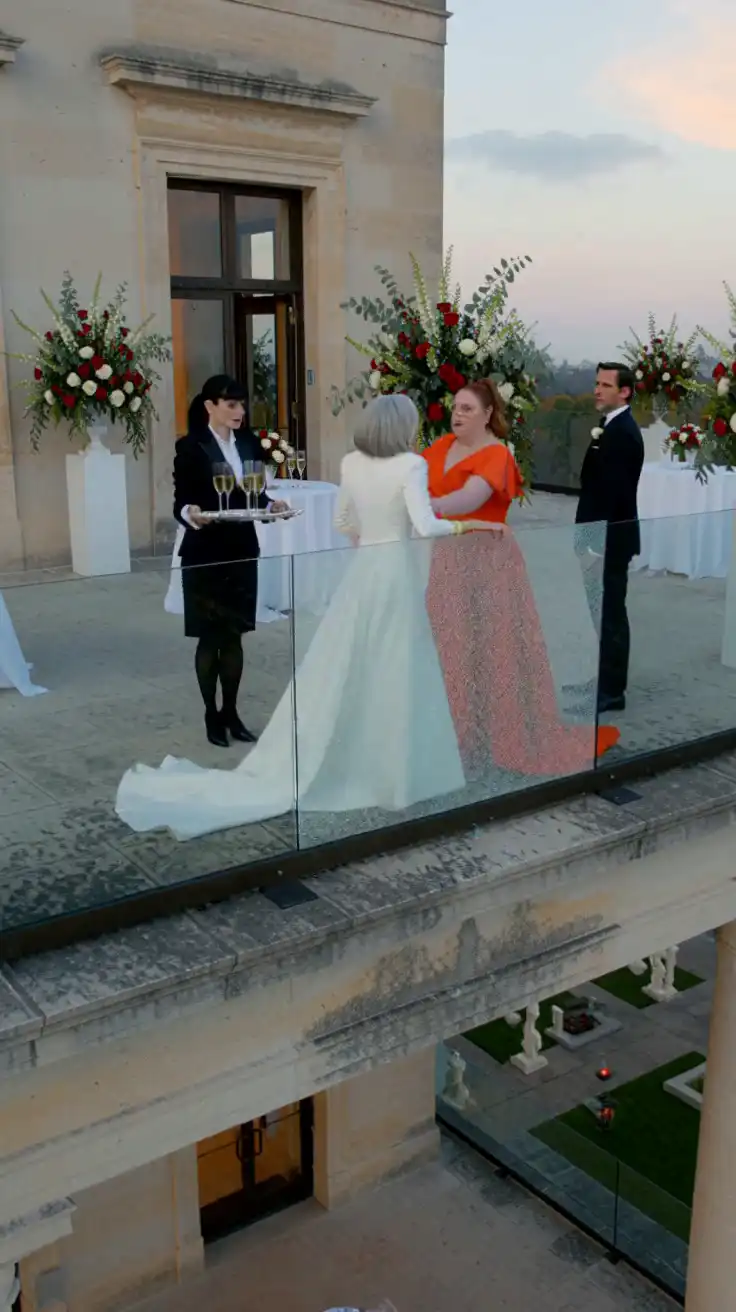
My son's bride shoved me through the glass railing on my gallery terrace. I'd already called in an appraiser for my collection, and now my son runs toward me as my assistant grips my wrist.
The glass gave way with a crack that ran through my wrist and up my arm. My fingers slipped against the assistant’s grip.
“Help me!” I shouted.
She had both hands locked around my wrist, her shoes braced against the terrace floor. Below me was empty air. The broken railing glittered around the edge, but I couldn’t look down for long.
“Mother!” Edward yelled.
Paige stood near the shattered glass, her veil caught against one shoulder. “She leaned too far.”
The assistant’s fingers tightened. Edward reached us, dropped to his knees, and caught me under the arm. Together, he and the assistant hauled me back over the railing. My shoes struck the stone. Edward kept a hand on my shoulder as if I might vanish if he let go.
“Say it again,” he said.
Paige’s mouth closed.
No one else was on the terrace. The wedding chairs stood in rows behind her, and the gallery paintings hung inside the open doors, each one part of the collection I had spent decades building. The ceremony was supposed to begin there, with Edward beside Paige and my name on every piece of paper that made the gallery mine.
Instead, Edward looked at the broken railing, then at the table where I had left a folder.
“Mother, what was she trying to stop you from showing me?”
I couldn’t answer without looking at Paige. My hand shook against the folder’s edge. Inside were two documents I had kept apart until I could put them in front of my son: an appraisal report and a shipping manifest.
Edward opened the folder. The report’s first page carried the appraiser’s signature and a typed finding: one canvas in my collection was a copy. The manifest listed a crate shipped abroad three weeks earlier.
Paige took a step toward the doors.
“Don’t,” Edward said.
He turned the report over, then found the photograph page. His thumb rested on its corner. Paige stepped back. The manifest lay beneath his other hand, its folded edge covering the destination.
“Which painting?” Edward asked.
He turned the page.
THE CANVAS BEHIND THE VEIL
The photograph showed a dark-haired woman standing beside a small, severe portrait in a gilt frame.
I knew the painting before I read the label.
“Winter Window,” I said.
Edward looked from the photograph to the gallery doors. “That’s the one in the east room.”
“The original is in the east room,” I said. “Or it was.”
Paige’s heel scraped against the stone.
Lena, my gallery assistant, was still beside me, one hand pressed to her own wrist after holding mine over the broken railing. She bent, picked up the manifest, and placed it flat on the table.
“Don’t touch that,” Paige said.
Lena stopped.
Edward lifted his eyes. “Why not?”
Paige looked at me. Her veil had slipped loose from its comb, and one end dragged across the floor like a torn strip of paper.
“It’s private gallery paperwork,” she said.
“You just tried to stop my mother from showing it to me.”
“I didn’t push her.”
Edward’s face did not change. “You said she leaned too far.”
“She did.”
“You said it after the railing broke.”
“I was frightened.”
“So was she.”
His hand moved to the bottom of the report. He turned the photograph page fully toward himself. Beneath the image, Dr. Miriam Bell had written her finding in black ink:
THE WORK PRESENTED AS “WINTER WINDOW,” 1931, BY ELIAS VALE, IS NOT THE ORIGINAL CANVAS. IT IS A MODERN COPY, EXECUTED AFTER 2010.
Edward read the sentence twice.
Paige took another step back.
I put my palm on the table to keep it from shaking. “The painting in the east room is a forgery.”
“No,” Paige said.
“The appraiser examined it yesterday.”
“You hired someone to insult me on my wedding day.”
“I hired someone to examine a painting.”
“You knew what this would do.”
“I knew what the truth would do.”
Edward picked up the manifest. “What is this?”
Paige’s eyes went to the folded edge.
“It’s a shipping document,” I said. “The crate left three weeks ago.”
“Where was it going?”
Paige moved toward the open gallery doors.
Edward stepped between her and the hall.
“Don’t walk away,” he said.
She stopped.
The terrace was silent except for the faint ticking of the fountain pump below us. Broken glass lay in a bright crescent at our feet. Behind Paige, the wedding chairs waited in neat rows, their white covers tied with silver ribbon. The altar flowers had been arranged beneath the largest painting in the gallery, a blue seascape that had belonged to my husband.
Edward opened the manifest.
The page listed my gallery’s name, its inventory number, the dimensions of the crate, and a consignee in Rotterdam. At the bottom, under the destination field, was a customs broker’s name and a final delivery address.
Edward read it aloud.
“Paige Whitmore.”
She closed her eyes.
The name did not surprise me. The address did.
It was not her apartment. It was not her parents’ home. It was a bonded storage warehouse near the port.
Edward lowered the page.
“What did you ship?” he asked.
Paige looked at him as if the question itself were cruel.
“Nothing.”
“The manifest says otherwise.”
“It’s a mistake.”
“Your name is on it.”
“Your mother made the shipment.”
I turned to Edward. “I did not.”
“She owns the gallery,” Paige said. “She signs everything.”
“I did not sign this.”
“You signed the release.”
“Show me.”
Her mouth opened, but no words came out.
Lena stepped closer to the table. “The signature on the release is not hers.”
Paige stared at her.
Lena’s voice was unsteady, but she did not lower it. “I saw the document when the courier came. Mrs. Whitmore signed for the crate. She told me you had approved the export.”
Paige turned toward me. “She’s lying.”
“I’m not,” Lena said.
“You weren’t even there.”
“I was behind the packing room door.”
“You were spying on me?”
“I heard you tell the courier to use your private broker.”
Edward’s fingers tightened around the manifest. “Lena, start at the beginning.”
Lena glanced at me.
I nodded.
She drew a breath. “Three weeks ago, Paige came to the gallery after closing. She said she wanted to surprise you with a new display for the wedding. She said she had permission to move one painting from the east room.”
“I never gave her permission,” I said.
“I know that now.”
Paige shook her head. “She misunderstood.”
“You told me the painting had to be removed before the florist arrived,” Lena continued. “You had a man with you. He brought a padded frame and a wooden crate.”
Edward’s head turned slowly toward Paige. “You brought a man into the gallery?”
“He was a shipper.”
“Why?”
Paige’s gaze dropped to the report.
Lena pointed at the photograph. “The original ‘Winter Window’ had been in the east room for years. I knew its frame. I knew the small scratch on the lower right corner. When Paige had it taken down, I asked why.”
“What did she say?” Edward asked.
“She said the painting was going on loan.”
“To whom?”
“She said it was none of my business.”
Paige’s voice sharpened. “Because it wasn’t.”
“It became my business when the inventory number disappeared from the wall.”
I looked at Lena. “Why didn’t you tell me?”
Her hands folded over one another. “You were in New York meeting the appraiser.”
That explained the first secret I had kept from everyone except Edward. It did not excuse hers, but I understood why she had waited.
Paige laughed once. The sound had no warmth in it. “This is absurd. You’re all building a story from a shipping crate.”
“No,” I said. “The crate is the second half of the story.”
Edward looked at the photograph again. “Where is the real painting?”
Paige said nothing.
He turned to me. “When did you realize?”
“I noticed the frame.”
“Not the canvas?”
“The painting in the east room had always had a slight ripple near the upper-left corner. The copy was flatter. The varnish was too bright. But I wanted to believe I was tired.”
“You own the gallery.”
“I own the collection. That doesn’t mean I stare at every canvas every morning.”
“You noticed the frame.”
“Because the original frame was made for the painting. It was hand-cut walnut with a repaired split on the inside edge. The copy was placed in that frame.”
I touched the folder.
“Dr. Bell examined the canvas under ultraviolet light. The ground layer was wrong. The pigment in the blue windowpanes did not exist when Elias Vale painted the work. Then she found the transfer marks beneath the surface. Someone had copied the image from a high-resolution photograph.”
Edward looked at Paige. “You replaced it.”
Paige crossed her arms. “Your mother is trying to ruin our wedding because she never wanted me.”
“That isn’t an answer.”
“She has treated me like a thief since the day we met.”
“Did you steal the painting?”
Paige’s jaw tightened.
The question hung over the terrace. No guests came through the doors. No voices rose from below. The gallery seemed to have drawn in on itself, every painting watching from the walls.
I had imagined my son standing beneath the wedding arch. I had imagined straightening his collar, pressing my fingers to his cheek, and telling him to breathe.
Instead, he stood between his bride and a table covered in evidence.
Paige turned to me. “You hired that appraiser before the wedding. You were going to accuse me in front of everyone.”
“I hired her after you asked me where ‘Winter Window’ was.”
“I asked because I wanted to understand the collection.”
“You asked me three times.”
“Because you wouldn’t answer.”
“Because you had already asked Lena to remove the inventory card.”
“That’s not true.”
Lena opened her bag and took out a small clear sleeve. Inside was a white card bearing the words WINTER WINDOW, ELIAS VALE, 1931, and the gallery’s inventory number.
“I found it in the florist’s box,” she said. “It had been folded behind the delivery receipt.”
Paige stared at the card.
Edward reached for it. Lena handed it to him.
“Why did you keep this?” he asked.
“I thought Mrs. Whitmore might need it.”
I looked at her. “You did the right thing.”
Paige’s face flushed. “You were watching me.”
“I was protecting the collection,” I said.
“You were waiting for me to fail.”
“I was waiting for you to tell the truth.”
Edward set the card beside the report. “When did you see the forgery?”
“Yesterday afternoon.”
“Why didn’t you tell me then?”
“Because I wanted to be certain.”
“You knew before today.”
“I knew the work was false. I did not know where the original had gone.”
His eyes moved to the manifest.
“Now we do.”
Paige said, “You don’t know anything. A crate going to Rotterdam does not prove what was inside it.”
“It lists the inventory number,” Lena said.
Paige swung toward her. “You read the inventory number?”
“It was on the crate.”
“What else did you see?”
“The packing label.”
“What packing label?”
“The one you removed.”
Paige went still.
Lena swallowed. “You peeled it off when you realized the inventory number was visible through the paper.”
Edward’s voice dropped. “What did the label say?”
“Winter Window. Elias Vale. Gallery inventory 31-17.”
Paige shook her head. “You’re making this up.”
“I can show you where the adhesive marks are on the crate’s copy in the shipping file.”
“Stop talking.”
Lena flinched.
I reached for her hand. “Stay with us.”
Paige looked at me with something close to hatred. “You brought her into this.”
“She was already in it.”
“You always need someone beneath you to agree with you.”
“No,” I said. “I need the truth to stand without me.”
Edward’s phone began to ring.
He looked at the screen. “It’s Detective Ruiz.”
Paige stepped forward. “Don’t answer that.”
Edward answered.
“Detective.”
He listened.
“Yes. I’m at the gallery.”
A pause.
“No, my mother is safe.”
I watched Paige’s fingers curl against her skirt.
“Yes, there was an attempted push over the terrace railing. The glass broke. She never fell to the ground.”
Another pause.
“Lena Ortiz witnessed it.”
Lena lifted her chin.
Edward looked at me. “We also have an appraisal report and a shipping manifest.”
Detective Ruiz said something that made Edward straighten.
“Yes. The painting is ‘Winter Window,’ by Elias Vale. Inventory 31-17.”
Paige turned away.
Edward looked at the manifest. “The crate is scheduled for departure?”
He listened.
“Rotterdam. The vessel leaves tonight?”
His eyes met mine.
“Yes,” he said into the phone. “Please contact customs immediately.”
Paige took one step toward the doors.
Lena moved in front of her.
Paige stopped.
“I am not going anywhere,” she said.
Edward ended the call.
“Detective Ruiz is sending officers,” he said. “He’s also contacting customs and the port authority.”
Paige’s laugh came out thin. “For a painting?”
“For the attempted assault and the theft.”
“You’re arresting me on your wedding day?”
“I’m not arresting anyone.”
“You called the police.”
“Because you pushed my mother.”
“She leaned over the railing.”
“Say it again,” Edward said.
Paige’s mouth closed.
He repeated the words more quietly. “Say it again.”
She looked at the shattered glass.
For a moment I thought she might finally understand the shape of what she had done. Not the legal consequences. Not the wedding. The shape of the gap that had opened between her and my son.
Then she pointed at me.
“She wanted this.”
Edward did not move.
“She wanted to humiliate me,” Paige said. “She wanted to make sure I never became part of this family. She has been waiting for a reason to take you away from me.”
“I have never tried to take him away.”
“You called an appraiser behind my back.”
“I called an appraiser because a painting was missing.”
“You were suspicious of me.”
“I was suspicious because the painting had changed.”
“You don’t know what it’s like to be judged by you.”
“I know what it is like to have my property removed from my gallery without permission.”
Paige turned toward Edward. “You’re going to believe her?”
He looked at the report.
“I’m going to believe the canvas.”
The words struck harder than any raised voice could have.
Paige’s expression crumpled for half a second. Then she recovered.
“I didn’t steal anything.”
“Then tell us what happened,” Edward said.
“I told you. Your mother arranged the shipment.”
“Why was your name on it?”
“I was helping.”
“Why did you sign it?”
“I was authorized.”
“By whom?”
Paige said nothing.
Edward took a step closer. “By whom?”
I had seen him angry before. I had seen him at sixteen, standing in the kitchen with a broken wrist after a bicycle accident, insisting he had not cried. I had seen him at twenty-three, packing his apartment after his father died, folding every shirt with mechanical care.
I had never seen him look at someone he loved as though he were searching for a stranger inside her face.
Paige’s shoulders lowered.
“Your mother was going to sell it,” she said.
I stared at her. “What?”
“She needed money.”
“For what?”
“She told me the gallery was in trouble.”
Edward looked at me.
“The gallery is not in trouble,” I said.
“You told me the east wing needed repairs.”
“It does.”
“You said the insurance premiums had gone up.”
“They have.”
“You said you were turning down invitations because you couldn’t afford the expenses.”
“I was turning down invitations because I was tired.”
Paige shook her head. “She wanted to sell the painting quietly. I stopped her.”
“By replacing it with a copy?”
“I was protecting the original.”
“By shipping it out of the country?”
“I found a buyer who would hold it safely.”
Edward’s voice became very still. “You found a buyer for my mother’s painting.”
“I was trying to save it.”
“From what?”
“From her.”
I looked at the report. The photograph showed the real canvas in Dr. Bell’s examination room, its surface dulled by age, the painted window glowing faintly behind the woman’s shoulder.
“I never agreed to sell it,” I said.
Paige’s eyes flicked toward the gallery. “You were going to.”
“Who told you that?”
“You did.”
“When?”
“You were speaking with your attorney.”
“Which attorney?”
“You don’t remember every conversation you have.”
“I remember conversations about selling a painting worth more than a house.”
Paige’s face tightened.
Edward asked, “Who was the buyer?”
“I don’t know.”
“Then why did you ship it?”
“The broker handled that.”
“What broker?”
She looked at the manifest. “Northstar Fine Art Logistics.”
Lena shook her head. “That company was on the label.”
“Where is the original now?” Edward asked.
“I don’t know.”
“Paige.”
“I said I don’t know.”
I picked up the manifest and read the destination address again. “This is a bonded warehouse. The crate was not delivered to a buyer.”
“It was being held.”
“For whom?”
“For the buyer.”
“Name?”
She looked away.
Edward’s phone rang again.
He answered without taking his eyes off her.
“Hello?”
He listened, then put the call on speaker.
Detective Ruiz’s voice came through, clipped and clear. “Mr. Whitmore, customs wants confirmation from the owner of the artwork. Mrs. Whitmore, can you confirm that the shipment is unauthorized?”
I leaned toward the phone.
“I am the owner,” I said. “The shipment was not authorized. The painting described as Elias Vale’s ‘Winter Window,’ inventory 31-17, was removed from my gallery and sent abroad without my permission.”
“Thank you. Dr. Bell has emailed us her appraisal. We have the manifest. We’re asking customs to place an immediate hold on the crate.”
“How long until the ship leaves?” Edward asked.
“Less than two hours.”
Paige’s head snapped up. “You can’t do that.”
Ruiz said, “Mrs. Whitmore, are you objecting to the hold?”
“You don’t understand.”
“Then explain.”
“She has no right to involve customs over a private dispute.”
“This is no longer only a private dispute.”
“It is a misunderstanding.”
“Were you present when the crate was sealed?”
Paige said nothing.
Ruiz continued. “Did you sign the export release?”
“No.”
Lena said, “She did.”
Paige glared at her.
Ruiz heard it. “Ms. Ortiz, stay available. I’ll need a statement.”
“She was not authorized to handle the painting,” I said.
“I understand.”
Paige pressed both hands to her temples. “I was trying to help.”
Ruiz’s voice hardened. “You can explain that in your statement. Officers are on their way.”
The call ended.
For several seconds, no one spoke.
Then Edward said, “You planned this before today.”
Paige looked at him.
“The crate left three weeks ago,” he continued. “The wedding was today. You knew the painting would be gone before my mother noticed.”
“I didn’t know she would notice.”
“Why replace it?”
“She would have seen the empty wall.”
“So you found a copy.”
“I found a painting that looked the same.”
“You found a forgery.”
“I didn’t know it was a forgery.”
“The person who sold it to you knew.”
Paige’s silence answered him.
I sat in one of the wedding chairs. My knees had begun to tremble, and the adrenaline that had kept me upright was draining away. Lena brought me a glass of water from the table near the doors.
“Drink,” she said.
I held the glass in both hands.
Edward crouched in front of me. “Are you hurt?”
“No.”
“Are you sure?”
“Yes.”
His gaze moved to my wrist, where Lena’s fingers had held me. A pale mark circled the skin, but there was no broken skin, no swelling.
“I should have been there sooner,” he said.
“You came.”
“I heard you.”
“I know.”
His hand closed around mine. “I heard you call for help.”
“I heard you call me.”
He looked over his shoulder at Paige.
She had removed her veil. She held it bunched in one fist.
“I need you to tell me everything,” he said.
Paige’s eyes were wet now, but no tears fell.
“I wanted the gallery.”
I felt Edward’s hand go still.
Paige continued, “Not the building. Not exactly. I wanted a place that belonged to us. You said your mother would help us start a foundation. You said the collection would stay in the family.”
“It is my collection,” I said.
“You told Edward it would be his someday.”
“That does not mean it is yours now.”
“You treat him like an heir and me like a visitor.”
“Because he is my son and you are his fiancée.”
“Your future daughter-in-law.”
“If you had become my daughter-in-law, you would still not have owned my paintings.”
Paige wiped at her cheek with the heel of her hand. “I had investors.”
Edward stood. “What investors?”
“People who wanted to build something.”
“Using a painting you didn’t own?”
“I wasn’t selling it permanently.”
“Then what were you doing?”
“Borrowing against it.”
The words fell into the open space.
I set the glass down.
Edward stared at her. “You used my mother’s painting as collateral?”
“I was going to replace it before anyone knew.”
“With a forgery.”
“With the money from the deal, I could have bought it back.”
“Bought what back?”
“The original.”
“From whom?”
“The buyer.”
“You sold it.”
“I placed it.”
“You shipped it to a foreign warehouse.”
“It was temporary.”
“You forged my mother’s signature.”
“I didn’t forge it.”
“You said you were authorized.”
“She had authorized me to handle the gallery.”
“I never authorized you.”
Paige looked at me. “You gave me the keys.”
“For the florist.”
“You trusted me enough to let me in.”
“To arrange flowers.”
“You knew I was going to be family.”
“I knew you were marrying my son.”
“What is the difference?”
“The difference is that marriage is not ownership.”
Paige turned back to Edward. “I was going to tell you.”
“When?”
“After the wedding.”
“After the painting was sold?”
“After the loan was paid.”
“And if it wasn’t?”
She did not answer.
The sound of a car stopping beyond the gallery’s front doors came through the open hall. A moment later, Detective Ruiz entered with another officer. They did not rush. They stopped several feet from the broken terrace door and looked first at me, then at the railing, then at Paige.
Ruiz was a broad-shouldered woman with gray threaded through her dark hair. She carried a notebook in one hand and wore a plain navy jacket over her uniform shirt.
“Mrs. Whitmore?” she asked.
“Yes.”
“Are you able to speak with me?”
“I am.”
“Do you need medical attention?”
“No.”
She looked at Lena. “You caught her?”
Lena nodded.
“Tell me exactly what you saw.”
Lena’s eyes moved to Paige, then back to Ruiz. “Paige stood near the railing. Mrs. Whitmore had the folder. They were arguing. Paige put both hands against Mrs. Whitmore’s upper body and shoved.”
Paige said, “That’s not what happened.”
Ruiz raised one finger. “You’ll have your turn.”
Lena continued. “Mrs. Whitmore went backward through the glass. The railing broke. I grabbed her wrist. Edward came from inside and pulled her back.”
“Did Mrs. Whitmore fall to the ground?”
“No.”
“Did she strike the ground?”
“No.”
Ruiz wrote something down. “Did Paige say anything?”
“She said Mrs. Whitmore leaned too far.”
Paige’s face tightened.
Ruiz looked at her. “Is that accurate?”
“I was frightened.”
“That wasn’t my question.”
Paige said nothing.
Ruiz turned to the officer. “Secure the terrace and photograph the damage.”
The officer nodded and stepped toward the broken railing.
“No one else is coming up here,” Ruiz said. “We’ll keep this area clear.”
That mattered to me. The wedding had not yet begun, and there was no gathering outside, no audience to feed on the disaster. Only the empty chairs, the paintings, my son, the woman he had intended to marry, and the evidence she had tried to stop.
Ruiz looked at the folder. “May I see the documents?”
I handed them over.
She studied Dr. Bell’s report, then the manifest. “Who commissioned the appraisal?”
“I did.”
“When?”
“Yesterday.”
“Why?”
“Because I noticed a change in the surface of ‘Winter Window.’ I asked Dr. Bell to compare it with the gallery’s old photographs and records.”
“Do you have the records?”
“In the office.”
“Are they originals?”
“Some. Digital scans of the rest.”
“Please show me.”
I rose. Edward reached for my elbow, but I steadied myself against the table.
“I can walk.”
“I know,” he said. “I’m still going with you.”
We led Ruiz and the officer through the doors. Paige remained on the terrace until Ruiz told her to come inside. Lena walked behind us, holding the clear sleeve with the inventory card.
The east room was at the end of the gallery. Its walls were painted a warm gray, chosen to make the older canvases appear less yellow under the lights. The copy of “Winter Window” hung above a narrow console table.
It had been presented as the original for twenty-one days.
Edward stopped beneath it.
The difference was obvious now that the report had given us permission to see it. The woman at the window had a rigid outline. The snow beyond the glass had been copied in short, repeated strokes. The sky had the polished, even finish of a reproduction.
The frame was original.
The painting was not.
Ruiz stood several feet away. “Do not remove it until we document it.”
“I won’t.”
Edward looked at the canvas. “How did you get the copy?”
Paige remained near the doorway. “It was already in storage.”
“That is not true,” Lena said.
Ruiz looked at her. “How do you know?”
“I saw the delivery.”
“When?”
“Two days after Paige removed the original.”
“Where was it delivered?”
“Back entrance. A white van.”
“Do you have security footage?”
“Yes,” I said. “The system keeps thirty days.”
“Good. Don’t access it. We’ll copy it properly.”
I opened the office safe and brought out the collection ledger. Each painting had a page containing its acquisition record, dimensions, materials, insurance value, and photographs taken at the time of purchase.
The page for “Winter Window” showed the original canvas with its uneven lower edge and a small crescent of missing varnish near the woman’s sleeve.
Ruiz compared the page to the painting on the wall.
“Where is the original acquisition document?”
“In the cabinet.”
I unlocked the drawer.
The file was there, along with correspondence from the estate that had sold me the work. The original painting had been authenticated in 1998 by three specialists. Its provenance went back to a private collection in Vermont and then to a museum exhibition in Boston.
Ruiz photographed every page.
Paige watched from the doorway.
“You built a case against me,” she said.
“I documented my collection.”
“You knew.”
“I suspected.”
“You never trusted me.”
“You gave me reasons not to.”
“When?”
“When you asked Lena to remove the inventory card.”
“I didn’t.”
“When you arranged a private shipment.”
“I was protecting the painting.”
“When you brought a forgery into this gallery.”
“I was buying time.”
“For what?”
Paige looked at Edward. “For us.”
He did not answer.
Ruiz set down the ledger. “Mrs. Whitmore, did Paige have permission to remove the original?”
“No.”
“Did she have permission to replace it?”
“No.”
“Did she have permission to ship it?”
“No.”
Ruiz turned to Paige. “Do you dispute that?”
Paige’s hands hung at her sides.
“I thought I had permission,” she said.
“From whom?”
“From Edward.”
Edward’s expression hardened. “You never asked me.”
“You told me your mother would help us.”
“That is not permission to take her property.”
“You were going to marry me.”
“That is not permission either.”
Paige’s lips parted, but he kept going.
“You took something that belonged to her. You replaced it with something false. You lied to me for three weeks. And when she tried to show me the proof, you pushed her over a railing.”
Paige looked toward me. “I didn’t mean for the glass to break.”
“That is what you’re worried about?” I asked.
“I didn’t mean for her to fall.”
“But you pushed me.”
“I was stopping you.”
“You were stopping the truth.”
The officer returned from the terrace. “Detective, I have photographs of the railing and the broken glass. No one has touched anything else.”
Ruiz nodded.
Her radio crackled.
She listened, then answered. “Understood.”
She turned to us. “Customs has placed the crate on hold. The vessel has not cleared.”
Edward released a breath.
Paige sat down heavily in one of the gallery chairs.
“The painting is still there?” I asked.
“For now,” Ruiz said. “A customs officer has matched the crate number on the manifest. They’re sending an inspector to open it with a representative from your insurance company.”
I pressed my fingertips to the ledger.
For three weeks, the original had been somewhere beyond my reach. I had imagined it in a private apartment, then in a buyer’s vault, then already hanging in another country under another name.
Now it was sealed in a wooden crate near the port, waiting for someone to say what it was.
Ruiz looked at Paige. “Who arranged the shipment?”
“Northstar.”
“Who contacted Northstar?”
She did not answer.
“Who paid?”
Paige’s face went blank.
Edward turned to her. “Who paid?”
“My account.”
“Where did you get the money?”
“I borrowed it.”
“From whom?”
“An investor.”
“Name.”
“I don’t have to answer that here.”
Ruiz closed her notebook. “You do not have to answer questions without counsel. You do have to remain available while we investigate.”
Paige looked at the front doors.
The second officer had moved into the hallway. He did not touch her, but his position made the choice clear.
Ruiz said, “You are not under arrest at this moment. Do not leave the premises without speaking to me.”
Paige’s face changed at the words not under arrest. She seemed to hear permission where there was only warning.
Edward stepped closer to her. “Where is your phone?”
“In my bag.”
“Give it to Detective Ruiz.”
“No.”
“Why?”
“Because it’s mine.”
“Because the messages are on it,” he said.
Paige said nothing.
Ruiz extended her hand. “We’ll obtain the proper warrant if necessary.”
Paige clutched the bag.
“I’m not a criminal,” she said.
Edward looked at the forgery hanging on the wall. “Then stop acting like someone who has something to hide.”
She slapped the bag onto the chair.
The phone inside vibrated.
Once.
Twice.
The screen lit up through the open clasp.
A message appeared from a number saved as MARCUS—NORTHSTAR.
DID THE OWNER SIGN THE RELEASE? WE NEED CONFIRMATION BEFORE THE CRATE OPENS.
Ruiz saw it.
So did Edward.
Paige reached for the phone, but Ruiz got there first.
“Leave it.”
“I have a right to privacy.”
“You had a right to avoid stealing a painting.”
Ruiz photographed the screen, then placed the phone in an evidence envelope.
Paige turned to Edward. “You’re letting her do this?”
He looked at her for a long moment.
“I’m not letting anyone do anything,” he said. “You did it.”
That was the moment the wedding ended.
No one announced it. No music stopped. No guests waited to hear the words. The decision moved through the room in the space between them.
Paige looked at the floral arch visible through the open doors.
“Edward,” she whispered.
He took off the ring from his left hand.
The diamond caught the gallery lights.
Paige’s breath hitched.
He did not throw it. He did not drop it. He placed it on the ledger beside the appraisal report.
“We’re not getting married,” he said.
She stared at the ring.
“You can’t cancel a wedding because your mother is angry.”
“This isn’t about anger.”
“You love me.”
“I did.”
She stepped toward him. “You still do.”
Edward’s hand closed into a fist, then opened again.
“I don’t know what I feel,” he said. “But I know what I cannot do. I cannot stand beside you and promise trust after watching you break it.”
Paige looked at me. “Tell him.”
“Tell him what?”
“That this can be fixed.”
“Can it?”
“You can withdraw the complaint.”
“The shipment has already been reported.”
“You own the gallery. You can say it was a misunderstanding.”
“I cannot say that.”
“You can save him.”
“I am trying to save him from marrying someone who thinks harm disappears when the paperwork is changed.”
Her face twisted.
Edward picked up the ring and placed it in his pocket.
Paige began to cry then. Quietly, without covering her face.
I wanted to feel satisfaction. I wanted the moment to be clean. Instead, I watched my son stand in front of the woman he had loved and understood that no one had won anything.
But the truth had stopped moving backward.
Detective Ruiz asked Paige to sit with the second officer while she took my formal statement. Edward stayed beside me. Lena sat across the office table, her hands wrapped around a paper cup of water.
Ruiz began with the railing.
I described the argument without adding anything. Paige had asked what was in the folder. I had said Edward deserved to see it. She had demanded the documents. I had refused to hand them to her. She had pushed me.
Ruiz asked whether Paige had threatened me before.
“Not physically,” I said.
“Verbally?”
“She said if I embarrassed her, she would make sure the gallery lost its license.”
“Did she have any basis for that threat?”
“No.”
“Why did she say it?”
“Because I told her Dr. Bell had examined the painting.”
Ruiz wrote it down.
Then she asked about the painting.
I explained how I noticed the copy. The night before the appraisal, I had stood in the east room after closing. The painting had looked wrong beneath the lamps. I had called Dr. Bell, who had once taught conservation at a university and now operated an independent appraisal practice.
“Why not confront Paige immediately?” Ruiz asked.
“Because suspicion is not proof.”
“Why involve Edward?”
“Because the wedding was being held in my gallery, and Paige had become part of the family I was about to entrust with my son.”
Ruiz’s pen paused.
“I wanted him to know before he married her.”
Edward looked down at the table.
Lena gave her statement next. She described the crate, the replacement painting, the label, and the argument on the terrace. She did not exaggerate. When Ruiz asked whether she had seen Paige push me, she said yes.
“Why didn’t you report the shipment three weeks ago?” Ruiz asked.
Lena looked at me. “I was afraid I had misunderstood. Mrs. Whitmore had given Paige access to the building. Paige told me the painting was being moved for a loan. I didn’t know about the copy until it arrived.”
“Why did you keep the inventory card?”
“Because the number on the wall was missing.”
That simple answer carried more weight than an accusation.
Ruiz asked me whether I wanted to press charges for the theft and the push.
I looked through the office window at the gallery.
The copy of “Winter Window” hung beneath the soft lights. Around it were paintings I had carried through three decades, through my husband’s illness, through Edward’s childhood, through years when keeping the doors open had required more courage than money.
“Yes,” I said.
Edward’s fingers touched the back of my hand.
Ruiz nodded. “We’ll document both.”
A call came to her phone.
She answered and listened.
“Open it,” she said. “Compare the canvas, stretcher, and frame marks with the appraisal photographs. Yes. I’ll remain here.”
She ended the call.
“The crate is being opened now,” she said.
Paige looked up from the chair.
“No,” she whispered.
Ruiz turned to her. “The customs inspector has authority.”
“You don’t know what’s in it.”
“We’re about to find out.”
The next twenty minutes passed slowly.
No one spoke much. The officer remained near the doorway. Lena sat with her back straight. Edward stood by the office window, watching the darkening terrace. I stayed at the table with the appraisal report and the manifest spread in front of me.
Paige finally said, “I didn’t know it was fake.”
Ruiz did not look up. “You’ve said that.”
“I saw photographs of the original.”
“You purchased a copy?”
“I paid for a reproduction.”
“To replace the original?”
“I thought no one would notice.”
Ruiz’s pen stopped. “That sounds like knowledge that the substitution was unauthorized.”
Paige pressed her palms against her knees.
“The broker told me the original could be used as collateral,” she said. “He said the lender would release it once the loan was paid.”
“Did the lender know it belonged to someone else?”
“I don’t know.”
“Did you tell them?”
“I told them I had authority.”
“From whom?”
Paige looked toward Edward.
He turned from the window. “Don’t use me for this.”
“I thought you would support me.”
“I supported you when you told me you needed help with the wedding.”
“I needed more than that.”
“Then you should have asked.”
“You would have said no.”
“Yes.”
“Because your mother controls everything.”
“No,” Edward said. “Because you were asking for something that wasn’t yours.”
Paige’s chin trembled. “You always choose her.”
“I am choosing the truth.”
The phone rang again.
Ruiz answered. “Detective Ruiz.”
She listened, then smiled without warmth.
“Describe the stretcher.”
Another pause.
“Understood. Photograph the signature and the inventory mark. Send everything to my email.”
She ended the call.
“The canvas is inside,” she said.
I closed my eyes.
“Is it original?” Edward asked.
“Customs says the surface and stretcher match Dr. Bell’s photographs. They found the inventory mark beneath the frame lining.”
My hand went to my mouth.
For the first time since the railing broke, I allowed myself to breathe all the way in.
Paige stood. “I need to see it.”
Ruiz blocked her path. “You’ll stay here.”
“It’s not hers.”
“It is,” I said.
“You don’t even know.”
“The customs officer does.”
“You paid someone to say that.”
“Dr. Bell examined it before you shipped it.”
“You had her examine a different painting.”
“I had her examine the copy. Her report includes photographs of the original from the collection archive and the examination images. The canvas in the crate has the same tear repair, same ground layer, and same stretcher marks.”
Paige looked at the report.
“You planned this,” she said.
“I planned to ask you the truth.”
“You were going to ruin me.”
“You ruined yourself when you removed the painting.”
“You never gave me a chance.”
“You had three weeks.”
“I was going to fix it.”
“By sending it farther away?”
She turned to Edward. “Please.”
He did not move.
She walked to him, stopping just beyond arm’s reach.
“I love you,” she said.
Edward’s eyes shone, but his voice remained quiet. “I know you believed that.”
“I do love you.”
“Then you should have told me.”
“I was afraid.”
“Of what?”
“Of losing the life we were supposed to have.”
“You lost it when you decided I could only love you if I was deceived.”
Paige lowered her head.
Ruiz told the officer to escort her to the front room while they completed the paperwork. Paige did not resist. At the door, she looked once more at the ring in Edward’s pocket.
“Don’t let her take everything from us,” she said.
Edward answered without looking at me.
“You did that.”
The wedding was canceled before sunset.
The caterer was called first. Then the florist. Then the small number of family members who had planned to arrive later. Edward made the calls from my office, one hand gripping the phone, the other braced on the desk.
He did not explain every detail.
“There was a serious incident,” he told one caller. “The ceremony will not take place. Please don’t come to the gallery.”
When he finished, he sat down.
“I’m sorry,” he said.
“For the wedding?”
“For bringing her here.”
“You brought your fiancée to the gallery. You didn’t bring her hands to the railing.”
“I should have known.”
“You knew what she showed you.”
“I ignored what I didn’t want to see.”
I sat opposite him.
The ring was still in his pocket.
“Your father once told me that trust isn’t a feeling,” I said. “It’s a series of decisions.”
Edward looked at the desk.
“I made the wrong decisions.”
“You made some.”
“Why didn’t you tell me the moment you suspected her?”
“Because I wanted evidence.”
“You thought I wouldn’t believe you.”
“I thought you would want to believe her.”
He nodded slowly.
“That’s worse.”
“No. It’s human.”
He rubbed his face. “I stood there and watched her say you leaned too far.”
“You heard the truth.”
“I heard what she said.”
“You also saw what happened.”
“I should have believed my eyes sooner.”
“You pulled me back.”
“I was late.”
“You were there.”
He looked at me then.
The fear that had crossed his face on the terrace returned, not as panic now, but as a small, exhausted tremor around his mouth.
“I thought I was going to lose you,” he said.
“You didn’t.”
“I almost did.”
“But you didn’t.”
He came around the desk and knelt beside my chair, just as he had on the terrace.
This time, when he took my hand, there was no broken glass under us.
“I’m sorry, Mother.”
I placed my other hand on his hair.
“You are not responsible for another adult’s choice.”
“I chose her.”
“You chose the person she showed you.”
“And now?”
“Now you choose what you do after learning who she is.”
His fingers tightened around mine.
“I’m going to give Detective Ruiz everything.”
“That is the right choice.”
“Even if it sends her to prison?”
“If she stole the painting and tried to stop the evidence by pushing me, that is the consequence of her choices.”
He nodded.
The customs inspector sent the photographs a little after six.
Ruiz showed them to me on her phone. The original “Winter Window” lay on a padded table inside the warehouse. The frame had been removed. The lower edge showed the old crescent of varnish loss. On the back of the stretcher was the inventory mark, faint but unmistakable.
The second photograph showed the crate’s interior.
Beneath the original canvas, hidden under a layer of packing foam, was the copy’s invoice. The seller had listed it as a “decorative reproduction.”
Ruiz looked at Paige.
“Would you like to explain why a decorative reproduction was used to replace a documented original?”
Paige sat with her hands folded in her lap.
“No.”
“That is your choice.”
“I want a lawyer.”
Ruiz nodded. “That is also your choice.”
The officer read Paige her rights. She listened with her face turned toward the floor.
No one celebrated when they put the cuffs on her.
They did not need to.
The wedding chairs remained outside. The flowers still stood beneath the empty place where “Winter Window” had once hung in the east room’s records, though not above the altar. The gallery’s walls held their silence.
Paige was taken out through the front door.
Edward watched until the car disappeared.
Then he came back inside.
“Did she say anything?” I asked.
“She asked me to visit her.”
“Will you?”
“I don’t know.”
“That answer is enough for tonight.”
He nodded.
Detective Ruiz remained to finish the inventory seizure forms. She explained that the case would involve the unauthorized removal of the painting, the attempted use of the painting as collateral, the forgery or purchase of a copy for substitution, and the assault on the terrace.
“Will the broker be charged?” I asked.
“If the records show he knew the painting was stolen or accepted a false authorization, the prosecutor will decide. We’re contacting him tonight.”
“And the lender?”
“Also being contacted.”
Edward looked toward the east room. “Will the original come back here?”
“Customs will release it after the seizure and authentication process,” Ruiz said. “Your insurance company may require a controlled return.”
I smiled faintly. “The gallery has survived worse paperwork.”
Ruiz closed her notebook.
“Mrs. Whitmore, you did the right thing by preserving the documents.”
“I nearly lost them.”
“You didn’t.”
“I nearly lost myself.”
She looked at the pale mark around my wrist.
“You had help.”
I glanced at Lena.
“She held on,” I said.
Ruiz nodded. “That matters too.”
After Ruiz left, Lena stood in the center of the office, uncertain.
“You can go home,” I told her.
“I can stay.”
“It’s late.”
“So is the wedding.”
Edward gave a short, humorless laugh.
Lena looked at the terrace. “I’m sorry.”
“For what?”
“I should have told you sooner.”
“You told me when it mattered.”
“I was afraid Paige would fire me.”
“I should have made it clear that you could come to me.”
“You did.”
“Not clearly enough.”
She shook her head. “You trusted her. Everyone did.”
“No,” Edward said. “I didn’t.”
Lena looked at him.
He seemed surprised by his own words.
“I trusted what she told me,” he said. “That isn’t the same thing.”
Lena gathered the documents into a neat stack. “I’ll secure the east room.”
“Leave the copy where it is,” Ruiz had said, but the evidence team would return in the morning. We covered the painting with a clean cloth without removing it from the wall.
The original would return after that.
I walked onto the terrace with Edward. The broken railing had been taped off. Beyond it, the city lights came on one by one.
He stood several feet from the edge.
“I keep seeing your hand,” he said.
“Lena’s?”
“Yours. Over the railing.”
“I keep seeing hers.”
“She didn’t let go.”
“No.”
“I thought I was going to have to pull you up alone.”
“You would have.”
“I would have broken something.”
“But you wouldn’t have let go.”
He looked at me.
“No,” he said. “I wouldn’t.”
We stayed there until the night air cooled the stone.
The next morning, the original painting arrived under the supervision of the insurance company and Detective Ruiz. The frame was examined, the canvas photographed, and the inventory mark compared with the ledger.
Dr. Bell came to the gallery and stood in front of the work for nearly ten minutes without touching it.
“The original has returned,” she said.
I looked at the woman painted beside the winter window. Elias Vale had given her a face turned halfway toward the glass, as if she had heard someone behind her but had not yet decided whether to look back.
“Can you tell where it has been?” I asked.
“The crate was properly packed. No environmental damage.”
“Then it’s all right?”
“It’s itself.”
That was enough for me.
The copy was removed and placed in evidence. The empty frame remained on the wall until the original was rehung. I had considered replacing it immediately, but Edward asked me to wait.
“Let the wall show what happened,” he said.
So we left it bare for a week.
Detective Ruiz kept us informed. Northstar’s broker admitted Paige had arranged the shipment. The lender produced documents showing that Paige had represented herself as authorized to pledge the painting. The copy’s seller confirmed that Paige had asked for an exact reproduction and had provided high-resolution images from the gallery archive.
The evidence did not soften.
Neither did the truth.
Paige was charged with theft, fraud, attempted use of stolen property as collateral, and assault. The prosecutor added charges related to the forged authorization after handwriting analysis showed that the signature had been traced from an old gallery release.
Edward testified about the terrace.
Lena testified about the crate.
I testified about the painting.
No one called it a misunderstanding in court.
Months later, after the legal proceedings began, I rehung “Winter Window” in the east room.
Edward stood beside the ladder while I adjusted the wire.
“Left,” he said.
“I know.”
“A little more.”
“I can see it.”
“You’re going to let it hang crooked?”
“I’m going to let you hold the ladder and stop giving orders.”
He smiled for the first time in weeks.
“There.”
I stepped down.
The original painting settled into the frame. Its surface held the warm imperfections I had missed when fear and suspicion had first made me doubt my own eyes.
Edward stood beneath it.
“Which one was the forgery?” he asked.
“The canvas that looked like the original but had no history.”
He nodded.
“The one in the crate was real.”
“Yes.”
“And the one Paige left here was the copy.”
“Yes.”
He looked at the painting for another moment.
“I thought the answer would make me feel better.”
“Answers don’t always do that.”
“What does?”
“Time. Honest work. Not lying to yourself.”
He glanced at me. “Are you saying I lied to myself?”
“I’m saying you’re my son. It would be strange if you didn’t.”
He laughed quietly.
Then he reached into his pocket.
The engagement ring was in a small box.
“I never gave this back,” he said.
“You should.”
“I will.”
“Not to her.”
“No.”
He placed the box on the console beneath the painting.
“I’m sending it to her attorney.”
“That’s your decision.”
“She asked for it.”
“What will she do with it?”
“Sell it, probably.”
“Then let it become someone else’s problem.”
He looked at the empty terrace through the gallery doors.
“We need to replace the railing.”
“We will.”
“Not with glass.”
“No.”
“Something stronger.”
“Glass is strong when it is installed correctly.”
He gave me a look.
I sighed. “We’ll consider iron.”
“Good.”
He stepped closer and rested his shoulder against mine.
For a while, neither of us spoke.
The gallery was open again. The paintings were in their places. The ledger was back in the safe. The shipping manifest had been copied, sealed, and entered into the case file. The appraisal report had become evidence, then history.
And the answer to the question that had nearly cost me my life was no longer hidden.
It was “Winter Window,” the 1931 Elias Vale portrait in the east room.
The original had been taken from my gallery and sent toward Rotterdam. Customs stopped it before the ship left. The copy had been placed in its frame to conceal the theft.
Paige had wanted to use the painting as a key to a life she had not earned. She had thought a false canvas could hold the place of a real one.
But a forgery can imitate a face, a signature, even the surface of age.
It cannot carry the truth of where it came from.
Edward looked up at the original.
“Mother?”
“Yes?”
“I’m glad you called the appraiser.”
“So am I.”
“I’m glad Lena caught you.”
“So am I.”
“I’m sorry I didn’t see Paige.”
I turned to him.
“You saw her eventually.”
He nodded.
Then, beneath the returned painting, with the broken railing gone and the wedding canceled, my son took my hand.
This time, neither of us let go.