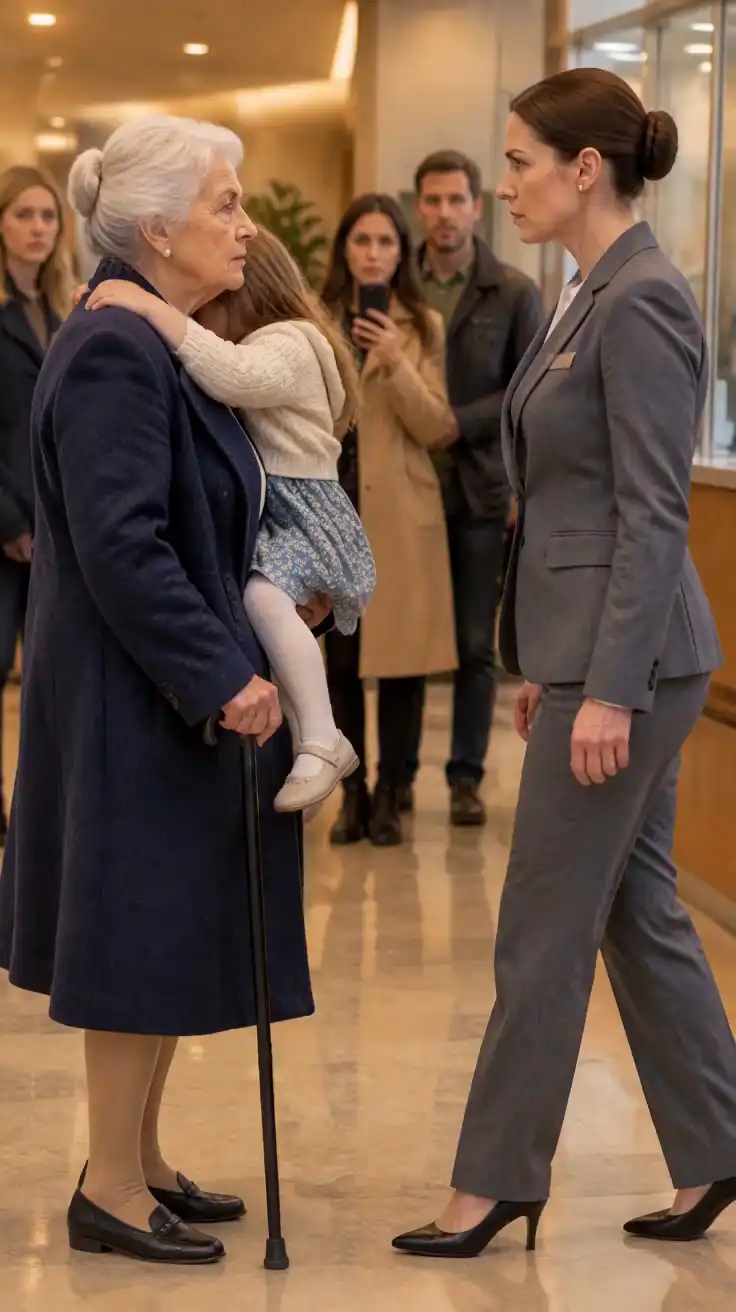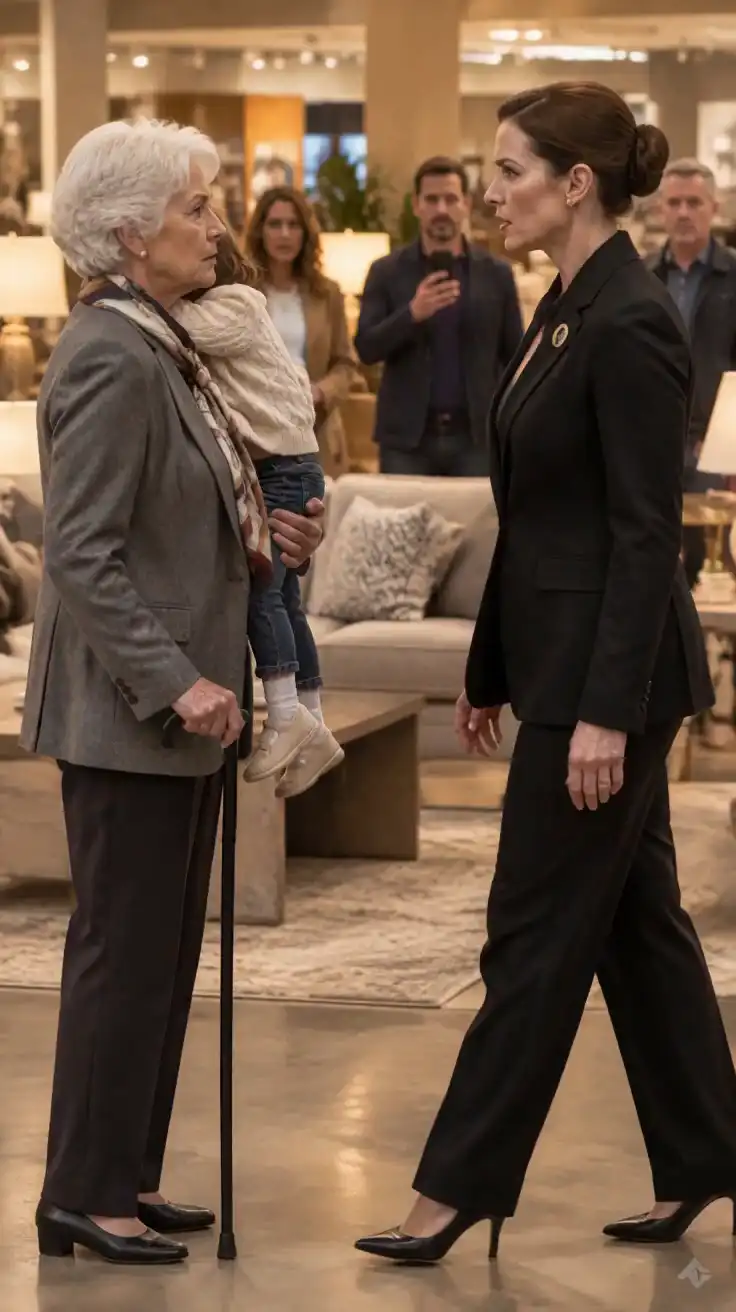
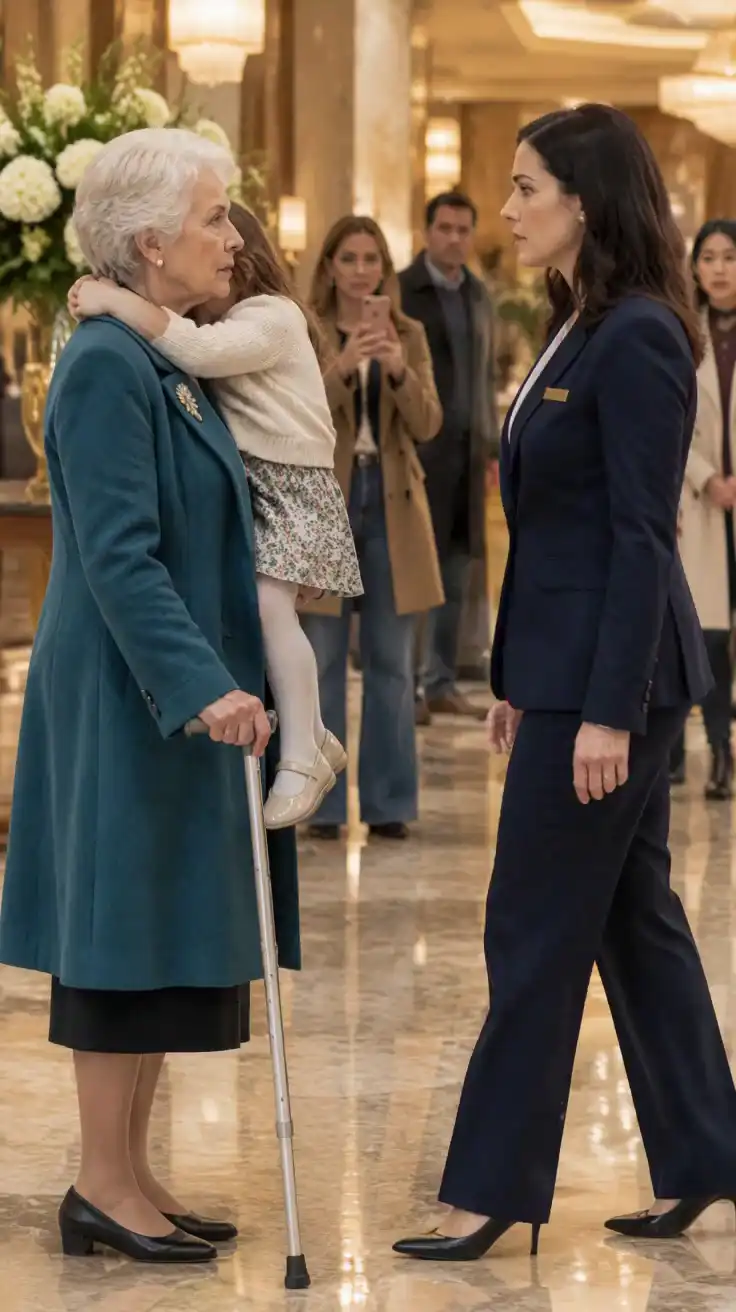
The hotel manager slapped me for asking about wheelchair service, while the guard steered me toward the doors. I called my son as the deed and accessibility inspection report came to the front desk.
My cheek burned where his palm had landed. A guard closed his hand around my elbow and steered me toward the doors while the manager kept his voice level, as if the guests watching us were the problem he needed to solve.
“Keep the entrance clear,” he said.
I tried to pull my arm free. The guard tightened his grip. Behind him, a suitcase wheel clicked over the lobby tile, then stopped. Someone raised a phone. Another guest did the same.
“I’m asking about a wheelchair,” I said.
The manager glanced at the phones and straightened his jacket. He had wanted a quiet lobby, a clean line of sight from the doors to the desk. I was in the way, and he had decided that was all there was to know.
The guard walked me another step. My shoe caught against the edge of a floor mat. A woman near the desk lowered her phone just long enough to say, “She asked for help.”
The manager’s jaw moved once. “Please don’t make this harder.”
I looked past him at the reception counter. My phone was still in my hand. I called my son.
He answered, and I heard the faint rattle of traffic on his end. I didn’t explain everything. I told him where I was and asked him to come to the front desk. Then I ended the call.
The manager gave a short laugh. “You can’t call someone to change the rules.”
The phones stayed pointed at us. The guard loosened his grip but didn’t step away. A guest in a dark coat moved closer to the counter, watching the manager now instead of me.
Minutes passed. The manager kept glancing toward the entrance. When the doors opened, he stopped speaking.
A man came in carrying two papers. He crossed the lobby without looking at the phones and went straight to the desk. The manager stepped aside. The guard let go of my elbow.
The man set the deed and the inspection report together on the counter.
The manager stared down at them. My son stood beside the papers, waiting for him to read.
THE NAME ON THE DEED
Adrian turned the top page so the lobby could see it, then laid one finger beside the name printed near the bottom.
“My mother owns this hotel,” he said.
The manager’s smile went first. His eyes stayed on the page, moving over the lines as if the letters might rearrange themselves if he read them slowly enough.
The guard released my elbow.
Adrian looked at him. “Step away from her.”
The guard did. He took two steps back and kept his hands at his sides.
I pressed my fingertips to my cheek. It had begun to throb. The woman who had said I asked for help was still near the desk, her phone raised again. A man beside the entrance held his own phone steady. The manager saw both of them and squared the papers against the counter.
“Mr. Hale,” he said to Adrian, “I can explain what happened.”
“You can start by reading the deed.”
“I’m aware of the ownership structure.”
“Then say her name.”
The manager’s mouth opened. His gaze shifted from Adrian to me, then back to the paper.
“My mother’s name,” Adrian said. “Out loud.”
The manager swallowed. “Eleanor Hale.”
A suitcase rolled a few inches across the tile and stopped. No one in the lobby seemed to know what to do with the quiet.
Adrian rested his palm on the deed. “And who did you strike?”
The manager looked at me. For a moment, I thought he might try to answer as if I were not standing there.
“Mrs. Hale,” he said.
“Your owner,” Adrian said.
The words did not feel like a victory. My cheek still hurt. The guard had left red marks where his fingers had pressed into my arm. Guests were watching me as closely now as they had watched the slap, and I wished I could disappear behind the desk and sit down.
I put my hand on the counter to steady myself.
“Adrian,” I said, “I came to ask about a wheelchair.”
“I know.”
“I was not asking you to make an example of anybody.”
“I know that too.”
He turned toward the manager. “Then we start with what she asked for.”
The manager’s shoulders relaxed by a fraction. He took the opening as permission to return to his explanation.
“We had a busy check-in period,” he said. “The entrance was getting congested. I believed she was creating a disruption.”
“She asked for a wheelchair,” the woman with the phone said.
“I understand what she said,” he replied.
“No,” I said. “You understood the words. You decided they did not matter.”
The manager looked at me again. The muscles in his jaw tightened.
Adrian did not interrupt. That mattered. He had come quickly, but he let my sentence stay in the air.
The woman lowered her phone a little. “I heard her ask twice,” she said. “Then the manager hit her.”
The manager’s eyes flicked to the phone in her hand.
“Was that on video?” Adrian asked.
“Yes.”
“Please keep the original file. Don’t post it. We’ll need a copy for the investigation.”
The woman nodded. “I can send it to the company.”
“Legal will give you a secure way to do that.”
The manager folded his hands in front of him. “There was no need to escalate this in front of guests.”
Adrian’s gaze settled on him. “You hit my mother in front of guests.”
“I did not—”
The guard shifted his weight. The manager stopped.
“You did,” I said. “You walked up to me, slapped me, and laughed.”
His face colored above his collar. “I was trying to maintain order.”
“You were trying to make me leave.”
The guard stared at the floor.
Adrian moved the second page beside the deed. “This is the inspection report. You signed the response.”
The manager looked down. This time his expression changed before he had read more than the heading. His fingers pressed into the counter’s edge.
“Where did you get that?”
“It belongs in the property records,” Adrian said. “It was delivered to the management office three months ago.”
“It’s an internal document.”
“It is a report from the accessibility inspection. Your signature is on the response.”
The manager’s eyes found mine. “Mrs. Hale, this has nothing to do with the incident.”
“You told the guard, ‘No wheelchairs here.’”
The guard flinched at hearing his own words repeated.
“I did not say there would never be wheelchairs,” the manager said. “I meant we didn’t have one immediately available.”
“That isn’t what he said,” I replied.
The guard’s face had gone pale. “I was repeating what I was told.”
“By whom?” Adrian asked.
The guard glanced at the manager. “I was told the service corridor was the only route. I was told not to bring a chair through the lobby during arrivals.”
“Who told you?” Adrian asked again.
The manager shook his head once. “This is not the time to interrogate staff.”
“Then tell us what the report says.”
“You don’t have the full context.”
“Give it to us.”
The manager drew a breath but did not answer. The quiet came back, heavier than before. The guests were not looking at me now. They were looking at the papers and the man whose signature sat on them.
I had bought the building years earlier, when it was a tired hotel with a leaking roof and a front desk that still kept reservations in a binder. I had kept it because I knew the neighborhood and because the staff who had stayed through the renovation treated every guest as if a small kindness could change the shape of a day.
I had not run the hotel myself. Adrian had built the operating company, hired the teams, and expanded it. I held the deed because the building was mine. He ran the group because he had the experience and because I had wanted him to do more than spend his life looking after my decisions.
When I visited, I did not announce myself. I would take a room, walk the public areas, speak to whoever was working, and leave a note for Adrian if I saw something that needed attention. The staff knew my name, but many did not know what I owned. I preferred it that way. I had never thought a title should be required for someone to receive basic help.
That afternoon, I had arrived with my cane and a small overnight bag. My knees were stiff after the drive. I had asked at the desk whether the hotel could provide a wheelchair while I waited for the room. The clerk had looked toward the lobby manager. He had been directing a line of arrivals and had waved me toward the side.
I had not wanted to block the desk. I had simply stayed where I was and asked again.
The manager came over. He looked at my cane, then at the guests moving through the doors. He had not asked my name. He had not asked what I needed. He had decided that I was in his way.
He had slapped me.
I looked down at the report. The small print blurred, partly because I was tired and partly because my eyes had begun to water. Adrian noticed.
“Sit down,” he said.
“I can stand.”
“I know. Sit anyway.”
He pulled a chair out from the reception counter. The clerk hurried around the desk, but I raised a hand to stop her from grabbing me. She waited until I sat and then placed a glass of water within reach.
“Thank you,” I told her.
Her cheeks were flushed. “I’m sorry.”
“You didn’t hit me.”
“I heard you ask. I should have done more.”
“You were working.”
“So was he.”
She looked toward the manager. He had turned away to speak to someone through the narrow opening behind the desk.
Adrian watched him. “Who are you calling?”
“Security.”
“They’re already here.”
“I’m calling the operations office.”
“Then put it on speaker.”
The manager’s hand paused at his phone. “I don’t think that’s appropriate.”
“Neither was the slap,” I said.
A few people shifted. The woman with the phone lowered it, then lifted it again when the manager turned toward her.
Adrian rested his hands on the counter, careful not to cover the report. “You have two choices. You can tell us what happened to the accessibility request, or you can wait for legal and answer their questions with this report in front of you.”
“I have to call my supervisor.”
“You can call him now.”
The manager’s face was set in a careful, professional expression. It was the same one he had used when he told me not to make things harder. “There are established procedures.”
“Then we can follow them,” Adrian said. “You are not in charge of what happens to the records.”
“I never said I was.”
“You asked where I got the report.”
“I asked because it is confidential.”
“It is a safety report about a property my mother owns. It was copied to the property file. You signed the response. What part is confidential?”
The manager did not answer.
Adrian took out his phone and placed it on the counter. “I’m calling the group’s general counsel. They can decide how to handle the report and the video.”
The manager gave a short, disbelieving laugh. “For one misunderstanding?”
The word hit me harder than I expected. I set down the glass.
“Do not call this a misunderstanding,” I said.
He looked at me.
“You knew I asked for a wheelchair. You knew the guard was dragging me toward the door. You watched people take out their phones, and you kept smiling. You were not confused. You wanted me gone before I embarrassed you.”
His face hardened. “I was trying to keep the lobby orderly.”
“The lobby is full of people who saw what you did. It was not orderly before you hit me. It was just quiet.”
One guest gave a small nod. The manager saw it. His gaze moved from face to face, counting witnesses.
The front doors opened. A woman in a gray suit came in carrying a tablet and a thin leather folder. She passed the guests and went straight to Adrian.
“I’m Marisol Vega,” she said. “Group counsel. I received your call.”
“I’m Eleanor Hale,” I said.
She took in my cheek, the guard standing apart, and the papers on the desk. Her professional expression softened, but she did not reach for me without asking.
“May I sit with you?”
“Yes.”
She pulled a chair over and placed her folder beside my water. “Have you been hurt anywhere other than your face?”
“My arm is sore.”
“Would you like medical attention?”
“Not yet.”
“An ice pack, then?”
I looked at Adrian. He nodded once.
“An ice pack would help.”
The clerk went to get one.
Vega turned to the manager. “I need you to preserve all records related to the inspection, the response, the wheelchair request, the lobby incident, and the staffing instructions for accessibility assistance.”
“I’m not sure what records there are.”
“Then preserve what you have.”
“I’m not authorized to hand over personnel files.”
“I didn’t ask for personnel files. I asked you not to delete or alter records. We will use the proper process for anything further.”
The manager stood very still. “You can’t remove me from duty based on a phone call.”
“I haven’t made that decision,” Vega said. “For now, you are not to supervise this incident, contact witnesses about their statements, or access the relevant records. We will speak with you after we have collected the available evidence.”
The manager looked to Adrian. “You’re letting her do this?”
“This is not about letting anyone,” Adrian said. “She is counsel. You have a right to respond. You do not have a right to shape everyone else’s account before they do.”
The guard lifted his eyes. “I can tell you what happened.”
Vega turned toward him. “You can speak with me privately. You are not in trouble for coming forward.”
The manager’s head snapped around. “You told me you were following the direction you were given.”
“I was,” the guard said. “You said the chair would make the entrance look crowded. You said to move her.”
“I said to clear the entrance.”
“You told me there was no wheelchair.”
“That is not the same thing.”
“It was what I was told to say.”
The guard’s voice cracked on the last words. He looked at me, then down again. “I should not have grabbed you.”
I pressed the cold glass of water against my fingertips. “No, you shouldn’t have.”
“I’m sorry.”
I did not tell him it was all right. His apology could be sincere and still not undo the grip of his hand, or the moment he treated my request as a reason to push me out.
He seemed to understand the silence. “I’ll give counsel a statement.”
“Thank you,” Vega said.
The woman who had filmed the slap came forward. “I have the video.”
“Please keep it exactly as it is,” Vega said. “We’ll take your contact details and arrange a copy.”
The guest handed over her name and number. Another man said he had recorded the manager after the slap. A third had seen the guard steering me toward the doors. None of them seemed eager to be involved. They looked at one another, then at me, and the woman put her phone away only after Vega explained that no one needed to post anything for it to be taken seriously.
The manager moved toward the back of the desk.
“Please stay here,” Vega said.
“I’m going to my office.”
“Not alone. I’ve asked another staff member to accompany you while the records are preserved.”
“I’m the lobby manager.”
“Not for this matter.”
He stared at her. “You’re making a scene.”
“No,” I said. “You made the scene. We are deciding what to do about it.”
He turned to me, and for the first time since I had sat down, I saw uncertainty in his face. It was not remorse. It was the realization that the room no longer belonged to his version of events.
A young desk clerk stepped out from behind the counter with an ice pack wrapped in a clean towel. She held it out to me.
“Thank you,” I said.
“Of course.”
She glanced toward the manager, then lowered her voice. “We do have a wheelchair. It’s in the storage room.”
“Can you bring it to the front desk?” I asked.
She hesitated, looking at Vega.
“Please,” Vega said. “That’s exactly what should happen.”
The clerk went through the staff door.
The manager watched her leave. “The chair is not for general use.”
“What is it for?” Adrian asked.
“Guests who need it.”
“Does a guest have to own the building?”
“No.”
“Does she have to ask you twice?”
The manager said nothing.
The wheelchair came out a minute later. The clerk wheeled it to my side and locked the brakes. I looked at it, then at her.
“I can walk to the elevator,” I said. “I don’t need it right now.”
“I understand,” she replied. “It should have been offered.”
That sentence eased something in my chest, though it did not erase the ache in my face. I put the ice pack against my cheek and held it there.
Adrian opened the inspection report. Vega moved closer and read over his shoulder. The manager stood near the desk with a second employee beside him, neither of them speaking.
The report described the front entrance. The threshold was too high for an unassisted wheelchair. The side entrance could be used, but it required a staff member to unlock a service door and guide the guest through a narrow route beside the loading area. The inspector had recommended an accessible route from the main entrance and a clear, written process for providing mobility assistance while permanent work was completed.
The response page was clipped behind it. In the space marked “property representative,” the manager had written that temporary procedures were adequate and that no immediate structural changes were planned.
His signature was below the statement.
I looked at him. “You signed this?”
“I signed the response prepared by the operations team.”
“Your name is on it.”
“I was given the wording.”
“Did you read it?”
He did not answer.
Adrian lifted the report enough for the manager to see the signature. “You said there was no wheelchair available.”
“The chair was in storage.”
“Your own report says the staff were supposed to offer it.”
“The report is not an order.”
“It records the inspector’s recommendation and your response.”
“I did not decide the building’s construction budget.”
“My mother owns the building,” Adrian said. “The group manages it. You decided what the staff should do that day.”
The manager’s eyes shifted to me. “The inspection found a deficiency. We had a temporary process.”
“Did you tell the staff to use that process?”
“I told them to direct guests to the side entrance.”
“Did you tell them how?”
“We have a procedure.”
“Where is it?” Vega asked.
The manager rubbed the side of his thumb with one finger. “It should be in the operations manual.”
“Should be?”
“I’ll have to check.”
The clerk who had brought the wheelchair spoke before anyone else could.
“There isn’t a procedure in the desk binder.”
The manager turned. “You haven’t seen the whole manual.”
“I checked when Mrs. Hale asked for a chair. The binder says to contact a supervisor.”
“Which is what you did.”
“I asked you. You said to clear the entrance.”
The clerk’s hands were tight at her sides. She looked afraid, but she did not look away.
The manager glanced at the guests. “We should not be discussing internal procedures in the lobby.”
“We are discussing a request that was made in the lobby,” Vega said. “The lobby is where it happened.”
Adrian took another sheet from his folder. “The property file has two emails from the inspector’s office. One confirms the report was delivered to the management office. The other asks for a date for the entrance work.”
The manager’s face changed again. “I never saw those.”
“You signed the response,” Adrian said.
“That doesn’t mean I handled every email.”
“Who handled them?”
“I don’t remember.”
“Then we’ll check the records.”
The two guests still holding phones were watching him closely. The first woman had put her phone in her coat pocket, but she had not left. The second guest, a man with a dark coat and a hotel key sleeve in his hand, stood near the front doors.
The manager noticed the key sleeve. “Sir, I’m sorry for the interruption. We’ll be able to assist you in a moment.”
“I’ve been waiting for twenty minutes,” the man said. “I watched her ask for help, and you hit her.”
“I did not hit her because she asked for help.”
“You hit her right after she asked.”
“It was an inappropriate response to a difficult situation.”
“You called it a misunderstanding a minute ago.”
The manager pressed his lips together.
The guest turned to me. “Are you all right?”
“I’ll be fine.”
“I’m sorry that happened.”
“Thank you.”
He looked at the wheelchair beside me. “I came in with my mother last month. We had to go around the building because the front door wouldn’t take her chair. A bellman helped us through a side door. He was kind, but it was cold and raining.”
The manager held up a hand. “I don’t know about that specific situation.”
“You should,” the guest said. “It’s your lobby.”
Vega opened her folder and wrote down his name. “Would you be willing to provide a statement about the entrance and the route you used?”
“I would.”
“I can also send a copy of the email I wrote the hotel afterward,” he said. “I got a reply that said someone would follow up. Nobody did.”
Adrian gave him the name of the group’s guest-relations office, and Vega noted the email address he could use. She did not ask him to make a public complaint or post his video. She asked him to preserve what he had, and he said he would.
The manager looked at the growing line at the desk. “We need to get back to serving guests.”
“We do,” Adrian said. “The clerk can handle check-in.”
“I’m the manager.”
“Not while you are part of the investigation.”
“I have a duty to the hotel.”
“So does every person here.”
The manager’s face went still. He turned to the second employee. “Get me the operations binder.”
Vega placed a hand on the folder. “You are not to search or remove records. The employee can locate the binder while counsel supervises.”
“That’s excessive.”
“Given the report and the missing process, it is appropriate.”
Adrian looked at the clerk. “Can you and the other staff member keep the desk moving?”
“We can,” she said.
“Then do that. Don’t discuss witness accounts among yourselves. Counsel will speak with each of you.”
She nodded.
A bellhop came through the doors pushing a luggage cart. He slowed when he saw the wheelchair, the ice pack against my cheek, and the cluster of people around the counter.
“Mrs. Hale?” he asked.
I knew him from an earlier visit. His name was Thomas, and he had carried my bag upstairs that morning.
“I’m all right, Thomas.”
He set the cart aside. “Do you want me to get your bag?”
“Please.”
The manager took a step toward him. “We don’t need to involve more staff.”
Thomas looked at me. “She asked me.”
“That’s enough,” Adrian said.
Thomas went to the luggage area. The manager watched him go, then stared at the deed again as if he could make the room return to the way it had been before my name was read aloud.
I kept the ice pack in place. My hand had begun to tremble. I put the other hand over it and held still.
Adrian noticed. “We can go upstairs.”
“Not yet.”
“You don’t have to stay here for this.”
“I want to know why there was no path from the front door.”
“We’re going to find out.”
“I don’t want a promise made because you’re angry.”
His shoulders lowered. “Then I’ll make no promise. I’ll get the records, and we’ll see what they say.”
Vega looked at me. “You can decide later whether you want to make a formal statement. I can arrange a private room and a doctor now. You don’t have to handle the investigation in the lobby.”
“I want the chair brought to the room, not because I need it for the elevator but because I want the staff to stop treating it as something that should be hidden.”
“I’ll make sure it is available,” she said.
“And I want the entrance fixed.”
Adrian glanced down at the report. “We’ll inspect the options.”
“Not options that end at a service door.”
“No.”
I looked at him until he met my eyes. “That is what I want you to hear.”
“I hear you.”
The manager gave a low exhale. “The building’s exterior is complicated. There are drainage issues. The curb and the historic entry—”
“Is that why you said there were no wheelchairs?” I asked.
“No. I said the entrance was congested.”
“You told the guard there were no wheelchairs here.”
He went quiet.
The guard, standing a few feet away, shifted again. “You said that before she came in.”
The manager turned sharply. “You need to be careful about what you say.”
Vega stepped between them, not physically blocking either one but placing herself where both could see her. “Do not contact or pressure witnesses. That includes staff.”
“I’m not pressuring him.”
“You just warned him to be careful. Stop.”
The manager looked as though he had a response ready. He glanced at the guests and let it go.
Adrian handed the inspection report to Vega. “Please make a copy and secure the original.”
“Of course.”
“Can we speak in the office?” the manager asked.
“We can speak with you after you are relieved of duty for the day,” Vega said. “For now, an employee will accompany you to a private room. You may gather personal belongings. You may not access the management files.”
“I’ll call my supervisor.”
“You can do that.”
“And I want my own counsel present.”
“You may have counsel present for your interview.”
The manager’s gaze moved to me. “I’m sorry this happened.”
The words came out stiffly, without the easy confidence he had used when he told me not to make things harder. He did not look at my cheek. He looked at the people listening.
I held the ice pack to my face. “Are you sorry you hit me, or sorry they saw?”
His lips parted. He closed them again.
“I’m sorry for the incident,” he said.
“That is not an answer.”
“I’m sorry I hit you.”
The lobby went silent again. This time, the manager looked at the floor.
I did not tell him I forgave him. Not because I wanted him to suffer, but because there was nothing for me to say that would make his apology complete. He had to decide whether he understood what he had done.
Vega nodded toward the second employee. “Please escort him to the office.”
The manager straightened his jacket. He walked behind the counter, then stopped at the staff door. A few minutes earlier, he had stood in front of me and used the lobby as a stage for his authority. Now he had to wait for someone else to open the door.
Before he left, he looked back at Adrian. “This is going to damage the hotel.”
Adrian’s voice stayed even. “The hotel was damaged before we arrived.”
The manager left with the employee. The guard remained, waiting for Vega to speak with him. The guests began to drift away, but not all of them. The woman who had filmed the slap sat in a chair near the windows. The man in the dark coat stayed long enough to give Vega his contact information.
The lobby did not return to normal. The front desk clerk kept checking on me while she handled arrivals. Each time someone asked for assistance, she made sure to ask what they needed instead of guessing.
Thomas returned with my bag. “I’ve got your room key,” he said. “Do you want me to walk with you?”
“I can walk.”
“I know. I can still walk with you.”
I looked at Adrian. He did not object.
“All right,” I said.
Thomas carried the bag. Adrian took the papers, leaving the original deed in its folder. Vega kept the report. She asked the clerk to place a temporary wheelchair sign at the desk, but I shook my head.
“Not a sign,” I said. “A process.”
Vega nodded. “You’re right. We need the actual procedure, not a sign.”
The clerk said, “I can write down the steps we use when someone asks. We just need to know what we’re allowed to do.”
“Don’t write a procedure without the people responsible for approving it,” Vega said. “But write down what you have been told to do, including what you were told today.”
The clerk looked at the manager’s empty station. “I can do that.”
We took the elevator upstairs. Adrian stood beside me, holding the folder flat against his leg. Thomas pushed my bag on the luggage cart. At the elevator doors, I caught the manager’s reflection in the polished metal at the far end of the lobby. He was no longer there.
When the doors closed, Adrian looked at my cheek. “It’s swelling.”
“It will settle.”
“Would you let a doctor look at it?”
“After we’ve had a minute.”
“I’ll ask one to come up.”
“Ask. Don’t order.”
He gave me a quick, tired smile. “All right.”
In my room, Thomas set my bag by the dresser and asked whether I wanted anything else. I thanked him and told him he could go. He lingered at the door.
“I’m sorry,” he said.
“You weren’t there.”
“I’ve seen how the manager treats people who slow things down. I should have said something sooner.”
I studied his face. He looked embarrassed, but not only on his own behalf. He had been working in the hotel long enough to know the pattern and had stayed quiet because keeping his job had felt safer.
“You can say something now,” I told him. “Tell counsel what you have seen. Don’t make it larger than it was, and don’t make it smaller.”
“I will.”
He left, closing the door behind him.
Adrian called for a doctor, then set the deed on the table. He did not put it back in his folder.
“You did not have to read my name in front of everyone,” I said.
“I thought the manager was going to keep pretending he didn’t know what the deed said.”
“He knew what it said.”
“He knew the property owner’s name. He didn’t know you were his employer.”
“I am not his employer. The group is.”
“You own the building.”
“And you run the group.”
“Which means the distinction matters.”
“It mattered to him because he thought power was somewhere else.”
Adrian sat across from me. “I’m not sure that’s all it was.”
“What do you think it was?”
“He wanted the lobby quiet. The chair was in storage. He had a line of people waiting. He made a fast choice that cost him nothing in the moment because he assumed you could be pushed out.”
“And because he thought I was nobody.”
“I don’t know what he thought.”
“He didn’t ask.”
Adrian lowered his eyes. “No, he didn’t.”
The doctor arrived, examined my cheek and arm, and recommended that I use a cold compress and call if the pain increased. There was no fracture, and my cheekbone seemed intact. He wrote down the time of the examination and gave me a copy of his notes.
When he left, Vega called. She had arranged for the management files to be secured and had asked the operations team not to access the relevant accounts until she could preserve them. She wanted to speak with the clerk, the guard, and the manager separately. She also wanted to know whether I was willing to make a statement.
“I will,” I said.
“Would you prefer that I come to your room?”
“No. I’d rather speak in the small conference room, with Adrian present.”
“That works.”
Adrian looked at me. “You don’t have to do it tonight.”
“I know.”
“You can sleep and decide tomorrow.”
“I have decided.”
He stood. “Then I’ll walk with you.”
In the conference room, Vega took my statement with a recorder on the table. She asked what I had said, what the manager had done, what the guard had done, and what I remembered hearing. She did not lead me or fill in gaps. When I could not remember the exact order of a sentence, she marked that I could not remember.
Adrian sat across from me. He did not speak for me.
When I described the slap, my hand went back to my cheek. Vega waited until I lowered it.
“Did the manager say anything immediately afterward?” she asked.
“He laughed. He said ‘Hah.’ Then he looked around.”
“Did he say why he struck you?”
“No.”
“What did you ask for?”
“A wheelchair. I said I had come to ask about wheelchair service.”
“Had you been asked to leave?”
“Not until the guard took my arm. The manager told him to keep the entrance clear.”
Vega turned slightly. “Did you feel you were in danger when the guard held you?”
“Yes.”
“Did you feel you were free to stay?”
“No.”
She wrote it down.
When we finished, she asked whether I would authorize the company to provide my statement to the police if I decided to report the assault.
“I’ll decide after I’ve read the medical note and seen the video.”
“That’s reasonable. No one here is asking you to decide tonight.”
She gave me a copy of my statement to review. I made one correction: I had said the manager looked at my cane, but I could not be certain he had. Vega changed the sentence without argument.
The next morning, Adrian and I met Vega in the hotel office. The report had been copied and secured. A records specialist from the group had collected the inspection emails and the operations binder. The manager was on leave pending the investigation. He had not been fired. Vega said the distinction mattered.
“I don’t want you to make a decision because I own the building,” I said.
“I won’t,” Adrian replied. “We need to know what happened, what the records show, and what the policy requires.”
“Then do that.”
Vega laid the inspection report on the table. “We found the inspector’s original notice and two follow-up messages. The first asked for a work plan. The second asked whether the temporary route was being used. The management office replied that the issue had been addressed through staff assistance.”
“Who wrote the reply?” Adrian asked.
“We’re still verifying that. The email came from the shared operations account. The manager approved the response.”
“Was there a documented work plan?”
“No.”
“Was the wheelchair procedure in the binder?” I asked.
“No,” Vega said. “There was a general instruction to contact the manager when a guest requested mobility assistance. There was no protocol for a guest arriving during a busy period, and no backup contact if the manager was occupied.”
“That explains the delay,” Adrian said. “It doesn’t explain the slap.”
“No,” Vega said.
She showed us a photograph from the inspection. It showed the front entrance and the raised threshold. The image had no readable text, only a measurement marker. The inspector had noted that a temporary portable ramp could be installed while the permanent work was planned, provided the slope and landing were checked.
“What happened to the temporary ramp?” I asked.
“The property team says one was ordered and rejected because it did not fit the entry. There is no record of a replacement being ordered.”
“Why not?”
“The facilities manager says the project was moved to the next budget period. We’re interviewing him today.”
Adrian leaned forward. “Who made that decision?”
“We don’t know yet.”
“Is the manager’s response on the report?”
“Yes. He signed it. The report says he represented that the temporary process was adequate.”
“He could have believed that.”
“He could have,” Vega said. “We still need to know what instructions he gave staff and whether he had authority to delay the work.”
I watched Adrian’s hands. His fingers were interlaced, knuckles pressed together. He was holding himself still.
“Do not turn this into a family argument about who owns what,” I said.
He looked up. “I’m not.”
“Good. The building is mine. The staff are employed by your company. Neither fact changes what the guest at that desk should have received.”
“I agree.”
“Then the company has to fix the process whether I am there or not.”
“It will.”
I waited.
“Not as a favor,” he added. “As a requirement.”
Vega wrote that down. “I’ll put it in the action plan.”
Over the next two days, the group interviewed the staff who had been working in the lobby. The clerk said she had asked the manager about the chair before I arrived because another guest had requested one earlier that week. She had been told the wheelchair was for emergencies and should be kept out of the public area.
The guard said the manager had told him to move me away from the entrance because the lobby was becoming crowded. He also said the manager had made remarks about keeping the front of house looking polished during a busy arrival period.
The manager disputed some of it. He said he had never instructed anyone to hide the wheelchair. He said the guard misunderstood a request to clear the doorway. He admitted that he had hit me, but described it as “a reflexive, regrettable act” after I had raised my voice.
The video did not show me raising my voice before the slap. It showed the manager approaching, striking me, and laughing. The guard’s shout came afterward. The video ended with the manager smiling while I called Adrian and he answered from the elevator. The guests’ recordings continued beyond that point. One showed him moving toward the desk and the guard releasing me when Adrian arrived.
Vega asked the witnesses to keep their original recordings. She collected copies and logged who had provided each one. No one posted the clips publicly. The hotel also did not make its own statement until the investigation had established what could be said accurately.
On the third day, Adrian called me into the building’s small conference room. He had the accessibility inspector on a video call and the facilities manager seated across from him. Vega was there, along with the operations director.
The facilities manager looked tired. “I thought the permanent work was going to start after the winter season.”
“Who approved that delay?” Adrian asked.
“I was told the front entrance would require new drainage. I didn’t have a confirmed price.”
“Did you request one?”
“I asked for an estimate.”
“Did you get it?”
“No.”
“Why not?”
The facilities manager looked down at his hands. “The project was marked low priority. I should have followed up.”
“Who marked it low priority?”
“The former regional operations lead.”
“Did you tell the hotel team to use the side entrance?”
“I said the side entrance could be used until we had a permanent solution.”
“Did you check whether a guest could reach it without staff assistance?”
“No.”
The inspector on the screen leaned closer. “The side entrance is not an accessible route from the street. It requires staff to unlock a door and move equipment from the service corridor. That is not an equivalent entrance. I wrote that in the report.”
The operations director shifted in her chair. “The staff were told to assist guests.”
“Were they trained?” the inspector asked.
“Not formally.”
“Was there a written protocol?”
“Not that I found.”
The facilities manager rubbed his forehead. “I thought the desk team knew what to do.”
“They did not,” I said. “One of them searched for a wheelchair and found it in storage. The other was told to push me outside.”
No one answered immediately.
Adrian looked at the operations director. “How many properties have the same instruction?”
“We don’t know yet. We’ve started checking the other hotels.”
“Start with every property that does not have a step-free main entrance. I want a list of the temporary arrangements and who owns each one.”
“Understood.”
“Who will make sure staff can provide assistance today, before construction is done?”
“I can assign a regional accessibility coordinator.”
“Not next week. Today.”
“We can have someone onsite by tomorrow morning.”
“Someone onsite today.”
The director nodded and began typing.
The inspector said the permanent entrance work could be done without altering the front facade if the curb and threshold were rebuilt with a compliant slope and a level landing. The project would take several weeks and require permits. A temporary ramp could be installed sooner, but it would need inspection and could not obstruct the entrance.
Adrian asked for a written plan with dates, costs, and responsible people. He did not ask the inspector to promise that the work would be easy. He asked what could be done now and what would take longer.
I listened to the plans and then asked, “What happens if someone arrives before the ramp is installed?”
The operations director answered. “A staff member meets the guest at the main entrance, brings the wheelchair out, and offers assistance. If the guest needs a step-free route, staff use the side entrance while the temporary ramp is installed.”
“That route still leaves the guest outside and dependent on someone finding a key.”
“We can put a staff member at the front desk on each shift with access to the side door.”
“What if that person is helping someone else?”
“We can designate a backup.”
“Write both names into the shift sheet. Not in a binder nobody looks at.”
The director looked at Adrian. He said, “Do that.”
The changes began that afternoon. A facilities team measured the entrance. A temporary portable ramp was fitted and tested with a wheelchair. The inspector returned to check its slope and the landing space. The hotel set up a chair beside the front desk, visible and available, and marked the shift schedule with the names of the staff responsible for assistance.
The manager remained on leave. He did not come back to the lobby while the investigation was open. Vega interviewed him with his attorney present. He said he regretted striking me and said he had not intended to injure me. He also denied that he had ever told staff to hide the wheelchair.
The guard’s statement contradicted that. The clerk’s statement supported it. The operations binder showed that there was no written process. The email response, signed by the manager, said the temporary arrangement was adequate even though the inspector’s report had said the route was not equivalent.
The group’s review concluded that the manager had used physical force without cause, had failed to provide appropriate assistance, and had misrepresented the adequacy of the temporary arrangement. It also found that the company’s own oversight had let the missing entrance work drift from one budget period to another. The manager had made the final choice in the lobby. The company had made earlier choices that left staff without a clear process.
When Adrian brought me the findings, he set them beside the deed rather than placing them in my hands.
“The manager is suspended while the employment review is completed,” he said. “The company has also removed his authority over the lobby team. We’re deciding the final disciplinary action this week.”
“Does he understand why?”
“He has received the findings and an opportunity to respond.”
“That isn’t what I asked.”
“I don’t know what he understands. He says he understands that he should not have struck you. He still disputes the instructions he gave.”
“Then he has not understood the whole thing.”
Adrian did not argue. “Maybe not.”
“Do not make his understanding a condition of fixing the entrance.”
“It isn’t.”
The operations director came in with a revised accessibility plan. It listed the temporary ramp, the permanent work, staff training, a procedure for requests, and an audit of the other group properties. Each task had a named owner and a due date.
I read the first page. “Who checks whether the staff are actually using this?”
“Regional operations,” she said.
“Who checks regional operations?”
She paused. “The compliance team will review it monthly for the first six months.”
“And after six months?”
“We’ll evaluate whether monthly checks are still necessary.”
“Put the evaluation date in the plan.”
She added it.
The deed still lay on the table. I touched the edge of the folder.
“I want the building transferred to Adrian,” I said.
He looked at me. “You don’t have to do that because of this.”
“I am not doing it because of the slap.”
“What are you doing it for?”
“I bought the building when I wanted to protect what my husband and I had saved. It made sense then. You have run the group for years. The hotel should not depend on me arriving in person before anyone does the right thing.”
“That isn’t a reason to transfer it immediately.”
“It is a reason to put the ownership where the responsibility already sits.”
“The group leases the property.”
“On paper. In practice, you answer for it. I want you to have the deed.”
He leaned back. “I won’t take it without your conditions.”
“Name them.”
“An independent accessibility audit of every property before the transfer closes. The hotel’s entrance work completed and verified. A written plan for the other properties. And the staff reporting process goes to compliance, not only to operations.”
The operations director looked up from her notes. “That will take a few months.”
“Then it takes a few months,” I said.
Adrian nodded. “I also want the transfer to be clean. No change to the investigation, no change to the company’s obligations, and no language that says you waive a claim because you’re transferring ownership.”
Vega, seated near the door, said, “That can be handled. The ownership change should not affect the employment process or any rights relating to the incident.”
“Good,” I said. “Put it in writing.”
The transfer was not a gift made in the heat of a public scene. We had a lawyer review it, and the company’s records were checked. The building was appraised. Adrian signed for the responsibility as well as the ownership. I kept a written commitment from the group to finish the entrance work and continue the audits.
The manager’s employment review concluded the following week. He was dismissed from his position for striking a guest, directing a guard to remove her, and failing to follow the documented inspection requirements. The letter did not say he was fired because the guest was the owner’s mother. It said the conduct was unacceptable regardless of who I was.
I read the decision twice.
“Does he know the reason?” I asked Vega.
“He has the findings. He has the witness statements and the video. He was allowed to respond through counsel.”
“Did he admit telling the guard to move me?”
“He said he told the guard to clear the entrance. He says the guard misunderstood.”
“And the report?”
“He said the response was prepared by the operations office. The signature is his.”
I set the papers down. “Then the record is clear enough.”
Adrian took the dismissal notice from the table. “I can have the company issue a correction to the staff.”
“What kind of correction?”
“An internal notice stating that the manager’s account of the accessibility procedure was wrong, that the report was not acted on, and that requests for mobility assistance must be handled immediately.”
“Do it. Do not include my name in a way that makes this sound like an exception.”
“We can say the procedure applies to every guest.”
“Say that.”
The correction went to the lobby team and the hotel’s other managers. It did not describe me as the owner. It did not say the manager had been dismissed because he had struck the wrong person. It said he had struck a guest, and that no guest should be treated that way.
Some of the staff came to see me before I checked out. The clerk who had brought the wheelchair came first. She stood just inside my room, unsure whether she should sit.
“I wanted to tell you the new procedure is posted at the desk,” she said. “The wheelchair stays beside the counter now. There are two people on every shift who can bring it out.”
“Is it easy to find?”
“Yes.”
“Do the staff know what to do if both of them are occupied?”
“They call the shift supervisor. The supervisor has to name a backup.”
“Good.”
She looked down at her hands. “I keep thinking I should have argued with him.”
“You did speak up.”
“Not enough.”
“You were one person in a room where your manager had decided he could hit an old woman and keep working. It was not your responsibility to stop him alone.”
She blinked hard and looked toward the window.
“Will you stay?” I asked.
“I think so.”
“Do you want to?”
“I like the job. I like helping people. I don’t want to feel I have to choose between doing that and keeping the job.”
“You shouldn’t have to.”
She nodded. “That’s what the new policy says.”
“Policies matter when people follow them.”
“I know.”
The guard came later with Vega. He had completed a statement and was still working at the hotel while the company reviewed his role. He stood by the door.
“I was told to move you because you were blocking the entrance,” he said. “I believed the manager. I did not have to grab your arm. I know that.”
I waited.
“I’m sorry.”
“Are you sorry you followed the direction, or sorry you used your hand?”
“Both.”
“Would you do it again?”
“No.”
“Why not?”
He looked at the floor and then at me. “Because a person asking for help is not a threat. And because I could have asked what you needed instead of taking you somewhere.”
“Good,” I said. “Remember that when the next person makes a request.”
He nodded. Vega accompanied him back to the office.
The permanent work began two weeks later. The contractor removed the raised threshold, rebuilt the entrance landing, and adjusted the drainage so water would not collect near the door. The temporary ramp remained in place during construction, and the hotel kept the side route available for anyone who preferred it.
I visited again when the permanent entrance was finished. I did not call ahead. The front desk clerk saw me come through the doors and came around the counter.
“Good afternoon, Mrs. Hale,” she said. “Would you like any assistance?”
“No, thank you. I’d like to see the entrance.”
She walked with me to the door. The new threshold sat level with the landing. There was room for a wheelchair to turn without blocking the entrance. The door closed easily behind us.
I set my cane against the wall and pressed my shoe against the metal edge where the old rise had been. It was smooth under the sole.
The inspector, standing nearby, asked whether I wanted to test the route with a chair.
“I don’t use one.”
“I know. The test is still important.”
He was right. The staff brought the wheelchair from the desk, and the clerk guided it through the doors. It cleared the landing, turned, and rolled across the threshold without catching. The route did not require a special key or a trip around the building.
The inspector recorded the measurements. The facilities manager watched while the contractor showed him how the door closer had been adjusted.
“Is it done?” I asked.
“The entrance is compliant,” the inspector said. “We still need to close out the documentation.”
“Then it is not done until that is finished.”
He nodded. “We’ll send the certificate to the property file and the compliance team.”
“Send a copy to the front desk.”
The facilities manager gave a small smile. “That can be done.”
“Not a sign,” I said. “The actual process, and the record that the entrance passed.”
“I understand.”
The company completed the audits at the other properties over the next four months. Some had step-free entrances already. Others had thresholds, narrow doors, or service routes that required staff to improvise. Each site received a written plan, a temporary measure, and a date for inspection. The compliance team reported its findings directly to the board and to Adrian, not only to the regional managers.
The ownership transfer went through after the audit and the hotel work were complete. My name came off the deed and Adrian’s went on it. He brought me the finalized copy one evening, and we sat at the kitchen table while rain tapped the windows.
“I wanted you to keep a copy,” he said.
“I have one.”
“This is the new one.”
“I know what it is.”
He set it down in front of me. I read his name in the place where mine had been, then closed the folder.
“Does it feel strange?” he asked.
“Some.”
“Do you regret it?”
“No.”
He turned his cup in a slow circle. “I keep thinking about the lobby.”
“So do I.”
“I keep thinking that if I’d been two minutes later—”
“You were in the elevator. You came when I called.”
“I should have known the entrance wasn’t fixed.”
“You should have. So should the operations team. So should the manager. So should the people who saw the report and let it sit.”
He looked at the folder. “I should have asked you earlier about the accessibility work.”
“You should have.”
He nodded. “I’m sorry.”
“I know.”
“I’m not asking you to make me feel better.”
“Good.”
He put his hands flat on the table. “I want the company to be better than the decisions we made here.”
“Then keep checking. The ramp is not proof the work is finished. It is proof that this entrance can be changed.”
“I will.”
“Do not wait for another person to be struck before you look at the next report.”
“I won’t.”
The next time I went to the hotel, the wheelchair stood beside the front desk, not tucked behind a door. The clerk asked whether I wanted assistance. I told her I had come to see Adrian.
She called his office and then walked me toward the elevator. On the way, a guest came through the entrance in a wheelchair. The clerk was already moving to open the door wider.
“Would you like help with the threshold?” she asked.
The guest rolled through on his own. “I’m fine, thanks.”
“All right. Let me know if you need anything.”
The clerk stepped aside. She did not insist. She did not point him toward the service entrance. She let him decide what help he wanted.
Adrian met me by the elevator. Behind him, the lobby kept moving: bags crossing tile, room keys changing hands, a child tugging at a parent’s sleeve. No one stopped to watch us.
He put an arm around my shoulders, careful of my cheek even though the bruise had long since faded.
“How does it feel?” he asked.
“Like a hotel should.”
He glanced toward the front doors. “That’s a start.”
I looked once at the level threshold, then at the wheelchair beside the desk. “It’s a good one.”
The hotel belonged to Adrian now. The decision to make the entrance usable belonged to everyone who had failed to do it before, and everyone who would have to keep it that way. My name had been read aloud in the lobby, but it had never been the reason I deserved help.
I had asked for a wheelchair. The answer should have been simple.