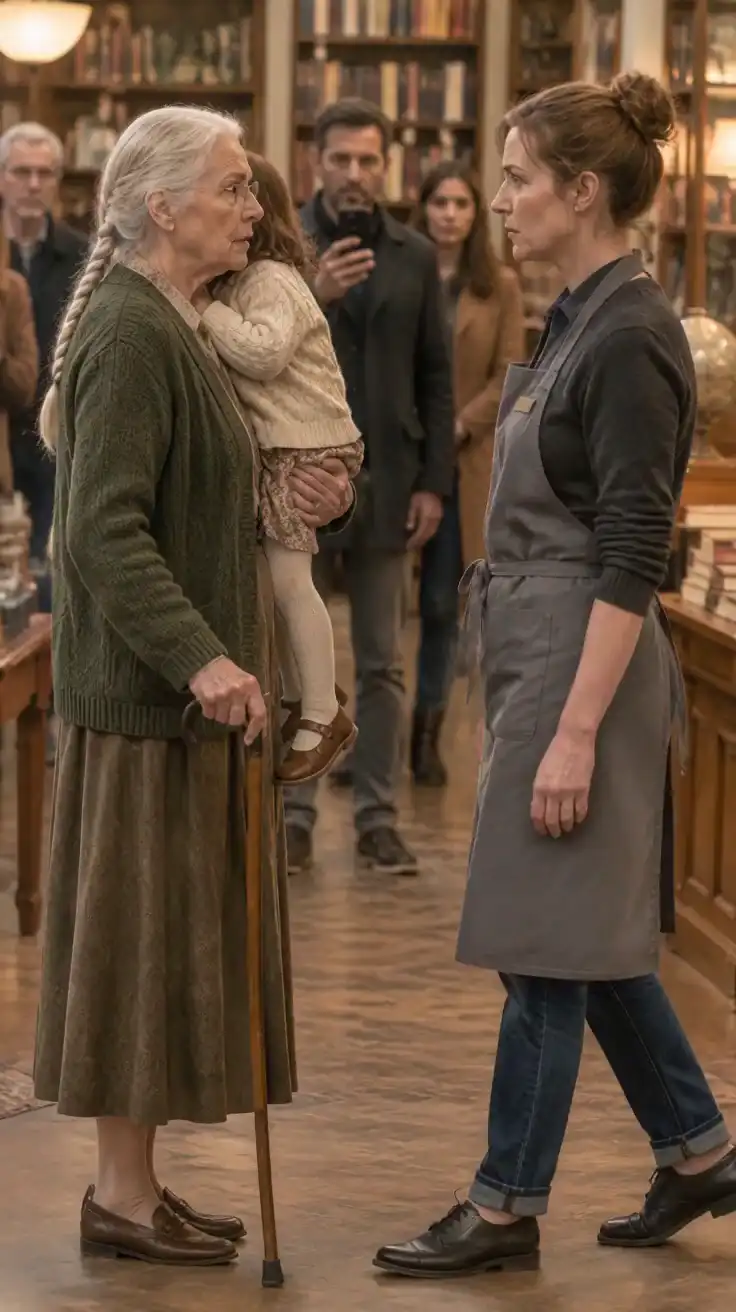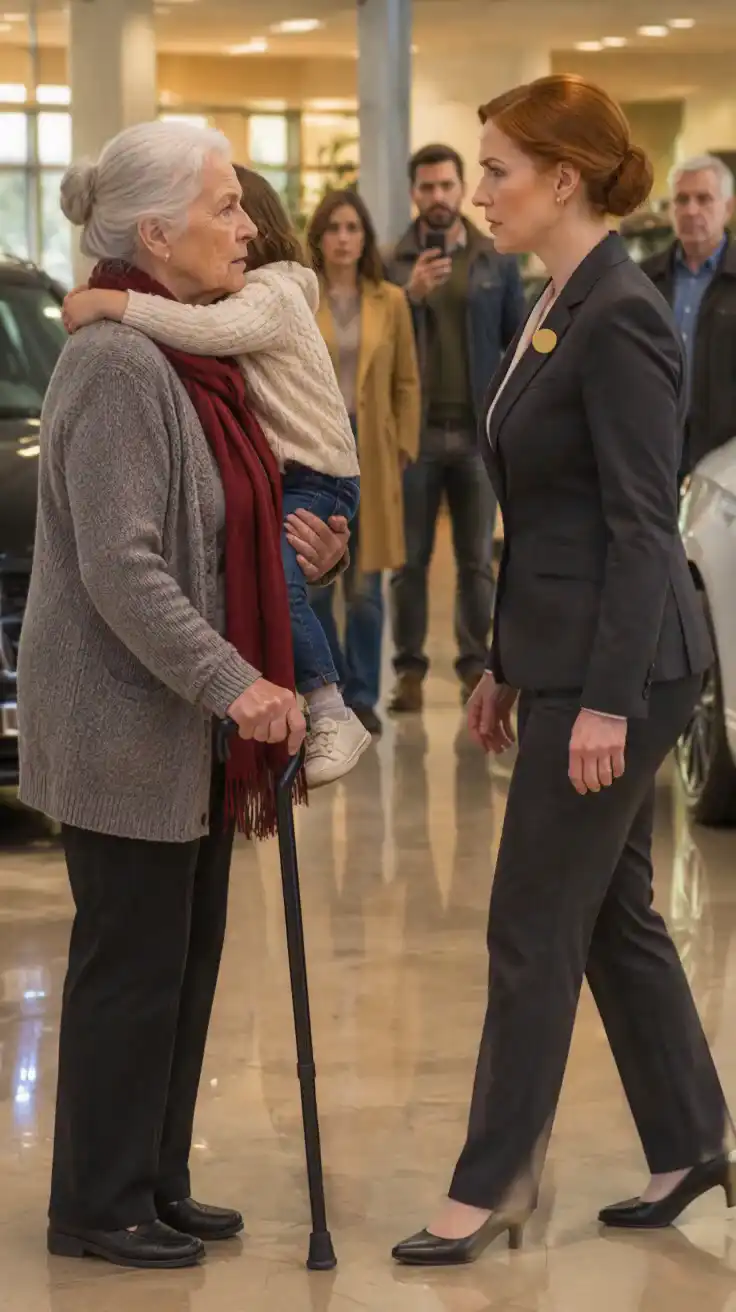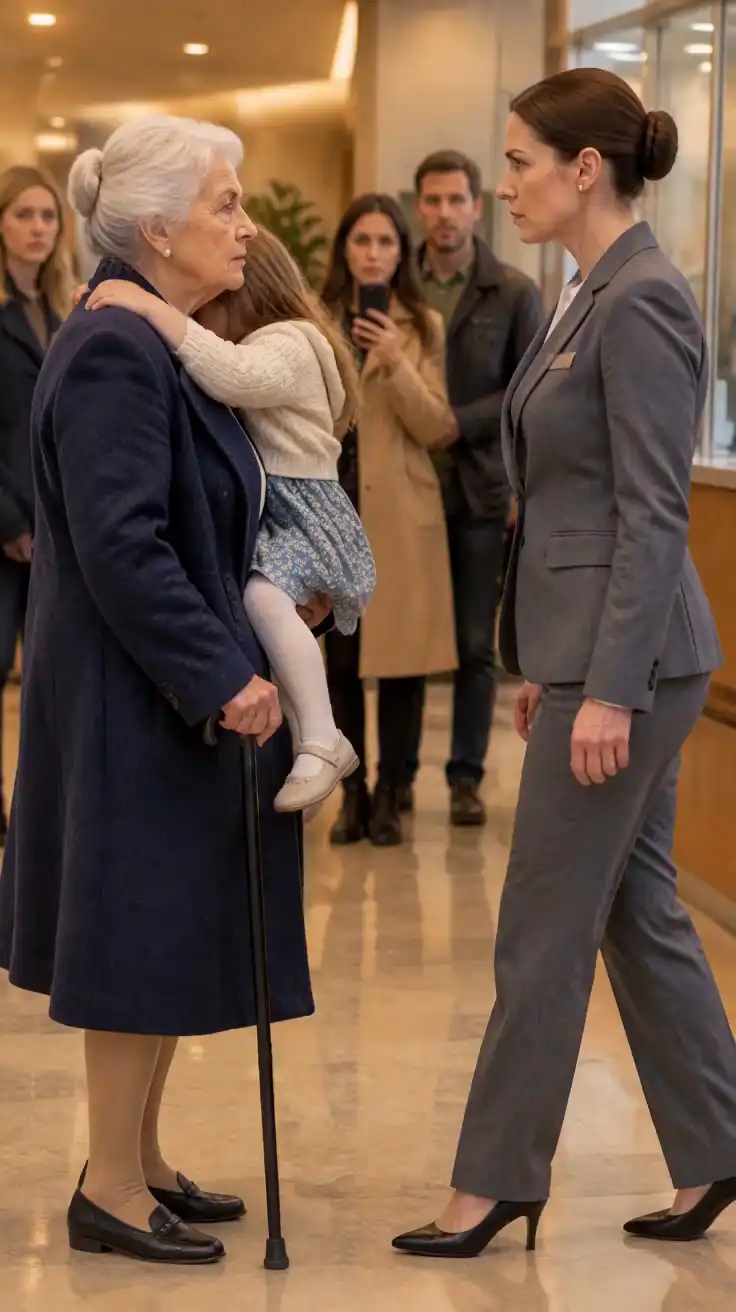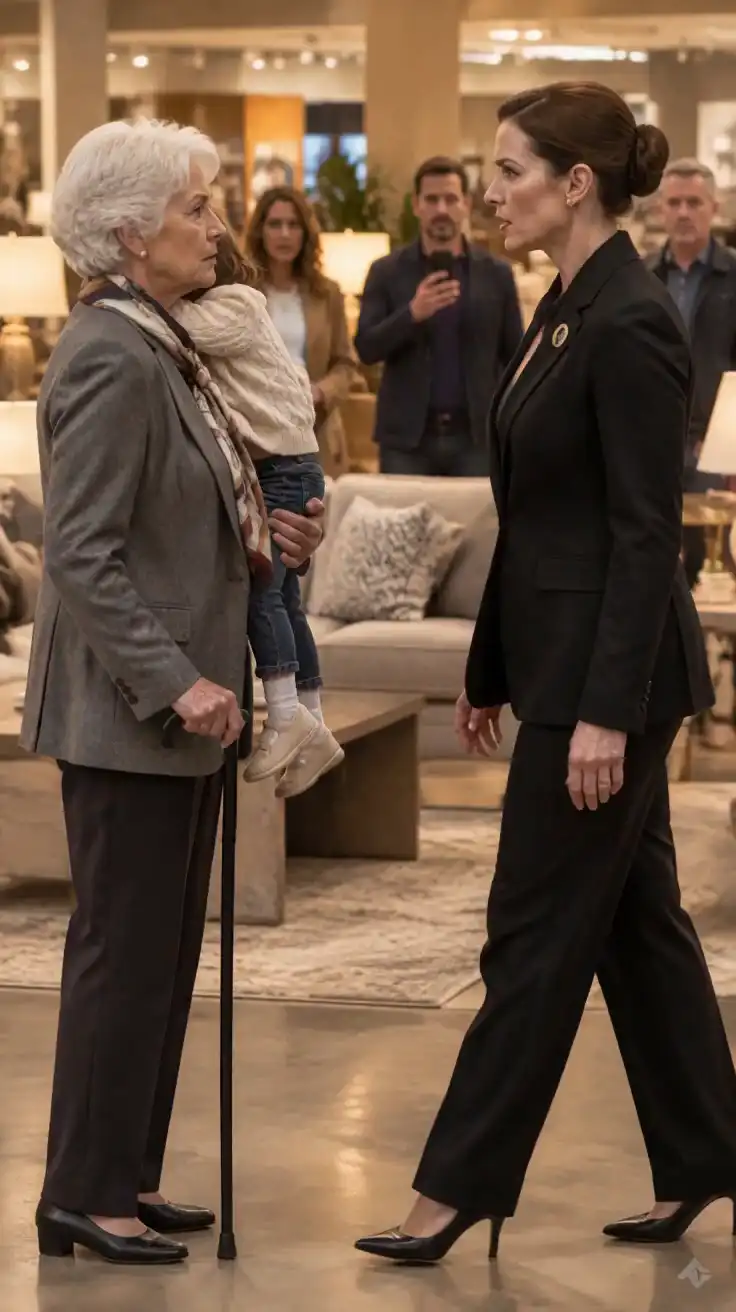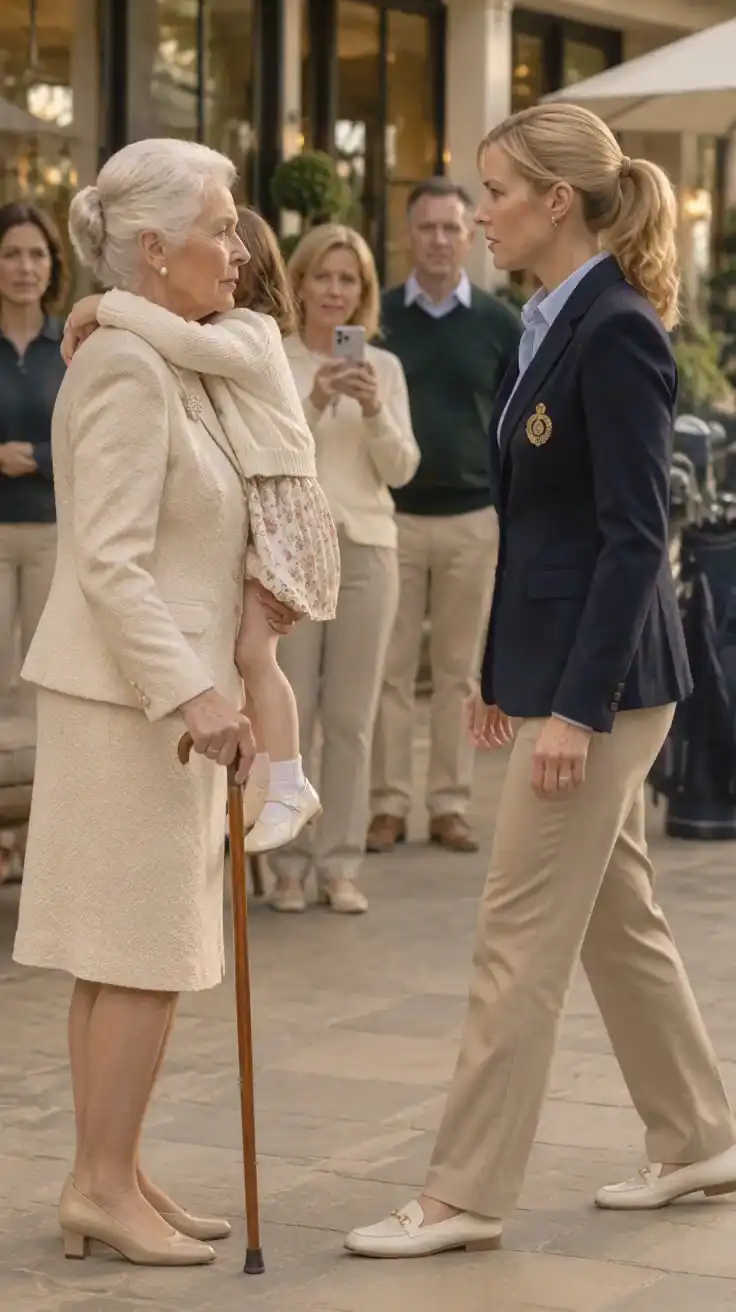
The manager slapped my scalp, laughing while the guard dragged me toward the door. I dialed my son, who was two blocks away with the floor lease.
The sting sharpened when the manager’s hand came down. My scalp throbbed beneath my fingers, and the room went quiet enough for me to hear a dryer click off.
“She says the perm burned her,” someone said.
The manager looked past me toward the waiting chairs. “She’s trying to make trouble for the business.”
A security guard stepped between me and the counter. His palm hovered near my elbow, then closed around it when I didn’t move. Chairs scraped back. One customer gathered her coat; another kept her phone pointed at us.
I tried to say the heat had reached my skin. The manager cut me off with a flick of her fingers.
“Get her out.”
The guard steered me toward the glass doors. I felt every eye follow us, but I kept my feet planted long enough to make him loosen his grip. Behind the counter, the manager had already turned to the next customer.
My phone was in my hand. I called my son.
The manager glanced over when she heard me say I needed him to come to the salon. “You can call whoever you want,” she said, loud enough for the waiting room. “You still can’t disrupt my shop.”
I didn’t answer. The guard stayed beside me, watching the doors, while the customers watched the manager. Someone asked for a refund. Someone else said she wanted hers too. The manager’s mouth tightened.
Then the front doors opened.
My son came in carrying a folded lease. He didn’t look at the guard or the customers. He walked straight to the mirror stations and laid the papers flat on the counter.
The manager lifted one hand as if to push them aside. Then she saw the address at the top.
Her hand stopped in the air.
THE LEASE ON THE MIRROR
Her hand stayed suspended above the papers.
Eric placed one palm on the lease to keep the curling edge from lifting in the salon’s warm air. With his other hand, he reached for me.
“Mom, sit down.”
“I’m fine.”
“You’re shaking.”
“I’m angry.”
“That too.”
The manager’s eyes moved from his face to the lease and back again. She was younger than Eric by at least fifteen years, with a sleek black ponytail and a name tag turned slightly sideways on her blouse. Until that moment, she had carried herself like the only person in the room whose decisions mattered.
Now she swallowed.
“Eric,” she said.
He looked at her. “You know my name?”
“You own the company.”
“I do.”
The customers who had been edging toward the door stopped moving.
The manager glanced at the lease again. “What is this?”
“You tell me,” Eric said. “You’re the one who asked my mother to leave.”
She let out a small laugh, but it had none of the confidence from the video. “This is a private business matter.”
“No,” he said. “It’s a landlord matter.”
The manager’s fingers lowered until they touched the counter beside the papers. She did not touch the lease.
Eric unfolded the second page, then the page behind it. He had brought the original renewal packet from his office, not a photocopy. The pages were thick, creased from being carried in his hand, and marked with the blue tabs his assistant used whenever a contract needed attention.
He turned the first page toward her.
“Read the name.”
“I can read it.”
“Then say it.”
Her jaw tightened. “Mrs. Whitaker.”
“My mother’s name is Sharon Whitaker.”
The room changed in a way I could feel in my shoulders. A few minutes earlier, I had been the old woman who had complained too loudly, the customer who had allegedly disrupted the shop, the body a guard could push toward a glass door.
Now every face turned toward the lease.
The manager finally touched the page. Her index finger followed the printed line under the address, stopped, and pulled back.
“You’re the owner?” one of the customers asked me.
I looked at her. She was the woman who had asked for a refund before Eric entered. Her hair was still wrapped in a silver processing cap, and a white towel hung around her neck.
“I own the floor,” I said. “The salon rents the entire floor from me.”
The guard’s hand fell away from his radio.
The manager straightened. “That doesn’t give her the right to come in here and accuse me of things.”
“It gives her the right to enter the property she leases to your company,” Eric said. “It also gives her the right to report an injury caused in a business operating under that lease.”
“She wasn’t injured.”
I touched the side of my head. My fingers came away dry, but the pain was still hot beneath the skin.
“I was burned.”
“You were not burned,” the manager said. “You complained that the perm was too warm. That happens.”
“You put a chemical solution on my scalp.”
“And it was removed.”
“After I told you it hurt.”
“You were making a scene.”
Eric’s face changed. He did not raise his voice. That was how I knew he was closest to losing control.
“Don’t use that word,” he said.
The manager looked toward the guard for support. “She came in without an appointment, demanded special treatment, and started telling customers the salon was unsafe.”
“She had an appointment,” the woman in the silver cap said.
The manager turned sharply. “You don’t know what happened.”
“I was sitting next to her,” the woman replied. “She had the appointment card.”
Another customer nodded. “She asked you to stop twice.”
“She did,” said a young stylist near the shampoo sinks. Her voice was low, but it carried. “I heard her.”
The manager stared at her. “Go back to work.”
The stylist didn’t move.
Eric folded the corner of the lease back down. “You knew she was the landlord?”
“No.”
“That’s what you said?”
“I said I didn’t know.”
“You’ve worked here for how long?”
“Three years.”
“And you never saw the lease?”
“It isn’t my job to review property documents.”
“No,” Eric said. “It was your job to treat a seventy-two-year-old woman who was complaining of a chemical burn like a human being.”
The manager’s nostrils flared. “You’re making this personal because she’s your mother.”
“It became personal when you hit her.”
The guard shifted his weight. “Nobody needs to get excited.”
I turned toward him. “You told me to sit down because nobody cared.”
He looked at the floor.
“You put your hand on me,” I said.
“I was escorting you out.”
“You were pushing me out.”
“I was following instructions.”
“Whose instructions?”
His eyes moved to the manager.
Eric looked at him. “Give me your name.”
The guard’s mouth opened, then closed.
“Your name,” Eric repeated.
“Darren.”
“Last name?”
“Darren Cole.”
“Are you employed by the mall?”
“Security contractor.”
“Which contractor?”
The manager stepped between them. “This is ridiculous. Eric, if you want to discuss the lease, you can do it in my office.”
“My mother was just struck in front of your customers. We’ll discuss it here.”
“You can’t threaten me in my workplace.”
“I haven’t threatened you.”
“You’re intimidating my staff.”
“I’m standing next to my mother.”
The words landed harder than a shout. The stylist by the sinks looked down. The woman with the silver cap lowered her phone, then raised it again when the manager noticed.
The manager pointed at the phone. “No recording in the salon.”
“You recorded yourself,” the woman said.
The manager’s face flushed.
I remembered the phone held up near the waiting chairs. I had not known whether it captured the slap, the guard’s words, or my call to Eric. I had only heard the sharp sound and then the manager’s laugh.
“Hah.”
That laugh had stayed with me.
Eric looked at my cheek. “Does it hurt?”
“The cheek less than the scalp.”
“Did you see a doctor?”
“Not yet.”
He took out his phone. “Then we’re going downstairs.”
The manager gave a bitter smile. “You’re going to make a medical emergency out of a routine service?”
“No,” Eric said. “You did that when you put chemicals on an open burn and then hit her.”
Her eyes flicked toward the back counter.
“What are you talking about?”
“I saw the bowl.”
“What bowl?”
“The one with the solution still in it.”
The stylist near the sinks went pale.
Eric had not been inside when the service happened. He must have seen the bowl when he entered, or perhaps the smell had told him. I remembered the burning liquid dripping behind my ear, the manager wiping it away with a towel, and the red skin beneath my hair.
The manager crossed her arms. “You don’t know what you’re talking about.”
“I know enough to take her to the clinic.”
“Go ahead. They’ll tell you it’s irritation.”
“Good. Then the treatment will say that.”
He gathered the lease, but I stopped him.
“Leave it.”
He looked at me.
“Let her keep looking at it,” I said.
The manager’s eyes dropped to the pages.
I had carried that lease for years in a small fireproof pouch, not because I expected to use it during a confrontation, but because it was part of my routine. The floor had belonged to my husband and me before Eric was born. After my husband died, I kept the property and managed the tenants through a local office. Eric’s company had leased the space for nearly eight years, first as one location, then as the flagship salon for the chain he built.
The manager had signed staff schedules there. She had accepted deliveries there. She had complained about plumbing there.
She had never once looked at the name of the person who owned the floor beneath her feet.
Eric tapped the first page.
“The lease runs through next week,” he said. “The renewal is due for signature on Friday.”
The manager’s expression tightened. “That renewal is between the company and the property office.”
“It’s between my mother and my company.”
“You don’t personally handle every lease.”
“No. She does.”
I said, “I do.”
The manager’s eyes widened. “You’re the landlord?”
“She is,” Eric said.
“But the company pays the rent to the management firm.”
“The management firm sends it to her.”
“That doesn’t make sense.”
“It makes perfect sense,” I said. “You simply never asked.”
The guard moved toward the entrance again, as though he wanted to be anywhere else. The woman in the silver cap stepped in front of him.
“No one is leaving until I get my money back.”
The manager snapped, “You’ll be refunded according to company policy.”
“I paid for a membership. I’m done.”
“You can’t cancel because you’re upset.”
“I can cancel because I watched you hit someone.”
A man near the front chairs lifted his hand. “I want mine canceled too.”
The manager looked from one face to another. “Everyone needs to calm down.”
The young stylist near the sinks said, “You should refund them.”
The manager stared at her. “Are you resigning?”
“No.”
“Then don’t give customers legal advice.”
“I’m not giving legal advice. I’m telling you what they’re asking for.”
The room had become too crowded for the manager to control with a gesture. Customers stood beside chairs, towels, and handbags. A child sat on the floor near a mother’s knees, looking up at the adults. Two stylists had stopped working entirely.
Eric moved closer to me. “Mom, can you walk?”
“Yes.”
“Are you sure?”
“I walked in here.”
“And the dizziness?”
I had not mentioned it, but the room had begun to sway at its edges. The overhead lights seemed too bright. I put my hand on the counter.
Eric saw.
“That’s it,” he said. “We’re going.”
The manager stepped in front of the aisle. “You can’t just take the lease.”
Eric looked at her. “It belongs to my mother.”
“I need a copy.”
“You’ll receive one through the management office.”
“You can’t remove documents related to the business.”
“They’re not your documents.”
The manager’s hand rose again, this time toward the lease. Eric caught her wrist before she touched it.
He did not squeeze. He simply held her there long enough for her to understand that he would not let her snatch the pages away.
“Don’t,” he said.
Her face hardened. “Let go of me.”
He released her immediately and stepped back.
For one second, no one spoke.
Then the woman in the silver cap said, “That’s exactly what she did to your mother.”
The manager turned on her. “Get out.”
“I’m trying to.”
“Then leave.”
“After my refund.”
The front door opened.
A man in a navy blazer entered with a woman carrying a tablet and a ring of keys. I recognized the man as Victor Hale, the shopping center’s property manager. He had handled the floor since my husband’s death. The woman beside him was from the center’s operations office.
Victor looked first at me, then at Eric, then at the lease on the counter.
“Mrs. Whitaker,” he said. “Are you hurt?”
“My scalp was burned. I was slapped.”
His mouth tightened. He turned toward the manager.
“Did you strike her?”
The manager’s answer came too quickly. “No.”
Several customers spoke at once.
“Yes, you did.”
“We all saw it.”
“It’s on video.”
“The guard pushed her out.”
Victor raised one hand. “One person at a time.”
The manager pointed at me. “She was disruptive. She refused to leave. I asked security to escort her out.”
“That is not what I asked,” Victor said. “Did you strike her?”
The manager’s lips parted.
Victor looked at Darren. “Did you physically remove Mrs. Whitaker?”
“I escorted her.”
“Did you put your hands on her?”
Darren glanced at the customers. “I held her arm.”
“Did you hear the manager instruct you to remove her?”
“Yes.”
“Did you hear her tell Mrs. Whitaker to sit down because nobody cared?”
Darren’s face went red.
Victor did not repeat the question. He waited.
“Yes,” Darren said.
The manager spun toward him. “You’re supposed to support the tenant.”
Victor’s eyebrows rose. “The tenant?”
She stopped.
Eric reached for the lease and held it up. “The tenant is my company. The landlord is my mother.”
Victor looked at the manager. “You didn’t know?”
“No.”
Victor’s gaze shifted toward me. “Mrs. Whitaker, did you come here today in your capacity as landlord?”
“I came for an appointment,” I said. “I had my hair treated. It burned my scalp. I complained. The manager said I was hurting the business.”
Victor looked at the manager again. “And then you struck her?”
“I did not—”
The woman with the tablet interrupted. “The video is clear.”
The manager glared at her. “You haven’t seen it.”
“I have now.”
The woman turned her tablet toward Victor, but the screen faced away from us. No readable words were visible from where I stood. I heard only the sound from the recording: my own voice, thin and frightened; the manager’s voice; the slap; her short laugh.
“Hah.”
Then the guard’s voice: “Sit down. Nobody cares.”
The recording ended with Eric’s voice saying he was two blocks away.
Victor’s jaw tightened.
The manager looked at me as if I had arranged the entire scene. “You brought him here to take over.”
“I called my son because you hit me.”
“You knew exactly who he was.”
“I knew he was my son.”
“You knew he owned the company.”
“I did not call him as the owner of the company.”
Eric said, “She called me because she was afraid.”
The manager gave a short, disbelieving laugh. “Afraid of me?”
I looked at the red mark on her hand where Eric had stopped her from taking the lease.
“No,” I said. “Afraid you would do it again.”
The words quieted the room.
Victor turned to the woman with the tablet. “Call the center office. I want the incident file opened now.”
The manager’s posture changed. “You can’t open an incident file against me without hearing my side.”
“You’ll have an opportunity to give a statement.”
“I’m the manager here.”
“Not for the next few minutes,” Victor said. “Step away from the front counter.”
She stared at him.
“Now.”
For the first time since I had entered the salon, someone gave her an instruction she could not ignore.
The manager moved behind the counter. Her heels struck the floor in quick, hard steps. She kept her chin raised, but her hands were trembling.
Victor looked at me. “You need medical care.”
“I’m going downstairs.”
“I’ll send someone with you.”
Eric put his arm around my shoulders. “I’ll take her.”
Victor nodded. “I’m coming.”
The manager called after him. “Victor, the renewal is next week.”
He stopped at the door.
“I’m aware,” he said.
She looked toward Eric. “You can’t cancel the lease over an argument.”
Eric did not turn around. “No one has canceled anything.”
“Then why are you making this public?”
He finally looked back.
“You made it public when you slapped her in front of the waiting room.”
We left the salon with the customers still gathered behind us.
The clinic occupied a small suite on the floor below, two turns past the elevators. I had used it once for a sprained wrist after I slipped in the parking garage. The receptionist knew me by name and stood as soon as she saw Eric supporting me.
“Mrs. Whitaker?”
“I’m all right,” I said.
The receptionist looked at my face. “You don’t look all right.”
“She had a chemical burn,” Eric said. “And she was struck.”
The receptionist reached for the phone. “I’ll tell the nurse.”
“I can walk.”
“No one is asking you to prove that.”
She brought me into an examination room. The walls smelled like disinfectant and paper towels. Eric stayed near the door until I told him to sit.
The nurse parted my hair carefully. When the water touched the skin, I clenched my hands around the edge of the chair.
“There,” she said. “That’s where it happened?”
“Yes.”
“Chemical service today?”
“Yes.”
“How long did the burning last before they rinsed it?”
“I told the manager almost immediately.”
The nurse looked at Eric.
He said, “She said they left the product on too long.”
“That isn’t what I said,” I told him.
“You said it burned as soon as it touched your scalp.”
“It did.”
The nurse took a photograph with the clinic’s camera. “There’s redness and a small area of broken skin.”
The manager’s voice came back to me: You’re trying to make trouble for the business.
The nurse dabbed ointment along the edge of the burn. “You’ll need to keep this clean. No coloring, perming, or heat near the area until it heals.”
“I won’t be going back there.”
Eric’s phone buzzed. He looked at the screen, then answered.
“Send it to me,” he said.
He listened.
“Not a general notice. I want the manager suspended pending investigation.”
A pause.
“Yes, today.”
Another pause.
“No, do not let her frame this as a customer dispute. The video shows an assault. The incident report should include the guard’s conduct and the employees’ statements.”
The nurse continued treating my scalp. I looked at the ceiling.
Eric said, “And contact counsel. We need to preserve all camera footage from the salon and the mall corridor.”
He ended the call.
“You’re suspending her?” I asked.
“Corporate is.”
“Without hearing everything?”
“They have the video.”
“That isn’t everything.”
He looked at me. “What else do they need to hear?”
I touched the edge of the examination chair. “Why she did it.”
“Because she thought I was hurting her business.”
“That’s part of it.”
“What’s the other part?”
“She forgot who I was.”
Eric frowned. “You were still your mother even if she knew exactly who you were.”
“I know.”
“And she still had no right.”
“I know that too.”
The nurse finished applying the ointment and handed me a small packet of instructions. She also printed a receipt. I folded it carefully and put it in my purse.
Eric watched me.
“What?”
“You’re keeping the receipt.”
“Of course.”
“Mom, the company will cover every bill.”
“That isn’t why I’m keeping it.”
He understood then. The lease was not the only paper I had brought into the salon.
The receipt was proof that the pain on my scalp had been real before the slap, before the argument, before the customers began demanding refunds. It showed that I had not invented an injury to damage his business.
Eric stood and held out his hand. “Give it to me.”
“I can carry a receipt.”
“I know. I want a copy.”
“You can take a picture.”
He took the receipt from my fingers and photographed it. Then he returned it.
The clinic door opened, and Victor stepped in.
“The mall has secured the salon,” he said. “The manager is still inside with our investigator.”
“Secured?” I asked.
“No customers are being admitted. We’re not closing the whole floor, but the salon is temporarily restricted until we finish the incident review.”
Eric leaned against the wall. “What about the customers?”
“They’re being offered refunds.”
“Good.”
Victor looked at me. “The manager says your lease ownership is irrelevant to what happened.”
“It is irrelevant to whether she hit me,” I said.
“Correct. It matters to what happens next.”
Eric looked at him.
Victor took out his phone. “Your renewal packet came through my office last month. We were waiting for the final signature.”
“I haven’t signed it,” Eric said.
“No.”
The room became quiet again.
Victor’s gaze moved between us. “The property office needs to know whether Mrs. Whitaker intends to renew the lease with your company.”
I looked at Eric.
He did not speak for me.
That mattered.
For years, people had assumed that because Eric ran the salon chain, he made every decision connected to the floor. He had inherited the business side from me gradually, and he had become good at it. But the building, the land, the leases, and the final authority over the property remained mine.
I had never needed to announce that.
“Is the company current on rent?” I asked Victor.
“Fully current.”
“Any outstanding maintenance issues?”
“Nothing beyond the usual repair list.”
“Has the company complied with the center’s safety requirements?”
Victor hesitated. “There are two open items. The chemical storage cabinet needs replacement, and the back sink drain has been reported twice.”
Eric looked at me. “I didn’t know about the cabinet.”
“I did,” Victor said. “We notified the salon’s operations contact.”
The manager had been the operations contact.
I pictured the bowl near the shampoo sinks and the chemical smell trapped in the warm air.
“Put it in the report,” I said.
Victor nodded.
Eric said, “If the company renews, I’ll make sure those items are corrected immediately.”
“I expect more than that,” I said.
His shoulders lowered slightly. “Tell me.”
“I want a written policy for chemical services. I want every complaint documented. I want staff trained on what to do when a customer says she has been burned. And I want no manager deciding that a customer is bad for business because she asks for medical attention.”
“You’ll have it.”
“I want the guard’s contract reviewed too.”
Victor said, “It will be.”
“Not just because he followed her instruction,” I said. “Because he told me nobody cared.”
Victor’s expression hardened. “That statement is included in the report.”
Eric reached for my purse. “The receipt.”
“I have it.”
“Mom.”
I handed it over.
He took another photograph and sent it to someone. “The clinic receipt is now attached to the incident file.”
Victor looked at it. “May I have a copy for the property record?”
I gave him the paper.
He studied it without reading it aloud, then returned it to me. “I’ll have the center’s investigator collect the clinic’s confirmation with your permission.”
“You have it.”
By the time we returned upstairs, the customers had formed a line in front of the counter. The manager stood behind it with a woman from corporate on one side and a center investigator on the other.
The manager looked at my bandaged scalp.
“You went to the clinic.”
“Yes.”
“It wasn’t serious.”
The corporate woman turned to her. “Do not make medical conclusions.”
“I’m simply saying—”
“Stop,” the woman said.
That single word made the manager fall silent.
The woman introduced herself as Marissa Cole, the regional director for Eric’s company. I had met her once at a holiday dinner, but she had not recognized me until Eric said my name.
“I’m sorry,” she said to me. “I should have known who you were.”
“You should have known she had no right to hit me,” I said.
Marissa lowered her eyes. “Yes.”
The manager crossed her arms. “This is an outrageous overreaction.”
The woman in the silver cap stepped forward. “I’ve been waiting forty minutes for my refund.”
Marissa turned to her. “You’ll receive it.”
“Not a credit.”
“Not a credit.”
“And I want the membership canceled.”
“Yes.”
The man near the chairs stepped forward next. “Mine too.”
A third customer raised her hand. “I want the same.”
The manager shook her head. “You can’t process cancellations without verifying the accounts.”
Marissa said, “We can and we will.”
“But the company policy—”
“Changed because of this incident.”
The manager turned toward Eric. “You’re letting them panic you into destroying the location.”
Eric answered, “They’re leaving because they watched you strike my mother and then heard you deny it.”
“I was under pressure.”
“So were they.”
The young stylist came out from behind the sinks. She had removed her apron and held it in both hands.
“I need to give a statement,” she said.
The investigator nodded. “We’ll take it in the office.”
The manager stepped toward her. “You work for me.”
“Not while you’re suspended.”
The manager blinked. “I haven’t been suspended.”
Marissa reached into the folder she carried and removed a single envelope. She did not hand it over immediately.
“Effective today,” she said, “you are suspended from all management duties pending completion of the investigation. You are not to contact staff, alter schedules, access personnel files, or enter the salon except by appointment with corporate security.”
The manager stared at the envelope.
“This is because of her,” she said.
“This is because you struck a customer, instructed security to remove her, and then misrepresented the incident.”
“She was disrupting the salon.”
“That does not excuse assault.”
“She was insulting me.”
“That does not excuse assault.”
“She owns the floor,” the manager said suddenly. “She knew I couldn’t remove her.”
The statement hung in the room.
I looked at her.
“You knew,” she continued, pointing at me. “You knew you had power over me, and you came in to use it.”
“I came in for an appointment.”
“You came in expecting everyone to bow.”
“I sat in the same chair as everyone else.”
“You made a complaint in front of customers.”
“I made a complaint because your service burned my scalp.”
“You could have handled it privately.”
“I asked you privately.”
The manager’s mouth tightened. “You never told me you were the landlord.”
“You never asked.”
Marissa held out the envelope. “Take it.”
The manager did not move.
“Take the suspension notice,” Marissa said.
The manager snatched it from her hand.
Her eyes moved across the page. She looked at Eric, then me.
“You’re going to let this happen?”
Eric said, “You made it happen.”
“I built this location.”
“You managed it.”
“I kept customers coming.”
“You frightened them away.”
“I protected the business.”
“You protected your position.”
She turned to me. “You’ll ruin him.”
I felt Eric’s arm near mine, but I did not need him to answer.
“I won’t,” I said. “I’m asking him to run it honestly.”
The manager laughed without humor. “You think owning the building makes you better than me?”
“No.”
“Then why are you standing there like you won?”
“Because you are talking about winning.”
She looked toward the customers, the guard, the suspended notice in her hand.
No one came to her side.
The security guard, Darren, remained near the entrance. Victor called him over.
“Darren, you are not to remove anyone else from this salon,” Victor said. “You’ll provide a statement before you leave.”
Darren nodded.
The manager glared at him. “You’re going to blame me?”
“I’m going to tell the truth.”
“You were doing your job.”
“I put my hands on her.”
“You were following instructions.”
“I still put my hands on her.”
He looked at me. “I’m sorry.”
The manager’s head snapped toward him.
The apology was not hers. It came from the guard, after the video, after the witnesses, after the property manager arrived. It did not erase his hand on my elbow, but it acknowledged what he had done.
I nodded once.
“Give your statement,” I said.
He did.
One by one, the customers spoke with the investigator. The woman in the silver cap described the burn complaint and the slap. The man who wanted his membership canceled described the manager’s laughter. A mother described pulling her child away when the guard moved me toward the door.
The young stylist told them that the manager had said complaints were bad for business and that she had warned her not to use the product on my scalp again.
When she finished, she came to me.
“I should have said something sooner,” she said.
“You were working.”
“I heard you ask her to rinse it.”
“I know.”
“I should have stopped her.”
“You’re not the one who struck me.”
“But I stood there.”
“So did I.”
She looked at the bandage. “Are you going to be all right?”
“Yes.”
She nodded, but her eyes filled.
Eric saw her. “You’re not in trouble for giving a statement.”
The stylist looked at him. “What about my job?”
“You’ll be paid for today. Corporate will contact you about the schedule.”
“And her?”
“Do not worry about the manager right now,” he said.
The stylist nodded and returned to the office.
The salon stayed closed for the rest of the day. The chairs remained empty, mirrors reflecting the people who were no longer allowed to work. Victor taped a temporary notice to the glass, but he turned it around so no one inside could read it. The center’s policy required the notice; the details belonged in the investigation.
Eric stood beside the entrance while corporate staff collected the chemical bowl, the appointment records, and the security footage. He asked the staff not to alter anything. The manager watched from a chair near the back, her suspension envelope beside her.
She had tried to call someone twice. No one answered.
When a corporate investigator asked for the service records, the manager said she needed permission.
Marissa replied, “You no longer have access to them.”
The manager looked at Eric. “You’re going to let her take my files?”
“They belong to the company.”
“I maintained them.”
“And you’ll turn them over.”
She rose suddenly. “I’m not staying here while everyone treats me like a criminal.”
Victor stepped toward her. “You can leave.”
She froze.
“Your suspension requires you to leave the premises,” Marissa said.
The manager gathered her purse. Her face had become very still.
At the door, she turned to me.
“You got what you wanted.”
I looked at her. “What do you think I wanted?”
“To embarrass me.”
“I wanted you to rinse my hair when I said it was burning.”
“That’s not what this is about anymore.”
“It is for me.”
She looked at the lease still tucked under Eric’s arm.
“You’ll renew with him,” she said.
I did not answer.
“You’ll keep the company here.”
“That decision isn’t yours.”
“You’ll do it because he’s your son.”
“I’ll do it if he meets the conditions.”
Eric looked at me. “I will.”
The manager’s smile was thin. “You’ll hand him the building because he knows how to put on a suit and talk to lawyers.”
“I’m not handing him anything.”
“You already did.”
“No,” I said. “I built it. He earned the right to run his company. Those are different things.”
She stared at me, perhaps expecting me to shout. I had spent too many years signing leases, resolving disputes, and sitting across from people who confused volume with authority. I did not need to raise my voice to make the distinction clear.
“The floor is mine,” I said. “The company is his. The choice about the lease is mine.”
She looked at Eric.
He said, “And the choice about the salon’s management is corporate’s.”
The manager left.
No one followed her.
After the doors closed, Eric sat beside me in one of the waiting chairs. The upholstery was stiff beneath my back. The salon smelled of shampoo, warm metal, and the faint chemical sweetness that had made my scalp burn.
“You should go home,” he said.
“I will.”
“I can take you.”
“I know.”
He looked at the mirror. “I’m sorry.”
“For what?”
“For bringing the business into your life like this.”
“You didn’t bring it.”
“I own the company.”
“You own the company. You don’t own every person who works in it.”
“I should have known she was like that.”
“You’re not responsible for every private thought someone has.”
“I’m responsible for who I put in charge.”
“You’re responsible for what you do after you learn.”
He rubbed his hands over his face. “Mom, when I started the first salon, you told me never to sign a lease I hadn’t read.”
“You were twenty-six.”
“You said a lease tells you who has the power to say no.”
“I said it tells you what both sides promised.”
“Same thing.”
“No. Power without promises is just a threat.”
He looked at me.
I tapped the lease under his arm. “The renewal needs conditions.”
“Name them.”
“Safety training. A clear customer injury procedure. An independent way to report complaints. No manager can personally handle a physical removal. And the guard contract needs language about elderly customers and medical complaints.”
“I’ll put all of it in.”
“Also, you will not place someone in charge because they increase sales while ignoring how they treat people.”
He nodded.
“Say it.”
“I won’t.”
“Not to me. To yourself.”
He sat back. “I won’t.”
Victor approached with the center investigator.
“We’ve finished the initial interviews,” Victor said. “The footage has been preserved. Corporate has taken possession of the records. We’re preparing a formal notice.”
“Will the salon reopen?” I asked.
“Not tomorrow.”
Eric nodded. “Good.”
Victor continued. “The center requires a corrective plan before reopening. Because the lease renewal is pending, the plan will be part of the renewal review.”
I said, “I want to see it.”
“You will.”
“And I want the management office to send all future notices directly to me and Eric.”
Victor looked at him. “That’s already standard.”
“It wasn’t happening,” Eric said.
“Then we’ll correct it.”
The investigator held a folder. “Mrs. Whitaker, we’ll need your written statement.”
“I’ll give it.”
“Tonight is fine. We can send a form.”
“No,” I said. “I’ll come to the office tomorrow.”
Eric started to object.
I raised a hand. “I’m not made of glass.”
“I know,” he said. “I just don’t want you dealing with this alone.”
“I won’t be alone. You’ll be there.”
“Of course.”
The investigator nodded. “We’ll schedule you for nine.”
I looked once more at the empty salon.
The manager had wanted me removed before anyone could ask why I was complaining. She had treated the floor as if it belonged to her because she stood behind the counter and held the keys.
But keys were not ownership. A uniform was not authority. A title was not permission to hurt someone.
Eric stood and offered me his hand.
This time, I took it.
The next morning, we met at the property office. The management staff spread the incident documents across a conference table: witness statements, the security report, the clinic receipt, and the footage log. Eric brought the lease. I brought the original appointment card from my purse.
The appointment card had been bent when the guard grabbed my arm.
The investigator photographed it.
“Why did you keep this?” she asked.
“Because the manager said I had come in without an appointment.”
The investigator wrote that down.
Eric sat beside me, but he did not answer questions for me. When I described the treatment, he kept his eyes on the table. When I described the slap, his hand tightened around a pen until his knuckles turned white.
The investigator asked, “Did you believe the manager knew you owned the floor?”
“No.”
“Did you believe she would have acted differently if she knew?”
I thought about it.
“I believe she would have been more careful with her words,” I said. “I don’t know whether she would have been kinder.”
That sentence stayed in the report.
The guard’s statement confirmed that the manager had told him to remove me. The customers’ statements confirmed that I had complained of pain before the slap. The clinic’s report confirmed redness, broken skin, and treatment.
The video confirmed the rest.
By noon, corporate had informed the staff that the manager’s suspension would remain in effect until the investigation concluded. By the end of the week, they formally terminated her employment for assault, violating customer safety procedures, and making a false incident report.
I did not attend the meeting.
I did not need to.
The consequence was not that she finally learned I owned the floor. She had learned that at the mirror station. The consequence was that the company could no longer treat her behavior as a private dispute between two women. The lease, the receipt, the witnesses, and the video placed the incident where it belonged: in the record of a business responsible for the people it served.
The salon stayed closed for twelve days.
During that time, Eric replaced the chemical storage cabinet, repaired the sink drain, and required every stylist and manager to complete safety training. He hired an outside consultant to create a customer injury procedure. Any complaint involving a burn, allergic reaction, dizziness, or other possible medical issue now required the service to stop immediately and the customer to be offered medical care.
No one was allowed to call a complaint “bad for business.”
The new policy was reviewed with me before it was posted for staff. Eric wanted my approval, but I told him it was not mine to approve.
“It’s your company,” I said. “Make it real.”
“I will.”
“And keep checking.”
“I will.”
When the salon reopened, Marissa served as interim manager. She stood at the front door while the staff gathered for the first meeting.
I was there too.
Not hidden in the back. Not introduced as a guest. I stood beside Eric, who held the renewal packet.
Marissa told the staff what had happened to the former manager. She did not use dramatic language. She said the manager had been terminated after an investigation confirmed that she struck a customer and mishandled a medical complaint.
Then Eric explained the new procedures.
A stylist asked whether they could refuse a service if a customer reported pain.
“Yes,” he said. “You must stop and notify the manager.”
Another asked whether a customer could be removed for being rude.
“Only for a legitimate safety reason,” he said. “And never by a manager using physical force. Security must be contacted through the center, and medical concerns come first.”
The young stylist who had given a statement raised her hand.
“What if the manager tells us not to document it?”
Eric looked at her. “Then you document that instruction and report it to corporate.”
She nodded.
Marissa handed out the training schedule.
The woman in the silver cap had not returned for another service, but she came by that afternoon to finish her cancellation. When she saw me, she walked over.
“How’s your scalp?”
“Better.”
“Still sore?”
“A little.”
She touched her own temple. “I’ve been thinking about that day.”
“So have I.”
“I almost left before I spoke up.”
“I understand.”
“I’m glad I didn’t.”
“So am I.”
She looked toward the front desk. “They refunded everything.”
“They should have.”
“And they gave me a written apology.”
I smiled faintly. “Good.”
She looked at Eric. “Your mother is tougher than you.”
Eric said, “I know.”
The woman laughed for the first time since I had seen her. Then she left with her cancellation papers.
The lease renewal was signed two days later.
I signed as landlord. Eric signed for the company. We added an attachment requiring compliance with the safety and reporting procedures. We added a clause allowing me, as property owner, to inspect the premises for safety concerns with reasonable notice. We added a requirement that any serious customer incident be reported to both the company and the property office within twenty-four hours.
Eric read every page before signing.
I watched him.
“What?” he asked.
“Nothing.”
“You’re checking whether I read it.”
“I’m checking whether you remember.”
He tapped the paper. “I remember.”
“You were the one who said the lease tells you who has the power to say no.”
“And you’re saying no to bad management.”
“I’m saying yes to responsible management.”
He smiled. “That sounds like something you’d put in a lease.”
“It might be.”
The floor remained mine. The salon remained his. The manager was gone. The security company assigned a different guard, and Darren Cole was removed from the mall rotation after his statement was reviewed. He had not been the one who hit me, but the center concluded that his handling of the situation violated its standards. He apologized again in writing.
I accepted the letter.
I did not forget his hand around my arm.
Forgiveness was not the same as pretending.
A month later, my scalp had healed. The clinic told me the skin would be tender for a while but should not scar. I returned to the salon for the first time on a rainy Tuesday morning.
The new manager recognized me immediately.
“Mrs. Whitaker,” she said. “Would you like to sit?”
“I have an appointment.”
“I know. Your son made sure it was in the system.”
“I made the appointment myself.”
She smiled. “Even better.”
The salon was quieter than before. The chairs had been rearranged so customers could see the front desk and the exit. A small first-aid station sat beneath the counter. The chemical cabinet was new. The back sink no longer dripped.
Eric was in the office, reviewing numbers. He came out when he saw me.
“You’re early.”
“I own the floor. I can be early.”
He laughed.
The new manager approached with a consultation form. “Before we begin, I want to confirm the products and check whether you have any sensitivity around the treated area.”
“I’m not getting a chemical service today.”
“Just a wash and trim?”
“Just a wash and trim.”
She nodded. “If anything feels uncomfortable, tell me immediately and we’ll stop.”
“I will.”
She paused. “And if I don’t respond, tell anyone else on staff.”
“That’s a good rule.”
Eric leaned against the desk. “She helped write it.”
The manager looked at me with surprise, but not fear.
“I didn’t write the whole thing,” I said.
“You gave us the important part,” Eric said.
The stylist who had spoken up that day came over to greet me. Her hair was tied back, and she wore a new name badge. She had been promoted to lead stylist after completing the training.
“I’m glad you came back,” she said.
“So am I.”
“I’ll take care of you today.”
She led me to a chair beneath the bright mirror. I sat down. In the reflection, I could see the whole salon: the waiting area, the front door, the counter, the new manager, and Eric watching from across the room.
The stylist touched my hair gently.
“Any tenderness?”
“Only if you pull.”
“I won’t.”
She began with water that was comfortably warm. I closed my eyes.
For a moment, I heard the old sounds: the dryer clicking off, the chairs scraping, the manager’s voice telling the guard to get me out.
Then I heard the new manager ask a customer, “Are you comfortable?”
The customer said yes.
The stylist rinsed my hair and checked the skin near my part.
“All right?” she asked.
“All right.”
Eric came over once the appointment was finished. He set a folder on the counter, but this time he did not drop it like a challenge.
“The renewal is filed,” he said.
“I know.”
“The inspection clause is active.”
“I know.”
“The training is complete.”
“Mostly.”
“Everyone completed it.”
“Even the executives?”
He smiled. “Especially the executives.”
I picked up my purse.
He looked at my scalp. “No pain?”
“No pain.”
“Want lunch?”
“Yes.”
We walked toward the glass doors together.
At the threshold, I turned back.
The floor beneath us had belonged to me before there was a salon. It belonged to me while the manager assumed she could order me out. It belonged to me when the customers demanded refunds. It belonged to me when Eric laid the lease across the mirror station and her hand froze above it.
But ownership had not protected me from the slap.
The papers had not stopped the guard’s hand.
What changed the room was not merely my name on a lease. It was the truth being placed where everyone could see it, followed by people willing to act on that truth. My son had not come to rescue me from being old or helpless. He had come because I called him. Then he had used the authority he actually possessed, while I used mine.
Eric held the door open.
“Mom?”
“I’m coming.”
I stepped outside beside him.
Behind us, the salon stayed open under new rules, with a new manager and a lease renewed on conditions that could be enforced.
The floor was still mine.
The business was still my son’s.
And no one inside could ever again claim that nobody cared.