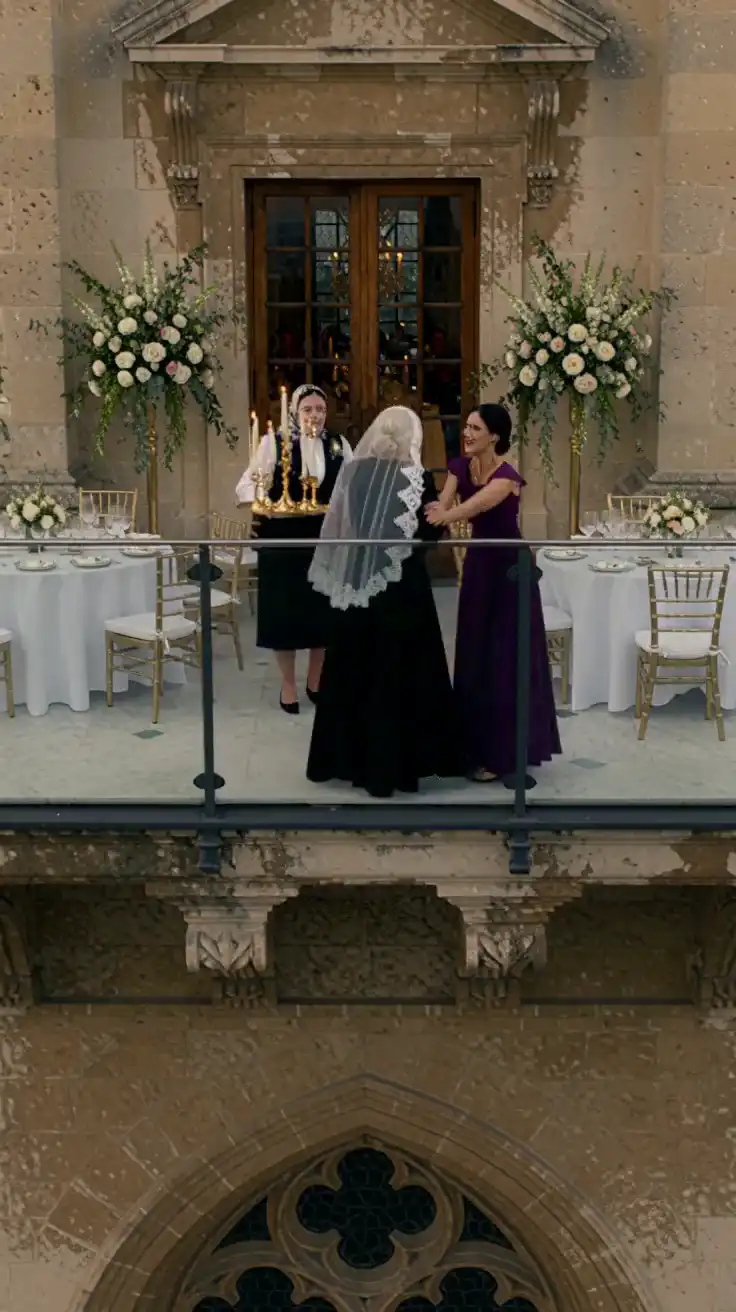
My son’s bride shoved me through the bell tower’s glass railing over my missing church donation, but the church guide caught my wrist just as my son rushed up to pull me back beside the restoration ledger.
Mira’s fingers dug into my wrist as my shoes scraped for a foothold. Glass crunched beneath Paul’s knees, and then his arms closed around me. He pulled until I was back on the terrace, my shoulder pressed against his wedding jacket.
“Say it again,” he said.
Vivian stood beside the broken railing, smoothing the front of her dress. “She leaned out. You didn’t see it.”
Paul kept one arm around me. With his free hand, he reached for Mira, the church guide, and helped her up from the floor. The restoration ledger she’d been carrying lay open beside her.
Mira picked it up and brushed a fleck of glass from the cover. “She asked me to bring this upstairs,” she told Paul. “Before Vivian came to get her.”
Vivian’s gaze dropped to the book. “This isn’t the time.”
Paul looked at her. “You brought my mother up here.”
“You were downstairs. I wanted a word with her.”
I caught Paul’s sleeve before he could step toward her. My hand left a gray mark on the white cuff. He looked down at it, then drew me farther from the railing and settled me on the stone bench by the door.
I had given the church money to repair the roof and the old windows. Last week, a receipt had arrived in my mailbox acknowledging my donation. When I checked my statements against the fund report, I couldn’t find a deposit to match it.
Mira had offered to fetch the ledger from the church office. She knew where the records were kept; she showed visitors the restoration plans every Sunday.
“There’s a gap in March,” she said now, holding the book against her skirt. “I found it when I brought the receipt to the office.”
Paul held out his hand. “Let me see.”
Vivian moved toward the door. “The flowers are being delivered. Someone needs to let them in.”
“Mira can call downstairs,” Paul said.
Mira took out her phone, then hesitated. “The office signed off on the monthly reports. If the receipt never matched a deposit, how did no one notice?”
Vivian reached for the ledger, but Paul drew it closer. A folded withdrawal slip protruded between its pages; he tucked it back before opening the cover.
He turned to March.
Across from him, Vivian’s hand began to tremble.
THE MARCH PAGE
Paul put his finger beneath the figures.
“Forty-eight thousand dollars,” he said. “That’s the March gap.”
Vivian’s hand closed around the edge of her skirt.
Paul unfolded the withdrawal slip. “And your signature is on this.”
He held it where Mira and I could see. The signature was Vivian’s, the same looping V she had put on the place cards downstairs. Above it was the name of an account I didn’t recognize: V. Hale Design.
“That’s my business account,” Vivian said. “I was moving the money temporarily.”
“From the church’s account?” Paul asked.
“It wasn’t supposed to stay there.”
Mira came closer to the bench. She kept her hands at her sides, as if she were afraid touching the paper might make it disappear.
Paul read the date on the slip. “March twenty-first.”
“That was months ago,” I said.
Vivian looked at me. “I meant to put it back.”
Paul turned the slip over. Nothing was written on the back. He returned it to the ledger and closed the book.
“Where is it now?”
Vivian’s eyes moved to the terrace door. “Some of it is in the business. I had bills.”
“Which bills?” he asked.
She didn’t answer.
Mira’s phone rang in her hand. She glanced at the screen. “It’s the office. I sent a message while you were looking at the page.”
“Who’s there?” Paul asked.
“Mrs. Alvarez. She handles the accounts.”
Vivian took a step toward Mira. “Don’t tell her anything until I’ve explained.”
Mira answered the phone. “Mrs. Alvarez, it’s Mira. We need you in the bell tower office. Please bring the March bank statement and anything you have for the restoration fund.”
A pause.
“Yes,” Mira said. “Now.”
Vivian pressed both palms against her dress. “You’re making this look like a crime.”
Paul set the ledger on the bench beside me. “You can explain the withdrawal to her.”
His voice had gone so level that I watched his face. He wasn’t looking at Vivian the way he had at the rehearsal dinner, when he had kept leaning close to hear her over the clatter of dishes. He was looking at the ledger.
“Mira,” he said, “can you get my mother inside?”
“I can walk,” I said.
He offered me his arm anyway. I took it, and Mira opened the terrace door. Vivian stayed where she was.
“Come downstairs,” Paul told her.
“I’m not leaving you alone with that book.”
“Then come downstairs.”
She followed us into the small room at the foot of the terrace steps. The church used it to store folded chairs and the old brass stands for the guide’s talks. Mira pulled a chair away from the wall for me. Paul brushed it with his hand before I sat, though there was nothing on it.
He placed the ledger on a narrow table and slid the withdrawal slip out again. This time he photographed both sides.
Vivian watched him. “You don’t need to do that.”
“I do.”
“Paul, listen to me. I was going to tell you after the wedding.”
“You had months.”
“I didn’t know how.”
“You knew how to sign this.”
Her mouth opened, then closed. She reached behind her neck and worked at the clasp of her veil. When she couldn’t undo it, she let it fall against her shoulders.
From downstairs came the muffled sound of a door closing. Mira moved to the landing and called, “Mrs. Alvarez?”
“Coming,” a woman answered.
I had met Elena Alvarez twice, once when I delivered my first donation and once at a meeting about the repairs. She was the church’s finance manager, a compact woman who carried her keys on a blue cord around her wrist. She came up the stairs with a folder tucked under one arm and stopped when she saw us gathered around the table.
“What happened?” she asked.
“Please look at this first,” Paul said.
He handed her the withdrawal slip.
Elena adjusted her glasses. Her gaze moved across the paper, then returned to Vivian.
“Where did you get this?”
“It was in the ledger,” Mira said.
Elena opened her folder and set a bank statement on the table. She ran a finger down the transactions until she reached March twenty-first.
“The transfer is here,” she said. “Forty-eight thousand.”
I leaned forward. “To her business?”
“The statement shows the last four digits of the receiving account. I’d need the bank’s transfer record to confirm the owner.”
“It’s mine,” Vivian said. “I just told them.”
Elena looked up. “Why?”
Vivian folded her arms. “I was reimbursing an advance.”
“What advance?”
“For the contractor. I covered costs when the church was waiting on donations.”
Elena put the withdrawal slip beside the statement. “The contractor was paid directly by the church. I have every invoice.”
“Not every invoice came through you.”
“Every invoice charged to this fund came through me.”
Vivian pointed at the ledger. “Then your records are wrong.”
“Possibly,” Elena said. “That’s why I’m asking you to show me the advance.”
Vivian did not move.
Paul pulled out the empty chair beside the table. “Sit down and explain it.”
“I don’t have my business records with me.”
“Who was the contractor?” Elena asked.
Vivian looked toward the door.
“Vivian,” Paul said.
“Dale Mercer.”
Elena shook her head. “He did the roof assessment. His invoice was for three thousand, eight hundred dollars, and the church paid him in February.”
“There was another bill.”
“For forty-eight thousand?”
“It was several bills.”
“From Dale Mercer?”
Vivian’s hands went to the veil again. This time she found the clasp, pulled it free, and placed the veil over the back of the empty chair.
“I need my phone,” she said.
Paul pointed to the small white bag hanging from her wrist. “You have it.”
“I need privacy.”
“No,” he said.
She stared at him. “You don’t get to tell me I can’t make a call.”
“You can make it here.”
For a moment I thought she might walk out. Instead, she took her phone from the bag and set it face down on the table.
Elena turned to me. “Mrs. Bennett, Mira said there was a receipt that didn’t match a deposit. Do you have it?”
I opened my purse. The envelope had bent at one corner when I gripped it on the terrace. I smoothed it against my knee and handed it to her.
Elena read the receipt, then pulled another sheet from her folder.
“This is our March deposit report,” she said. “Your donation is listed here as received on the fifteenth.”
“But there’s no deposit on my statement,” I said. “I wrote a check. It never cleared.”
Elena looked at me over her glasses. “You gave us a check?”
“I gave it to Vivian.”
The room went still.
Vivian’s gaze fixed on the floor. Paul turned to her.
“You told me Mother had donated electronically.”
“I was going to deposit the check for her,” Vivian said.
Elena held up the receipt. “This was issued after Vivian entered the gift in the donor system. She was authorized to help with acknowledgments for the restoration campaign.”
“Why?” Paul asked.
“She volunteered when our office assistant was out. She had experience with invoices and donor lists from her business. Father Thomas approved limited access.”
“Limited?” I asked.
“She could enter pledged gifts and prepare receipts. She was not supposed to certify that deposits had cleared.”
Vivian lifted her chin. “I didn’t certify anything.”
Elena turned the deposit report so she could see it. “Your initials are in the verification column.”
“That only means I entered it.”
“It means you verified it against the bank deposit.”
“I didn’t know that.”
“You were trained.”
Vivian picked up her phone, unlocked it, and began tapping. Paul watched her.
“Who are you calling?” he asked.
“My attorney.”
“Do that,” he said.
She looked at him as if she had expected an argument. Then she put the phone to her ear and walked to the far side of the room.
Elena kept her voice low. “Mrs. Bennett, when did you give her the check?”
“March twelfth. She came to my house with the plans for the stained-glass windows.”
Paul glanced at me. “Why didn’t you mail it?”
“Vivian offered to take it straight to the office. She said she’d be there the next morning.”
I looked at Vivian’s back. Her voice had dropped to a whisper.
“She brought me tea,” I said. “She had the drawings spread across my dining table. I asked whether the roof should come first, and she said the board had already set the order. I wrote the check while she was there.”
Elena made a note on the back of an envelope. “Was the check made payable to the church?”
“Yes.”
“Did you keep the stub?”
“I keep all of them.”
“Good. Don’t change anything on it.”
Vivian ended her call and turned around. “My attorney says I shouldn’t answer questions until she gets here.”
“That’s your choice,” Elena said. “I need to secure our records.”
She reached for the ledger, but Paul kept his hand on the cover.
“Will it be safe in the office?” he asked.
Elena met his eyes. “I’ll lock it in the cabinet. You can photograph the March pages before I take it.”
Mira fetched her phone. Together, she and Paul took pictures of the ledger, the receipt, the withdrawal slip, and the bank statement. Elena wrote down what each document was and who had handled it. She did not ask Vivian to help.
Vivian stood beside the chair with her veil draped over it.
“This is my wedding day,” she said.
Paul stopped taking pictures.
“I know,” he said.
“People are waiting downstairs.”
“There aren’t any guests here yet. We told them the doors would open at two.”
“The florist is coming. The musicians—”
“I’ll call them.”
She picked up the veil. “You’re not canceling because of a bookkeeping mistake.”
Paul set his phone down. “Forty-eight thousand dollars went into your account. My mother gave you a check that never reached the church. And you brought her up to that terrace.”
Vivian’s fingers tightened around the veil. “She leaned out.”
Mira looked directly at her. “You pushed her.”
Vivian turned. “You were behind us.”
“I saw your hands.”
“You saw me try to catch her.”
“No,” Mira said. “I saw you push.”
Vivian took one step toward her. Paul moved between them.
“Stay there,” he said.
“You believe her over me?”
“Mira caught my mother.”
“I could have been helping if you hadn’t rushed in.”
My mouth had gone dry. I put my hand on the ledger to steady it when Elena lifted the withdrawal slip.
“Vivian,” I said, “where is my check?”
She looked at me.
“I want to know what you did with it.”
“I don’t remember.”
“You remember taking it.”
“I took a lot of things to the office during the campaign.”
“You folded it into the blue folder with the window drawings.”
“I don’t remember,” she said again.
Paul held out my purse. “Mother, there’s water downstairs. Let’s get you away from this room.”
“I’m staying until Elena has what she needs.”
“I can bring the water up,” Mira said.
She slipped past Vivian and went down the stairs. Elena continued comparing the receipt with the report. Paul stood close enough that I could reach his hand, but he let me keep my chair by the table.
Vivian’s phone buzzed. She looked at the screen and answered.
“Yes,” she said. “I’m still here.”
She listened, then moved toward the landing.
Paul said, “Vivian.”
“My attorney wants to speak to you.”
He held out his hand. Vivian passed him the phone.
“This is Paul Bennett,” he said.
He listened without interrupting. Then he said, “The wedding is canceled.”
Vivian grabbed the back of the chair. “Paul.”
He raised one finger, not looking at her. “Your client can wait here for you, or she can leave. The church will be contacting the police.”
Elena looked up. “I already have.”
Vivian’s face changed. “You had no right.”
“I’m responsible for the accounts,” Elena said. “A transfer from the restoration fund has gone to your business, and you haven’t produced an invoice or authorization for it. I called while I was downstairs.”
Paul returned Vivian’s phone.
She put it to her ear. “They called the police.”
She listened again. Her hand stopped shaking long enough for her to tuck a strand of hair behind her ear.
“All right,” she said. “I’ll wait.”
When she ended the call, she put her phone in her bag.
“Are you satisfied?” she asked me.
“No,” I said. “I still don’t know where my check is.”
Mira returned with a bottle of water and a paper cup. She poured some into the cup and handed it to me.
“Father Thomas is downstairs,” she said. “He’s closing the tower stairs to visitors.”
“There won’t be visitors,” Paul said. “I’m canceling the ceremony.”
Mira nodded. She looked at Vivian, then at the veil over her arm.
“I’ll tell him.”
Vivian followed her to the landing. “Wait. Father Thomas should hear from me.”
“He can come up,” Mira said. “I’m not bringing anyone else into this room.”
Vivian’s cheeks flushed. “You think I’m going to run?”
Mira did not answer. She went down the stairs, and Vivian returned to the chair.
Elena spread the March statement flat. “I want to understand the entry. Mrs. Bennett’s check was for how much?”
“Forty-eight thousand.”
She looked at the withdrawal slip. “The same amount.”
Vivian stared at the wall.
Elena turned to the ledger. “The donation was recorded as a March deposit. It never arrived at the bank. Then forty-eight thousand was transferred out of the fund.”
Paul looked from one page to the other. “So the report showed Mother’s donation in the balance, and the transfer brought the balance back down.”
“Yes. The recorded balance looked like it should have before her donation.”
“Even though the bank never got the check,” I said.
Elena nodded slowly. “There should have been a reconciliation showing the difference between the ledger and the bank. I signed the monthly report because the summary said the accounts matched.”
Paul’s jaw tightened. “Did you compare them?”
“I compared the summary totals. I did not check every supporting entry myself. Vivian prepared the reconciliation while our assistant was away.”
Vivian gave a short laugh. “You signed it.”
“I did,” Elena said. “I should have checked the deposit against the statement. I didn’t.”
She said it without looking away from me.
“I’m sorry, Mrs. Bennett. We relied on the verification column and the reconciliation Vivian prepared. The bank statement was in the file, but I accepted the figures she gave me.”
I turned the paper cup between my hands. “When I called last week, why didn’t anyone find it then?”
“Your first message went to the general office. It was forwarded to Vivian because she had handled the donation. She told the office she would call you.”
Vivian said, “I did call.”
“You told me the check was being processed,” I said.
“It was an old check. I thought the bank might have held it.”
“For three months?”
“I didn’t know.”
Elena opened another folder. “Your second message came to me yesterday afternoon. I asked for the March file, but the cabinet was locked. Vivian had the key because she was finishing donor acknowledgments.”
“I returned it,” Vivian said.
“This morning,” Elena replied. “Mira brought the ledger up before I got here.”
Paul looked at Mira, who had returned to the doorway with Father Thomas behind her.
“I found the key on the office desk,” Mira said. “Mrs. Bennett had asked me to bring the book to her before the ceremony.”
Father Thomas took in the papers and Vivian’s veil. “Elena told me there was a problem with the fund.”
“There is,” Elena said. “We need the police and the bank to review the records.”
He looked at Paul. “And the wedding?”
“Canceled,” Paul said.
Vivian swung toward him. “You’re telling him before you’ve even spoken to me privately?”
“I’ve spoken to you.”
“You’re throwing everything away over numbers you don’t understand.”
Paul picked up the withdrawal slip. “I understand your signature.”
“You know what my business was going through. You know I was waiting on payments.”
“You told me your clients were late. You didn’t tell me you took church money.”
“I borrowed it.”
“From whom?”
Her voice rose. “I was going to replace it.”
“Who agreed to lend it to you?”
She looked at Father Thomas. “I’ve worked for this church for months.”
“That isn’t an answer,” he said.
“I arranged the fundraiser. I dealt with the printers. I made the donor packets. I gave up paying work to do it.”
“And you were thanked for that,” Father Thomas said. “You were not authorized to take money from the fund.”
Vivian shook her head. “You all benefited.”
Mira stepped aside as footsteps sounded below. A man’s voice called up, and Father Thomas went to the stairs.
“Officer, up here,” he said.
Two officers entered the room. One remained by the doorway while the other introduced herself as Officer Reed. She asked whether anyone needed medical assistance.
“No,” I said. “I want to sit here.”
She looked at the broken glass visible beyond the terrace door, then at Paul and Mira.
“I’ll need to speak with each of you separately,” she said. “First, is everyone safe where they are?”
Paul answered before anyone else. “Yes.”
Vivian picked up her bag. “My attorney is on her way.”
Officer Reed nodded. “You can wait for her.”
Elena gathered the documents into separate folders under the officer’s direction. Paul showed Officer Reed the photographs on his phone. She asked him not to delete or alter them and wrote down his number.
Mira gave her name and explained that she worked as a guide. Officer Reed asked her to wait downstairs with Father Thomas until it was her turn.
Before she left, Mira came over to me.
“Do you want me nearby?” she asked.
“Yes, please.”
“I’ll be at the bottom of the stairs.”
She touched the back of my chair, then followed Father Thomas out.
Officer Reed pulled another chair close to mine. “Mrs. Bennett, can you tell me about the donation first?”
I described the check and the blue folder. She asked for the date, the amount, the bank, and the name I had written on the payee line. I told her I had the checkbook at home and could provide the number.
“Did anyone else see you hand the check to Ms. Hale?” she asked.
“No. It was just the two of us in my dining room.”
“Did she give you a receipt then?”
“No. It came in the mail later.”
“Was the envelope from the church?”
“Yes.”
Elena spoke from the table. “We use the church’s postage machine for donor mail. I can provide the mailing log.”
Officer Reed wrote that down.
Then she asked me about the terrace.
I looked at Paul. He had moved to the doorway, leaving space for the officer, but his eyes were on me.
“I can answer,” I told him.
He nodded.
Officer Reed waited while I took a drink of water. I told her what I had said to Vivian and what Vivian had said to me. When I reached the moment at the railing, my hand closed around the paper cup hard enough to bend it.
“Take your time,” the officer said.
I set the cup down.
“I did not lean out,” I said. “She put both hands on me and pushed.”
Officer Reed asked where Vivian’s hands had been. I showed her against my own shoulders. She asked where Mira was standing and where Paul had come from. I answered as clearly as I could.
“Did Ms. Hale say anything afterward?”
“She said I leaned out.”
“Did you hear her say that?”
“Yes.”
She wrote for another minute, then looked up. “We’ll document both the financial matter and what happened on the terrace. An investigator will follow up with you about the records.”
Paul stepped closer. “Can she leave with me when you’re finished?”
“Yes. We may need a formal statement later, but she can go home.”
Vivian’s attorney arrived while Officer Reed was speaking with Elena. I heard her introduce herself at the landing. Vivian went out to meet her, and they stood where I could see them but not hear their conversation.
Paul came back to my chair.
“I’m going to call the florist,” he said. “Then the musicians. Can I use the office downstairs?”
I nodded.
He crouched beside me. “I’m not leaving the building.”
“I know.”
He picked up his phone and paused.
“Mother, did she say anything to you about the money before she brought you upstairs?”
“She said she could explain the receipt where we wouldn’t be interrupted.”
His face tightened. “Why didn’t you tell me you were meeting her?”
“I thought I was meeting my future daughter-in-law for a difficult conversation. I didn’t know I needed an escort.”
He lowered his head. “I should have listened when you said the deposit was missing.”
“You told me to ask Elena.”
“I also told you Vivian would sort it out.”
“You believed her.”
“I did.”
He rested his hand briefly on mine. “I’m sorry.”
“Call the florist,” I said. “They’ll be loading the flowers.”
He stood and went downstairs.
Elena finished with Officer Reed and sat in the chair Paul had vacated. She removed her glasses and cleaned them with the edge of her sleeve.
“I should have caught it in March,” she said.
“You didn’t know she would take money.”
“I knew she had access to records I was responsible for. That was enough reason to check.”
She put her glasses back on. “The transfer required two approvals. Vivian had temporary access to prepare payments, but the bank normally required my approval as well.”
“How did it go through?”
“I don’t know yet. The slip has a second authorization code on it, but not my signature. The bank can tell us which credentials were used.”
“Could someone have used yours?”
“I’m going to change every credential as soon as I’m back at my desk. The bank has already frozen outgoing transfers from the fund.”
Vivian returned with her attorney, a woman in a navy suit carrying a slim leather folder. The attorney spoke to Officer Reed, then to Vivian. Neither came near our table.
Elena stood. “I should give the officer the account information directly.”
She took her folder to the other side of the room.
I could hear Paul downstairs, speaking into his phone.
“Yes, every arrangement,” he said. “Please don’t bring them. Send the bill to me.”
A pause.
“No, nobody else needs to call you. I’m the groom.”
He made the next call from the same spot. I heard him tell the musician not to unload the instrument. Then he called someone about the reception and asked what food could still be stopped.
Vivian heard him too. She walked to the landing, but her attorney touched her arm and brought her back.
Officer Reed spoke to her attorney for several minutes. Vivian answered a few questions about her name and address. When the officer asked about the transfer, the attorney said Vivian would respond through counsel.
The second officer went onto the terrace, keeping well away from the broken section. She took photographs and spoke into a small recorder. No one else went outside.
When Paul came back upstairs, he had taken off his jacket. His white shirt was creased at the shoulder where I had held it.
“The florist and musicians won’t come,” he said. “The reception manager is calling the caterer.”
“What about the guests?” I asked.
“I’m going to send a message now.”
Vivian’s attorney said something to her. Vivian shook her head and crossed to Paul.
“Let me see it before you send it.”
“No.”
“They’re my guests too.”
“You can contact them yourself.”
He typed, stopped, and showed the screen to me instead.
The ceremony and reception are canceled. Please do not come to the church. I’m sorry for the short notice.
I read it twice. “That’s enough.”
Vivian leaned in. “You’re making it sound like I left you at the altar.”
Paul turned the phone away. “I’m not explaining the fund to everyone in a group message.”
“Then don’t send anything yet.”
“The first guests will leave their houses soon.”
“I can fix this.”
“How?”
“Let me talk to Elena. Let me get my records.”
“You can give them to the investigator.”
“I’m asking you, Paul.”
He pressed the screen. His phone made a soft sound as the message went out.
Vivian reached for his arm. He stepped back before she touched him.
“I am not marrying you today,” he said.
Her attorney came over. “Vivian, we should let the officers finish.”
Vivian looked at me. “You wanted this.”
“I wanted the church to receive my donation.”
“You never liked me.”
“That isn’t true.”
“You checked your bank account because you didn’t trust me.”
“I checked it because the check hadn’t cleared.”
“You could have asked me.”
“I did.”
“You asked like you’d already decided I stole it.”
I remembered calling her from my kitchen, my bank statement open beside the telephone. She had said she would look into it, then asked whether I had considered donating the old silver candlesticks as well.
“I asked you where the check was,” I said. “You told me it was being processed.”
Vivian opened her mouth, but her attorney put a hand lightly against her elbow.
“We’re leaving that discussion for another time,” the attorney said.
Officer Reed returned from the terrace. She told Vivian that she and her attorney could leave after providing contact information. She also told Elena that an investigator would contact the church about the financial records.
“Will you be filing a report?” I asked.
“Yes, ma’am. We’re opening a case. You’ll receive the report number before we leave.”
Paul took a breath beside me. Vivian looked from him to the officer.
“You can’t seriously be treating this as an attack,” she said.
“Your attorney can discuss the investigation with us,” Officer Reed replied.
Vivian’s attorney guided her toward the stairs. At the landing, Vivian stopped and turned back to Paul.
“My dress is in the bridal room,” she said. “I have things there.”
“I’ll have Father Thomas arrange a time for you to collect them,” Paul said.
“I want them now.”
Father Thomas came up behind her. “The room will be locked. Your attorney can call me, and we’ll make sure your belongings are returned.”
Vivian looked as though she might argue with him too. Then she took the veil from the chair and followed her attorney down the stairs.
No one spoke until the outer door closed.
Paul sat in the chair she had left. He stared at the place where the veil had been.
Mira appeared at the landing. “She’s gone,” she said.
I held out my hand, and she came to me. Her fingers were warm around mine.
“Thank you,” I said.
She shook her head once. “I’m glad I was there.”
“I am too.”
She crouched beside my chair. “Father Thomas has locked the tower entrance. You won’t have to come this way again today.”
“I’d like to go home,” I said.
Paul stood at once. “I’ll get the car.”
“I can bring it around,” Mira said. “You stay with her.”
He gave her the keys. She took them downstairs while he helped me to my feet.
Elena gathered the papers into her folder. “Mrs. Bennett, I’ll call you as soon as I hear from the bank.”
“Call me too,” Paul said.
“I will. And I’ll send both of you copies of the March reconciliation and the report I signed.”
I looked at her. “I don’t want another donation to disappear because everyone assumes someone else checked.”
“It won’t be handled the same way again,” she said. “I’m removing Vivian’s access today. After that, the finance committee will review every deposit and transfer since she started helping.”
Officer Reed handed me a card with the case number written on the back. I tucked it into my purse beside the bent envelope.
Paul walked me downstairs. At the bottom, Father Thomas held the door open. The church was quiet; the florist had not arrived, and the sanctuary doors were shut.
“I’m sorry about today,” he said.
Paul looked toward the sanctuary. “Please don’t apologize for canceling it.”
“I wasn’t.”
Father Thomas put his hand on the doorframe. “I should have asked how much access Vivian had. Elena will have whatever support she needs to review it.”
Outside, Mira pulled the car to the curb. Paul opened the passenger door for me. Before I got in, I turned back to her.
“Will you let me take you to lunch when this is settled?”
She gave me a small smile. “Only if you let me choose somewhere without stairs.”
“Agreed.”
Paul drove me home. At the first red light, he reached across and turned down the radio, though no music was playing. At the second, he took off his tie and laid it on the seat between us.
“Do you want me to call anyone?” he asked.
“Not yet.”
He nodded.
At my house, he followed me to the dining room, where the checkbook was still in the drawer of the sideboard. I brought it to the table and found the March stub.
There, in my handwriting, were the date, the church’s name, and the amount.
Paul photographed it for me. Then he opened his laptop.
“What are you doing?” I asked.
“Checking whether the check cleared under a different number or date.”
“I’ve already looked.”
“I know. I’d like to look with you.”
I sat beside him and logged into my account. We searched every check from March through the current month. The number on the stub did not appear.
Paul wrote it down on a pad. “We should ask the bank to stop payment.”
“It may be too old to cash.”
“Let’s ask anyway.”
We called together. The bank employee confirmed that the check had not been presented and placed a stop payment on it. She explained the fee. I agreed, and Paul wrote the confirmation number beneath the check number.
When the call ended, he closed the laptop but did not move it away.
“Do you have the envelope the receipt came in?” he asked.
“In the kitchen drawer.”
We found it beneath a stack of coupons. I had nearly thrown it out. Paul slipped the envelope and receipt into a clean folder without folding them again.
My phone began to ring. His message had reached the family.
The first call was from his aunt, who wanted to know whether she should still wear the blue dress. Paul took the phone from me.
“No wedding,” he said. “Please don’t come to the church.”
He listened.
“Mother is home with me. We’re all right. I’ll call you tomorrow.”
He ended that call and silenced the phone.
“You don’t have to protect me from my sister,” I said.
“I’m protecting both of us from explaining it ten times.”
He put the phone on the sideboard. Mine rang again a minute later, but I let it ring.
Paul opened the refrigerator and looked inside.
“Do you want something to eat?”
“No.”
“I’m making toast.”
“You can make toast for yourself.”
“I’m making two pieces.”
He found the bread, set the toaster, and stood waiting with his hands on the counter. I watched him from the dining room. He had been dressed that morning to promise his life to Vivian. Now he was searching my cabinets for a plate.
When the toast popped up, he brought both pieces to the table. He put butter on mine the way I liked it, all the way to the corners, and set it beside the folder of papers.
“Move those first,” I said.
He lifted the folder away from the plate.
I ate half a piece. He ate his standing up.
Elena called that evening. Paul put her on speaker so I could hear.
“The bank confirmed the transfer went to Vivian’s business account,” she said. “The authorization was submitted using a code assigned to the church’s former treasurer. It should have been deactivated when he left.”
“Was Vivian given that code?” Paul asked.
“We don’t know. The bank has the request to preserve the records. I’ve given the information to the investigator.”
“Could she have found it in the office?” I asked.
“Possibly. There was an old instruction sheet in the payment file. It should not have been there.”
Paul looked at me. “And the check?”
“We haven’t found it in any church file. Vivian’s attorney has been asked whether she still has it.”
Elena paused. “I also checked the deposit report against the bank statement for February through June. So far, your receipt is the only one without a matching deposit. We’ll keep checking.”
“Thank you,” I said.
“I owe you more than that.”
“You owe the church a careful review.”
“Yes,” she said. “I do.”
After the call, Paul pulled a chair beside mine.
“Vivian told me she was covering expenses for the wedding until her clients paid,” he said. “I offered to help. She said she didn’t want my money.”
“Did you give her any?”
“I paid the deposits we agreed on. The reception, the musicians, some of the flowers. Nothing to her business.”
He rubbed a thumb along the edge of the table.
“She talked about a supplier who was threatening to stop work. She said a client had held back a payment. I thought she was handling it.”
“You couldn’t know she had taken it from the church.”
“I knew she was in trouble.”
“That isn’t the same thing.”
He looked at the folder. “She brought you up there because you were getting close to finding out.”
I did not answer. He didn’t need me to put it into words again.
That night he slept in my guest room. In the morning, I found him at the dining table with a legal pad, writing down the names of everyone who had been told about the ceremony.
“I sent one message,” he said, “but I don’t want Aunt Diane calling people with her own version.”
“What version is that?”
“She asked whether you and Vivian had fought over the seating chart.”
I pulled out the chair across from him. “What did you tell her?”
“That the wedding was canceled and you were home. I didn’t discuss anything else.”
“Good.”
He turned the pad toward me. “Some people will have heard something by now. Father Thomas said the florist called the church after I canceled.”
“I don’t want a family meeting.”
“Neither do I. But I’m going to call the people who need a direct answer.”
“Tell them the wedding is canceled. You don’t have to defend it.”
He drew a line through the first name after making the call. Then he made another. He did not mention the terrace or the ledger. When someone pressed, he said, “There’s a police investigation, and I’m not discussing it.”
At noon, an investigator named Collins called. He asked whether he could come by that afternoon to collect copies of my bank statement, the check stub, and the receipt.
Paul looked at me. I nodded.
“Three o’clock is fine,” I said.
Before the investigator arrived, I put the documents on the dining table. Paul brought out the blue folder Vivian had left at my house in March. The restoration drawings were still inside.
“Do you remember whether she took the check out of the folder before she left?” he asked.
“No. She closed it with the check inside. Then she carried it to the front hall.”
“Was the folder here afterward?”
“She returned it the following week. She said the church had made copies of the drawings.”
Paul opened it. There was a pocket on each side, both empty.
Investigator Collins arrived with a notebook and a flat envelope for documents. He asked to see the folder and checked the pockets himself.
“Do you mind if I take it?” he asked.
“It belongs to me,” I said, “but you may take it.”
He labeled it and gave me a receipt. He also photographed the check stub and bank statement. I handed over the original donation receipt and envelope.
He asked me to describe my conversations with Vivian from March onward. I told him about the afternoon at my table, the receipt in the mail, and the call I made after checking my statement.
“Did she ever ask you to write a replacement check?” he asked.
“No.”
“Did she ask you not to contact the church directly?”
“She said she would take care of it. When I told her I had left a message at the office, she said Elena was busy with the wedding preparations.”
“Was Elena involved in the wedding preparations?”
“She was arranging access to the church for the vendors. I assumed that was what Vivian meant.”
Collins wrote it down.
Paul asked, “Has Vivian given you the check?”
“Her attorney says she doesn’t have it. We’re requesting records from the bank and her business. I can’t tell you more until we’ve reviewed them.”
“Can she move what’s left of the money?” I asked.
“We’ve notified the relevant bank about the investigation. The prosecutor can seek orders concerning the accounts. I don’t want to promise a recovery before we know what’s there.”
I appreciated that he did not promise. Paul had spent the morning trying to reach every person who might be heading toward a wedding that no longer existed. I did not want another assurance someone would later have to retract.
Before he left, Collins asked me to read the statement he had typed from our conversation. I corrected the date of Vivian’s second visit and added that the check had been made payable to the church. He printed the revised page from a small portable printer and gave me time to read it again.
Paul stayed at the other end of the table. He did not answer for me.
When Collins left, my son carried the dishes from lunch to the sink. I heard water running, then the clink of a plate against the faucet.
“You don’t have to wash those,” I said.
“I know.”
He kept washing.
A week later, Elena asked me to come to the church office. She had invited Paul and Father Thomas too. Mira met us at the side entrance and took us to the finance room, a small office with a metal cabinet and a window facing the garden.
Elena had set out four folders.
“The committee met last night,” she said. “I want you to see what we found and what we’re changing.”
She handed me a copy of the March reconciliation. Vivian’s initials appeared beside the line saying the donor deposit had been verified. At the bottom was Elena’s signature.
“I should have compared this to the statement,” Elena said. “The report included your donation as if it had been deposited. Vivian then recorded the transfer as a project disbursement. The ending balance matched the bank because the two entries were for the same amount.”
Paul read over my shoulder. “So the missing deposit hid the withdrawal.”
“It hid the discrepancy in the total. The underlying entries would have exposed it if I had checked them. I didn’t.”
Father Thomas sat across from us with his hands folded. “The finance committee has instructed that no one preparing a reconciliation can approve it. Elena will review the bank statement with a second committee member each month.”
Elena opened the next folder. “All old bank credentials have been revoked. Payments now require two current authorizations through the bank, not a code kept in a file. Donor receipts won’t say a gift has been received until the deposit clears.”
Mira pointed to a sample receipt. “What happens if someone gives us a check at an event?”
“We’ll issue an acknowledgment that we have the check, then a separate receipt after deposit. Two people will log it, and neither will take it home.”
I looked at the sample. “And donors can ask Elena directly?”
“My number is on the bottom,” Elena said.
She slid the last folder toward me. Inside was a list of the other March donations, each matched to a deposit.
“We checked every receipt in that period,” she said. “We haven’t found another missing check.”
“What about the money Vivian transferred?” Paul asked.
“The investigator has traced it into her business account. Some went to business expenses and some to her personal account. We’re waiting for the full bank records.”
“Did any go to the restoration?” I asked.
Elena shook her head. “Not that we’ve found.”
Father Thomas looked down at the plans on his desk. “The window contractor has agreed to postpone the next phase while we sort out the funding. The roof work already completed is paid for.”
“Will postponing the windows cause a problem?” I asked.
“We can secure the existing panes for now. The contractor came yesterday and gave us a price for temporary protection.”
He showed me the estimate. It was modest compared with the restoration, but it would come out of the remaining fund.
Paul leaned back. “What happens to the projects Vivian handled?”
“Her access has been removed,” Father Thomas said. “The committee is reviewing her work. She won’t handle church records again.”
Mira brought a pot of coffee from the shelf. “Mrs. Bennett, would you like some?”
“Yes, please.”
She poured a cup and handed it to me. I set it beside the sample receipt.
“I’d like a copy of these procedures,” I said.
Elena gave me one. “I hoped you would ask.”
Paul turned to Father Thomas. “Has Vivian contacted the church?”
“Through her attorney. She requested her belongings from the bridal room. We packed them with an inventory and arranged for the attorney to collect them.”
“My mother’s check?”
“Not among them,” Elena said.
I folded the procedures and put them in my purse. The paper was crisp, unlike the bent envelope Officer Collins had taken.
As we stood to leave, Mira touched my arm.
“Lunch?” she asked.
I looked at Paul.
He raised his hands. “I’m not inviting myself.”
“You could,” I said.
Mira smiled. “The place I chose has three steps.”
“You promised no stairs.”
“Three is hardly a staircase.”
Paul opened the office door. “I’ll inspect them first.”
We went together. Mira told us about a visitor who had once asked whether the church’s stone walls were original or merely painted to look old. Paul laughed, and then looked at me as if checking whether he was permitted to. I passed him the bread basket.
Two months later, Investigator Collins called while Paul was at my house repairing a loose kitchen drawer. I put the call on speaker and laid the phone on the counter.
“We’ve reviewed the business records,” Collins said. “The forty-eight thousand went into Vivian Hale’s business account. From there, she paid twenty thousand toward overdue supplier invoices and eight thousand toward a business loan. Four thousand went to her personal account and was used for rent and other expenses.”
“That leaves sixteen thousand,” Paul said.
“Sixteen remained in the business account when the bank acted. We also located eight thousand transferred from her personal savings after her attorney contacted us. The prosecutor’s office has arranged for those funds to be held for restitution.”
“Twenty-four thousand,” I said.
“Yes. Half the amount transferred from the church.”
“And my check?”
“We haven’t recovered it. It was never deposited. With the stop payment in place, it can’t be used.”
Paul set down the screwdriver. “What happens now?”
“The prosecutor has filed charges against Ms. Hale related to the transfer and the incident at the church. Her attorney has been notified. The court will address restitution as the case proceeds.”
He gave us the case number and the name of the prosecutor’s office contact. Paul wrote them on the back of an envelope.
After the call, he pushed the drawer closed. It slid smoothly for the first time in months.
“She put some of it back,” I said.
“She put back what she could after they found it.”
“Or what she thought might help her.”
Paul picked up the screwdriver again. “Either way, it belongs to the church.”
Elena called the next day to confirm that the church would receive the recovered funds through the restitution process. She did not put the amount back into the restoration account until the money was actually released.
“We’re not counting a promise as a deposit,” she said.
I looked at the sample receipt pinned beside my desk. “That sounds familiar.”
“You made me repeat it at the committee meeting.”
“I did.”
“And I’m glad you did.”
The case moved slowly. I met with the prosecutor and gave another statement. Mira did the same. Paul brought his photographs of the ledger and the withdrawal slip. Elena delivered certified bank records and the church’s copies of the monthly reports.
Vivian’s attorney requested copies through the court. Vivian did not contact me directly.
One afternoon, Paul came over carrying a small box. He placed it on the dining table.
“Her engagement ring,” he said. “Her attorney returned it.”
I did not open the box.
“What will you do with it?”
“Give it back to the jeweler, if they’ll take it. If they won’t, I’ll put it away until I decide.”
He moved the box to the sideboard.
“I went to the apartment today,” he said. “Her things are gone.”
“Did you go alone?”
“Her attorney arranged a time. My friend David came with me.”
“What did you need?”
“My clothes. My laptop. The photographs from my desk.”
He sat down. “I found the list we made for the first anniversary trip.”
I waited.
“It was taped inside a cabinet. She wanted to go to the coast. I wanted the mountains. We wrote down both and said we’d decide later.”
“Did you bring it?”
“No. I left it in the recycling.”
He looked at the ring box.
“I keep thinking about the version of her who sat at this table and asked for your soup recipe.”
“I remember her too.”
“She made me believe she wanted to be part of this family.”
“She may have wanted that.”
He looked at me sharply. “After what she did?”
“I don’t know what she wanted, Paul. I know what she did.”
He sat with that for a while. Then he reached for the box and put it in his coat pocket.
The restitution payment reached the church near the end of summer. Elena called me from her office.
“The bank confirmed the deposit this morning,” she said. “Twenty-four thousand dollars.”
“Have you checked it yourself?”
“Twice. A committee member checked it with me.”
“Then I’ll come in.”
I took my checkbook and the folder of new procedures. Paul drove me, though I told him I could manage. He said he wanted to see Elena’s face when I made her follow every line of the new process.
At the office, Elena had the deposit confirmation on her desk. She showed it to us before I sat down.
“Restitution,” she said, pointing to the entry. “It’s in the restoration fund.”
I took out my checkbook.
Paul looked at me. “Mother.”
“I told you I intended to give forty-eight thousand.”
“You don’t have to make up what she took.”
“The church has recovered half. I’m giving the other half.”
Elena set down her pen. “Please don’t feel responsible for replacing it.”
“I don’t. I’m choosing to finish the gift.”
I wrote a check for twenty-four thousand dollars, made payable to the church, and tore it carefully along the perforation. This time I handed it to Elena across her desk.
She called the committee treasurer into the office. He checked the amount and entered the check in the log while Elena watched. Both signed beside the entry.
Elena gave me an acknowledgment.
“This confirms we have the check,” she said. “The receipt comes after it clears.”
“I know,” I said.
She placed the check in a deposit envelope. The treasurer sealed it, wrote the date across the flap, and put it in the locked bank bag.
Paul watched the whole procedure.
“That’s a lot of signatures,” he said.
“Would you prefer fewer?” Elena asked.
“Not today.”
Father Thomas joined us with the revised restoration schedule. The recovered funds and my new check would allow the window work to proceed after the temporary protection was removed.
“We can start in October,” he said. “The contractor has a crew available.”
I read the schedule. “Will the roof be checked before they bring the scaffolding in?”
“Yes. That’s the first line.”
“It wasn’t the first line last time.”
“It is now.”
He left the schedule with me and went to speak with the contractor on the phone.
Paul followed me into the garden while Elena prepared the bank deposit. The path was narrow, and he walked beside me rather than ahead.
“You could have kept the money,” he said.
“I could have.”
“You didn’t owe it.”
“I know.”
He stopped near the bench beneath the kitchen window.
“Does it feel finished to you?”
“The donation will feel finished when the check clears.”
He smiled a little. “Elena has converted you.”
“I was always in favor of receipts.”
“That’s not what I meant.”
I sat on the bench. He sat beside me.
“Vivian has been charged,” I said. “The court will decide the rest. The church has half the money back, and the windows can be repaired. I can’t make any of that happen faster.”
“I know.”
“You can stop checking whether I’m afraid to come here.”
“I wasn’t checking.”
“You’ve asked me three times this morning whether I wanted to wait in the car.”
He looked down at his hands. “All right. I was checking.”
“I wanted to come inside.”
“I saw that.”
“And I wanted you with me.”
He turned toward me. “You have me.”
“I know.”
Elena came out with the bank bag tucked under her arm. The treasurer walked beside her.
“We’re taking this straight to the bank,” she said. “I’ll call when it’s deposited.”
“I’ll check my account in a few days,” I said.
“I hope you will.”
The treasurer opened the gate for her. They left together, the bag between them.
Mira arrived at the garden door carrying a stack of new visitor brochures. She set them on the bench beside me.
“The printer finally corrected the restoration date,” she said. “Would you like one?”
I took a brochure. Inside was a drawing of the windows and a note explaining how donations were recorded. Elena’s office number appeared at the bottom.
Paul read it over my shoulder.
“Three steps,” he said to Mira.
She looked at him. “What?”
“You promised Mother lunch without stairs. You owe her another one.”
“I thought we settled that.”
“You said three hardly counted.”
Mira considered. “There’s a new place on Main Street with a ramp.”
I closed the brochure. “Then we’d better try it.”
A few days later, Elena called to say my check had cleared. The following morning, the receipt arrived in the mail. I compared it with my bank statement, then put both in the folder with the restoration schedule.
When Paul came by that afternoon, I showed him the cleared transaction.
He read the amount and handed the statement back.
“Forty-eight thousand,” he said. “Half recovered, half from you.”
“And all of it where it belongs.”
I put the folder away. Outside, Paul’s car waited at the curb. Mira had already called twice to make sure we would not be late for lunch.
I picked up my purse, and Paul held the door while I went through.