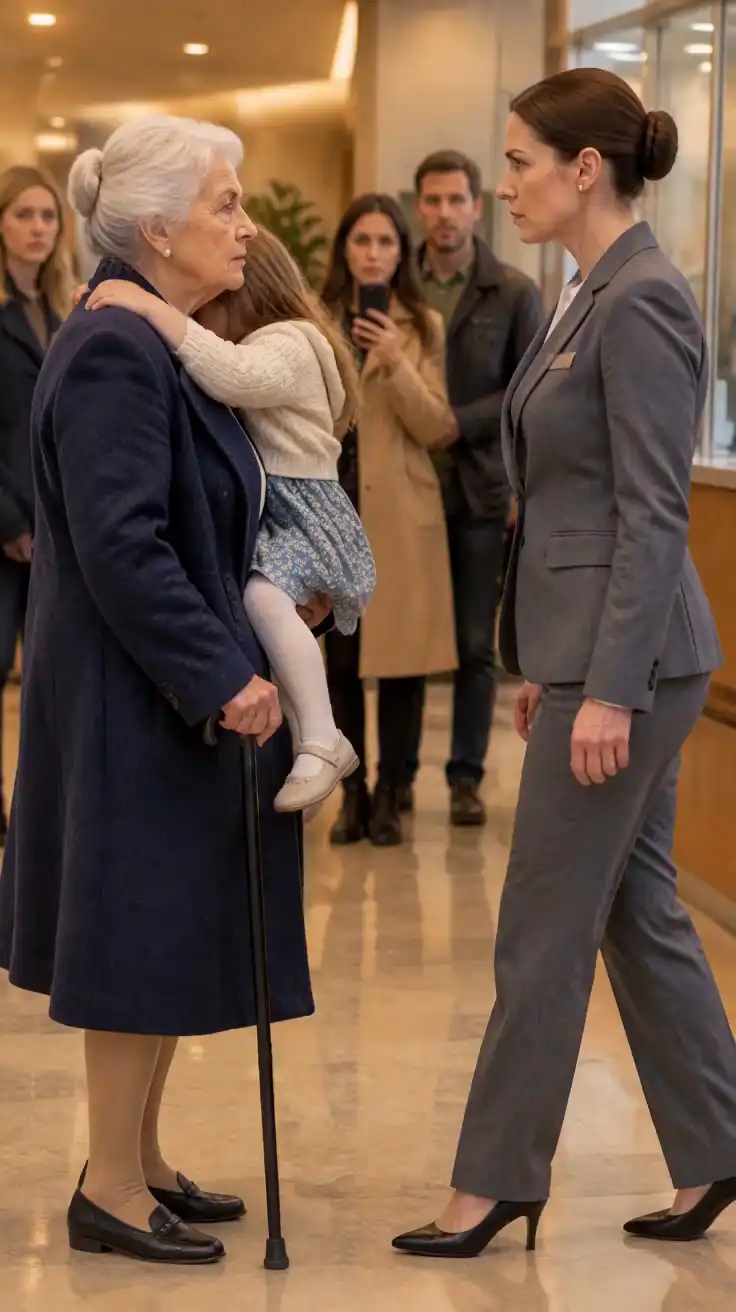
A young man mocked the night-shift cleaner whose son was away at college, right before the student in the back row stood up and walked up the aisle.
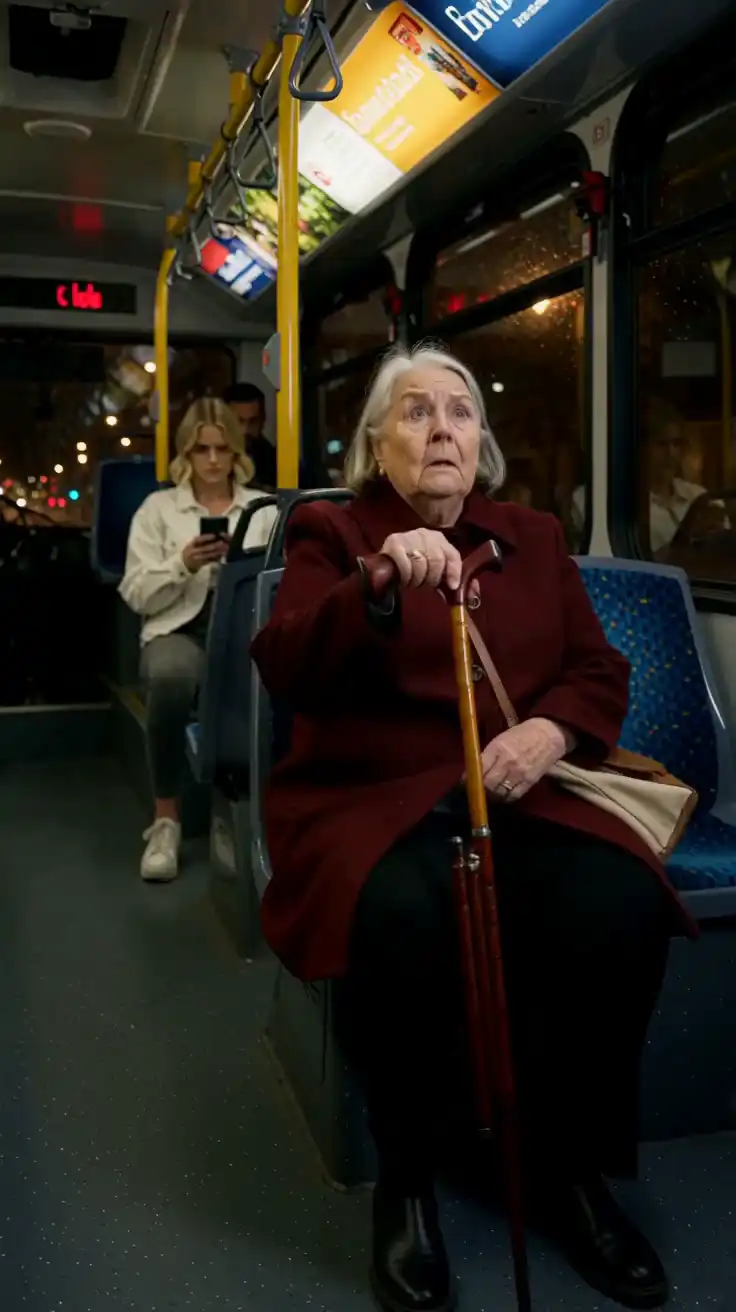
The bus lurched, and the cleaner’s palm slid against the cold seat back. Her cane lay near the door. A few rows ahead, the young man who had kicked it was still laughing, one polished shoe angled into the aisle.
She had just finished another night cleaning the mall. Her work bag rested against her leg, its strap biting through her coat. The cleaning shift log inside was folded around a tuition receipt she had carried for two years. She reached down for the cane, but the bus rocked again, and she caught the seat instead.
Behind her, a young woman lowered her phone. She stood and walked up the aisle without saying a word. The laughter broke off. The young man’s mouth stayed open for a moment; then his face changed as she came closer.
The cleaner watched the girl pass her. She did not know her name. She did not know why she had stood up. The bus kept rattling through the dark, with passengers looking over seat backs and the young man drawing his shoe out of the aisle.
The girl picked up the cane and placed it within the cleaner’s reach. When she lifted the work bag to make room, a paper slipped from its outer pocket and landed near the young man’s shoe.
He bent to retrieve it. The cleaner saw the university seal before he turned the page. Two years of payments were listed beneath it. Her shift log, creased from being carried night after night, lay open beside the receipt.
The young man held the paper by its edge. His eyes moved down the page and stopped at the student number.
The girl stood beside the cleaner, waiting. The young man looked from the number to the cleaner’s face, then back at the receipt. His fingers tightened on the paper.
He lifted his eyes toward her, the question already forming: did he know who had been paying his tuition?
THE RECEIPT UNDER HIS SHOE
His fingers tightened on the paper. “Why are you paying my tuition?”
The question came out loud enough for the whole bus to hear.
The cleaner’s hand was still braced against the seat back. Her other hand reached for the cane the young woman had set beside her boot.
“I’m not paying you,” she said.
He turned the receipt toward her. “Your name is on it.”
The girl standing beside the cleaner looked down at the paper, then at the young man. She had stopped close enough that he had to tilt his head back to meet her eyes.
The receipt was folded along the middle, but the university seal showed clearly at the top. Beneath it were the student number, the semester, and the amount paid. The same student number appeared on every line.
His student number.
The cleaner took the paper from him. Her fingers shook once, then steadied.
“You know who I am?” she asked.
He stared at her gray hair, her navy work coat, and the plastic cleaning bag hanging from her shoulder.
“No.”
“You know your mother?”
His face hardened. “Don’t bring my mother into this.”
“She’s the reason.”
“That doesn’t answer me.” He pointed at the receipt. “Why are you paying my tuition?”
The bus rolled through an intersection. A metal handrail rattled above them, and the young man caught it with one hand. His polished shoe swung back from the aisle.
The girl placed herself between that shoe and the cleaner’s cane.
The cleaner folded the receipt against her palm. She knew the paper by its soft edges. She had carried it from the bursar’s office to work, from work to home, and from home back to the bursar’s office whenever another payment came due.
The young man leaned toward her.
“You don’t even know me.”
“I know your name.”
“You don’t know anything about me.”
“I know you’re Daniel Mercer.”
His mouth tightened.
“I know your student number,” she continued. “I know you’re in your third year. I know your tuition was due this morning.”
The passengers behind them grew quiet. Even the engine seemed to settle into a low, steady hum.
Daniel glanced at the girl beside him. “Did you do this?”
She shook her head.
It was the first movement she had made since the video ended. Her dark hair fell across one cheek as she looked back at the cleaner.
“My name is Anna Ruiz,” she said. “I was sitting in the back.”
“I didn’t ask your name.”
“You didn’t ask anyone anything until you saw your number.”
His eyes snapped back to the cleaner.
She reached into the work bag and pulled out the folded shift log. The cover was streaked with silver dust from the mall’s service corridors. A corner had been softened by rain. She opened it to the current month.
Every night had a mark beside it.
Monday: 10:30 p.m. to 5:00 a.m.
Tuesday: 10:30 p.m. to 5:00 a.m.
Wednesday: 10:30 p.m. to 5:00 a.m.
The last two years were recorded in six thin notebooks, but the current log showed the same handwriting, the same cramped numbers, and the same initials at the bottom of each page.
Daniel looked at the pages.
“What is that?”
“My shift log.”
“Why are you showing me?”
“Because you asked why I paid.”
He gave a short, disbelieving laugh. “That proves you work nights. It doesn’t prove anything else.”
“It proves where the money came from.”
Anna shifted her weight. “Let her sit down.”
Daniel looked at her as though he had forgotten she was there.
“She almost fell,” Anna said. “You kicked the cane out of her hand.”
“He put his foot in the aisle,” a man from the front row called out.
Daniel turned sharply. “What?”
“Your foot,” the man repeated. “It was in the aisle. Her bag brushed your shoe because you stretched it out.”
“I didn’t ask you.”
“You don’t have to ask for what everyone saw,” said an older woman near the window.
Daniel’s face went red.
The bus driver’s voice came through the overhead speaker. “Everyone stay seated until the next stop. Daniel, move away from the aisle.”
Daniel looked toward the front. “How does he know my name?”
“You said it when you were laughing,” the older woman answered. “You said she should watch where she was going, then you called her an old janitor.”
The cleaner lowered her eyes to the shift log.
The word had not hurt because it was untrue. It had hurt because he had used it as though cleaning were something shameful, something that gave him permission to put his foot in her path and laugh when she stumbled.
Daniel crumpled the corner of the receipt.
“Don’t,” the cleaner said.
He stopped.
“That paper belongs to you,” he said.
“No. It belongs to the university. You can bend it, but you can’t change what it says.”
He smoothed the receipt with his thumb. “You’re saying you paid all this?”
“I am.”
“Why?”
The bus passed under a row of streetlights. Their pale flashes moved across Daniel’s face, making him appear older and younger by turns.
The cleaner held the receipt against her chest.
“Your mother asked me to.”
Daniel’s hand fell from the rail.
“You never met my mother.”
“I met her at the mall.”
“No, you didn’t.”
“She came in through the east entrance every Wednesday.”
“I said you never met her.”
“She wore a red wool coat,” the cleaner said. “The buttons were missing from the left cuff. She carried a blue purse with a broken clasp. She bought coffee from the kiosk and stood beside the fountain until her hands stopped shaking.”
Daniel stared at her.
The girl, Anna, glanced from him to the cleaner.
The cleaner continued, “She waited for you to come out of class.”
“My mother never went to my school.”
“She watched for you at the mall.”
“You’re lying.”
“I watched her watch you.”
Daniel’s jaw clenched. “You don’t know my mother.”
“I knew she was dying before you did.”
The bus went silent again.
The cleaner folded the shift log closed, but did not put it away.
“Two winters ago,” she said, “I found her sitting on the floor beside the family restroom. She had fallen. There was blood on her sleeve. She told me not to call an ambulance because she had already missed work and could not afford another bill.”
Daniel shook his head. “She had insurance.”
“Not enough.”
“She had family.”
“She had you.”
“That’s not what I mean.”
“She had you,” the cleaner repeated. “And she was proud of you.”
He looked away.
The girl beside the cleaner spoke quietly. “Let her finish.”
Daniel’s eyes cut toward her. “You don’t know what she’s talking about.”
“No,” Anna said. “But I know you’re trying to make her stop before she tells you.”
He opened his mouth, then shut it.
The cleaner remembered the first night clearly. She had been pushing a cart past the restroom doors when she saw the red coat crumpled against the wall.
She had parked the cart, knelt, and placed a folded towel beneath the woman’s head. The woman’s name was Claire Mercer. The name had been printed on the card in her purse, along with three prescription bottles and a photograph of a dark-haired boy standing beside a campus sign.
Daniel.
At the time, the cleaner had known him only as the student Claire waited for.
“He’s studying engineering,” Claire had whispered from the floor. “He thinks I’m all right.”
The cleaner had called the mall’s medical office. Claire had gripped her wrist until the nurse arrived.
“Please don’t let him leave school,” Claire said.
“You should tell him that.”
“He’ll come home.”
“He might need to.”
“He needs to finish.”
The cleaner had seen enough mothers hide pain from their children to understand what Claire meant. She had also seen the unpaid notices sticking out of the woman’s purse.
Claire was taken to the hospital that night. Three weeks later, she returned to the mall in the red coat. She looked smaller. Her hair had fallen out in uneven patches, and the broken clasp on her purse had been tied shut with a shoelace.
She brought an envelope.
The cleaner had refused it twice.
Claire had followed her into the service hallway and pressed it into her hand.
“I don’t know what this is,” the cleaner had said.
“It’s the last of the account.”
“You need it.”
“I need him to stay in school.”
“Your son should know.”
“He knows I’m sick. He doesn’t know how sick.”
“Then tell him.”
Claire had leaned against the cinder-block wall, breathing through the pain.
“If he knows I’m leaving money for tuition, he’ll quit and come back. He’ll take the first job he can get. He’ll spend the rest of his life saying he should have stayed.”
The cleaner had looked at the envelope.
“How much is it?”
“Not enough for all of it.”
“Then I can’t—”
“Your son is in college too.”
The cleaner had stiffened. “How do you know that?”
“I see you counting change at the coffee kiosk. I see the school payment reminders in your pocket. You’re working nights because you’re sending him away.”
The cleaner had said nothing.
Claire had lifted her hand from the wall and pressed the envelope harder into hers.
“You understand.”
The envelope had contained a small savings bond, a handwritten note, and a request to pay Daniel’s tuition without telling him where the money came from. It covered one semester. The cleaner had taken extra shifts, washed the glass doors before dawn, and paid the rest herself.
She had done it again the next semester.
Then again.
Claire had died before the second payment cleared.
The cleaner had never attended the funeral. She had stood outside the church with the receipt in her pocket and watched people carry flowers through the doors. Daniel had not seen her.
Now he was standing in front of her with the same eyes as the boy in the photograph.
Daniel’s voice dropped. “My mother died two years ago.”
“I know.”
“You weren’t there.”
“No.”
“Then how do you know about the account?”
“Because she gave it to me.”
“You expect me to believe that?”
“She gave me the bank papers. She gave me your student number. She wrote down the name of the university and the due dates.”
Daniel’s face had lost its color.
He reached for the receipt again. The cleaner held it out.
He read the lines.
Fall semester. Paid.
Spring semester. Paid.
Fall semester. Paid.
Spring semester. Paid.
The payment method changed after the first year. The first two entries had come from Claire’s account. The remaining entries came from the cleaner’s checking account, each one made after a week of night shifts.
Daniel’s thumb stopped over the payer information.
“Evelyn Hart,” he read.
“Yes.”
“You’re Evelyn Hart?”
“That’s my name.”
He looked at the work bag. “You’re a cleaner.”
“I clean the mall.”
“You paid my university?”
“I paid the bursar.”
“With what?”
“With wages.”
“You don’t have that kind of money.”
“I do when I don’t spend it on myself.”
Anna’s gaze moved to the cleaner’s coat. One button was missing near the throat. Her gloves were patched at the fingertips. The sole of one boot had been repaired with black adhesive.
Daniel saw Anna looking and followed her eyes.
“You could have told me,” he said.
“Your mother asked me not to.”
“She was dead.”
“She was still your mother.”
“Don’t use her to excuse this.”
“I’m not excusing anything.”
“You let me think—”
“What did you think?”
He stopped.
Evelyn waited.
Daniel’s fingers tightened around the receipt again. “I thought my tuition was covered.”
“It was.”
“By my mother.”
“Partly.”
“By some scholarship.”
“No.”
“By the financial aid office.”
“No.”
He gave a strained laugh. “Then what was I supposed to think?”
“That someone cared whether you finished.”
“I had people who cared.”
“Your mother cared. She asked me because she was afraid you’d give it up for her.”
He shook his head. “She wouldn’t have done that.”
“She did.”
“She would have told me.”
“She tried.”
His eyes lifted.
Evelyn reached into the work bag and withdrew a smaller envelope. It was sealed, yellowed, and marked in Claire’s handwriting.
Daniel’s name was written across the front.
Anna inhaled softly.
Evelyn did not hand it over.
“Your mother gave me this too,” she said. “She told me to give it to you when you had finished.”
“Finished what?”
“School.”
Daniel stared at the envelope.
“Why didn’t you give it to me before?”
“Because I promised.”
“You promised a dead woman?”
“Yes.”
“And you think that makes this right?”
“No.”
The answer seemed to hit him harder than an argument would have.
Evelyn held the envelope between them.
“I knew you might hate me when you learned,” she said. “I knew you might say I had no right. She knew that too.”
“Then why did you do it?”
“Because she asked me.”
“That’s all?”
“No.”
The bus slowed for a red light. Passengers leaned forward with the motion, then settled back.
Evelyn looked at Daniel’s shoe.
“I also did it because I have a son.”
Daniel’s eyes flicked toward her.
“He studies in another state,” she said. “He works two jobs and still calls me every Sunday. When he left, he told me he was afraid I’d be alone. I told him I was afraid he’d come home before he knew what he could become.”
Daniel swallowed.
“Your mother understood that fear,” Evelyn said. “She wanted you to have one more semester every time the bill came due. So I found one more shift.”
The older woman near the window pressed a hand to her mouth.
Daniel looked around the bus as though the passengers had become part of the story without his permission.
The man from the front row leaned over the seat.
“She’s telling the truth,” he said.
Daniel’s head snapped around. “You know her?”
“No. I know what I saw at the mall.”
“What does that mean?”
“I work deliveries there. I saw her come out at five in the morning. Sometimes she was carrying a broom. Sometimes she was carrying a bucket. One morning she fell asleep sitting on a stack of boxes.”
Evelyn’s face tightened. “That’s not necessary.”
“It is now,” the man said.
A woman two rows behind him lifted her phone.
“I’ve seen her at the bus stop,” she said. “She gets off at the mall before midnight and rides this route home after five. Every night.”
Daniel looked at the cleaning log.
“You work every night?”
“Most nights.”
“Why?”
“To pay the bills.”
“What bills?”
“Mine. My son’s. Yours, for a while.”
The girl named Anna had not moved. Her hand rested loosely on the top of the seat beside Evelyn.
Daniel turned to her.
“You knew this?”
“No.”
“Then why did you get up?”
Anna looked at Evelyn first.
“Because you kicked her cane.”
“That’s it?”
“That was enough.”
He scoffed. “You walked up here like you knew me.”
“I didn’t.”
“You looked at me like I was dangerous.”
“You were laughing while she was trying to stand.”
“I didn’t touch her.”
“You kicked what she needed to stand.”
“I didn’t know.”
“You didn’t look.”
Daniel’s face tightened again.
Anna continued, “My father used a cane after his stroke. People did the same thing to him. They moved it with their foot when they wanted his seat. They laughed when he reached for it. One man kicked it under a table and told him to crawl.”
The bus moved forward.
“My father stopped going outside,” she said. “He stayed in the apartment until he died.”
Daniel looked down.
“I saw you put your foot in the aisle,” Anna said. “I saw her bag touch your shoe because you left it there. I saw you kick the cane. I stood up because no one should have to decide whether it’s safe to reach for the thing keeping them upright.”
Daniel glanced at Evelyn’s cane.
It was a folding aluminum cane with a black rubber handle. One of the joints had been taped. The rubber tip was worn nearly flat.
He had kicked it toward the door because a plastic corner of Evelyn’s cleaning bag had brushed his shoe.
The reason sounded smaller now than the space it had taken up inside him.
“I was tired,” he said.
Anna did not answer.
“I had a bad day.”
The older woman near the window said, “So did she.”
Daniel looked at Evelyn. “You could have told me all this before.”
“I didn’t know where to find you.”
“You had my name.”
“And an old address.”
“You knew the university.”
“I paid the university. I didn’t ask them to give me your room number.”
“You could have called.”
“I didn’t have your number.”
“You could have asked.”
“Your mother told me not to.”
“She was dead!”
The shout filled the bus.
The driver pressed the brake, and the bus came to a smooth stop at the next station. The doors opened with a sigh.
No one got off.
Daniel’s chest rose and fell quickly.
Evelyn placed the receipt in his hand.
“Your mother was dead,” she said. “That didn’t make her request disappear.”
He looked at the paper.
“It made it harder,” Evelyn added.
The bus driver turned halfway in his seat. “We’re holding here for a minute. If anyone needs the ramp, say so.”
Evelyn raised one hand.
The driver came down the aisle and lowered the accessibility ramp at the front, though she was not leaving. He had seen her struggle and wanted her seated before moving again.
Anna helped Evelyn into the first row.
Daniel stepped aside.
The driver pointed to an empty seat across from Evelyn. “You sit there.”
Daniel started to object.
“Sit,” the driver said. “You’ve had enough room.”
Daniel sat.
Anna took the seat beside Evelyn. The other passengers remained where they were, but no one returned to their phones.
The driver waited until Evelyn’s cane was secure between her knees, then closed the doors.
Daniel kept the receipt on his lap.
“What does the letter say?” he asked.
Evelyn’s fingers rested on the sealed envelope.
“I don’t know.”
“You never read it?”
“No.”
“You had it for two years.”
“Yes.”
“Why didn’t you read it?”
“Because it wasn’t mine.”
“Did she say what was in it?”
“She said you would know when you were ready.”
Daniel gave another short laugh, but this one broke in the middle.
“How would she know that?”
“She was your mother.”
He bent over the receipt.
The bus pulled away from the curb. Outside, the station lights slid across the windows, followed by closed storefronts and dark apartment buildings.
Daniel said, “I sent her money.”
Evelyn said nothing.
“Not much. But I sent it.”
“I know.”
“How?”
“She told me.”
“When?”
“Before she stopped coming to the mall.”
“I called her every day.”
“I know.”
“I went home.”
“I know.”
“Then why did she say I’d leave school?”
“Because you told her you would.”
He looked up.
“You said it in the hallway,” Evelyn continued. “You said you’d take a semester off and work. She heard you.”
“I was trying to help.”
“She knew.”
“She should have let me.”
“She knew that too.”
Daniel’s eyes reddened, but he looked away before the tears could fall.
“I thought she was getting better,” he said.
Evelyn kept her hands folded over the cane.
“She wanted you to think that.”
“I hate her for that.”
“You can.”
“I hate you too.”
“You can.”
He looked at her, startled.
“You don’t get to decide what I feel,” Evelyn said. “But you do get to decide what you do next.”
Daniel stared at the envelope.
“What if I don’t want the letter?”
“Then don’t open it.”
“What if I don’t want your money?”
“Then pay the university back.”
“Do you want me to?”
“I want you to understand that it was never a favor you had to repay with obedience.”
He said nothing.
“I didn’t pay because I wanted you to become someone I could be proud of,” she said. “Your mother already was.”
Anna looked down at her hands.
Daniel turned the receipt over. On the back, his own name was printed beside a payment reference number.
“Why didn’t the university tell me?”
“They don’t tell students who makes a payment if the account is settled.”
“You could have put your name on every check.”
“I did.”
He looked up.
“Your mother wanted you to know one day,” Evelyn said. “She never said I had to hide my name. I just didn’t want your gratitude.”
“You didn’t want me to know.”
“I didn’t want you to think the money bought a place in your life.”
Daniel’s lips parted.
“You don’t owe me a visit,” she said. “You don’t owe me a phone call. You don’t owe me a seat at your graduation. The money was for school. That is all.”
His shoulders lowered.
“That’s not all,” Anna said.
Evelyn glanced at her.
Anna looked at Daniel. “She also got kicked in a bus because you didn’t want her bag touching your shoe.”
Daniel’s face flushed.
The man from the front row said, “You should apologize.”
Daniel looked at him. “I said I was tired.”
“That’s not an apology.”
“I didn’t ask you.”
“No,” the man said. “But you owe her one.”
The older woman near the window nodded. “You owe her one in front of everybody who heard you laugh.”
Daniel looked toward Evelyn.
She did not rescue him.
He rose from his seat, then stopped when the driver called from the front.
“Stay seated while the bus is moving.”
Daniel sat again.
“I’m sorry,” he said.
The words were low.
Evelyn’s eyes remained on him. “For what?”
He looked down at the cane.
“For kicking it.”
“And?”
“For laughing.”
“And?”
“For calling you an old janitor.”
“You didn’t call me that.”
“I called you a janitor like it was an insult.”
“It isn’t.”
“I know.”
“No, you don’t.”
He took a breath.
“I’m sorry I acted like your work made you less important than me.”
The bus went quiet.
Evelyn looked at the receipt in his hands.
“You should say that to the people who work where you study,” she said.
“I will.”
“Not because they can help you.”
“I will.”
“Not because you’re afraid someone recorded it.”
Daniel looked toward Anna.
She held his gaze.
“I don’t know if anyone recorded it,” she said.
“That’s not why.”
“Then why?”
He looked back at Evelyn.
“Because I did it.”
The bus crossed the river bridge. A line of lights trembled in the black water below.
Evelyn opened the sealed envelope.
Daniel leaned forward, but she kept it in her hand.
“Your mother said I could give it to you after you finished.”
“Give it to me now.”
“You haven’t finished.”
“I’m enrolled.”
“You’re not finished.”
“I’ll finish.”
“Then wait.”
He let out a breath through his nose. “You’re still making rules.”
“No. Your mother did.”
He leaned back.
Anna smiled faintly, the first change in her expression since she had stood in the aisle.
The bus reached Evelyn’s stop near the row of brick apartments where she lived. The driver lowered the ramp again.
Evelyn rose with the cane. This time Daniel stood before she asked.
He moved the cleaning bag from her path, lifted it carefully, and held it by the strap.
The plastic bag was heavier than it looked. Bottles shifted inside. A roll of trash liners knocked against a metal scraper.
“I can carry it,” he said.
“I know.”
She took it from him.
He stepped back.
Anna gathered the receipt and the shift log from the seat.
“Your papers,” she said.
Daniel accepted the receipt. Anna handed the shift log to Evelyn.
At the open door, Daniel said, “Mrs. Hart.”
Evelyn turned.
“Evelyn,” she corrected.
He nodded.
“Evelyn.”
She waited.
“Thank you.”
She looked at the shoe that had kicked her cane, then at his face.
“Do better tomorrow.”
“I will.”
She stepped onto the ramp.
Daniel remained at the door until she reached the sidewalk. The driver waited, watching through the mirror. When Evelyn entered the apartment building, the driver closed the doors.
Daniel returned to his seat.
Anna sat across the aisle now.
“You should have apologized sooner,” she said.
“I know.”
“You should have helped her up.”
“I know.”
“You should have asked why the paper had your number before you accused her.”
“I know.”
Anna looked out the window. “Knowing after the fact is not the same as knowing.”
Daniel lowered his head.
The bus carried them another six blocks in silence.
At the next stop, Anna stood.
Daniel looked up. “You’re getting off?”
“Yes.”
“Why did you stay?”
She shrugged into her coat.
“Because she was alone.”
“She has a son.”
“Not here.”
“He’s away at college.”
“So am I.”
The doors opened.
Anna stepped onto the pavement, then turned back.
“Don’t make her come find you,” she said.
Daniel watched her walk toward the campus housing blocks.
He kept the receipt flat on his lap all the way to the university district.
The next morning, Daniel went to the bursar’s office before his first class.
He placed the receipt on the counter.
“I need a payment history,” he said.
The clerk entered his student number.
Daniel watched the screen.
The first payment had been made by Claire Mercer.
The second payment had been made by Evelyn Hart.
Then another.
And another.
The clerk printed the history and slid it across the counter.
“Is there a problem with the account?” she asked.
“No.”
“Are you disputing a payment?”
“No.”
“Then what do you need?”
Daniel looked at the list.
“I need to know how to reimburse someone.”
The clerk gave him a form.
He filled out Evelyn’s name, his student number, and the amount he owed. His hand paused when the form asked for a reason.
He wrote: Tuition support.
Then he crossed it out.
He wrote: A debt my mother asked me to understand.
The clerk read it without comment.
Daniel also asked for a copy of the payment history to be sent to him. He folded it into the letter from Claire and placed both inside his backpack.
His first class began in twelve minutes.
He did not go.
Instead, he walked across campus to the maintenance building.
He asked for the supervisor and waited beside a row of supply carts. The supervisor, a tired-looking woman with a yellow safety vest, came out from an office.
“Can I help you?”
“I need to apologize to the night staff.”
The supervisor studied him. “Are you a student?”
“Yes.”
“Did someone complain?”
“No.”
“Did you damage something?”
“No.”
“Then why are you here?”
Daniel looked at the carts.
“Because I treated a cleaner like she was invisible.”
The supervisor’s expression changed slightly.
“Which cleaner?”
“Her name is Evelyn Hart. She works at the Northgate Mall, but I don’t know if she cleans here.”
“She doesn’t.”
“I know.”
The supervisor waited.
Daniel took out his phone. He had written the words in the notes app during the bus ride home.
“I’m sorry for thinking a person’s work makes them less important,” he said. “I’m sorry for laughing when she needed help. I’m sorry for making her prove she deserved respect.”
The supervisor looked at him for a long moment.
“Do you want me to pass that along?”
“No.”
“Then what are you doing?”
“Trying to say it where people can hear it.”
The supervisor nodded toward the maintenance crew gathering near the loading entrance.
“Say it to them.”
Daniel did.
Not smoothly. His voice caught twice. One worker folded his arms. Another kept wiping a cart handle. The supervisor did not interrupt.
When he finished, a man with a gray mustache said, “You planning to change anything?”
Daniel looked at him.
“I’m going to pay back the tuition.”
“That’s money.”
“I’m also going to stop treating people like obstacles.”
“That’s a start.”
Daniel nodded.
He left the building with the payment form still in his backpack.
That afternoon, he called the university financial office and arranged monthly deductions from his student account. The amount would take years to repay, but the clerk told him it could be done.
He did not tell anyone that the first deduction would leave him short for groceries.
He bought a bag of rice instead.
For the next two days, he carried Claire’s letter unopened.
He went to class. He answered questions. He stopped putting his feet into the aisle on buses. When he saw a man struggle with a walker outside the library, he held the door without being asked.
The man nodded once.
Daniel stood there until the walker cleared the threshold.
On the second night, Daniel went to the Northgate Mall.
He arrived at 10:15 p.m. and waited near the employee entrance. A security guard asked whether he was looking for someone.
“Evelyn Hart,” Daniel said.
“She works nights.”
“I know.”
“Are you family?”
Daniel looked at the glass doors, where the mall’s bright interior reflected his face.
“I hope to be.”
The guard glanced at him, then at the time clock near the entrance.
“She doesn’t come in through here?”
“Where does she come in?”
The guard pointed toward the bus-side entrance. “Most of the cleaning crew uses the service corridor.”
Daniel walked around the building.
He stood beneath the awning while cold rain tapped against the metal roof. At 10:28, a bus pulled away from the curb. At 10:31, Evelyn crossed the parking lot carrying her work bag and cane.
She saw him before he spoke.
“What are you doing here?”
“Waiting.”
“For what?”
“To see you.”
“You should be in bed.”
“I know.”
“You have class tomorrow.”
“I know.”
She studied him. “Did you open the letter?”
“No.”
“Why not?”
“I wanted to talk to you first.”
“You came to ask permission?”
“No.”
“Then why?”
Daniel took the folded payment history from his coat pocket.
“I went to the bursar.”
Evelyn looked at the paper but did not take it.
“I saw every payment,” he said. “Your name. My mother’s name. The dates.”
She said nothing.
“I set up a repayment plan.”
“That wasn’t necessary.”
“It is to me.”
“Your mother didn’t ask you to repay me.”
“No. She asked you to keep me in school.”
“I did.”
“You did more than that.”
“Don’t turn it into something else.”
“I’m not.”
Rain blew under the awning and dotted the shoulders of his coat.
Evelyn looked toward the employee entrance.
“You’ll be late,” he said.
“I’m always late leaving.”
“I’ll wait.”
“You don’t have to.”
“I know.”
She placed her hand on the cane handle.
“Why?”
Daniel looked down at the pavement.
“Because you waited for me.”
“I waited for your mother.”
“You waited for me without knowing me.”
“I knew enough.”
“I didn’t.”
“What do you know now?”
He took the envelope from his pocket.
“That my mother was afraid I’d come home.”
“She was.”
“That she wanted me to finish.”
“She did.”
“That she trusted you.”
Evelyn looked at the envelope.
“And that you lied to me,” he said.
Her expression tightened.
“You told me she asked you not to tell me. You didn’t tell me she gave you money.”
“She told me to use it for the first payment.”
“You used your own money after that.”
“She didn’t have enough.”
“You could have said no.”
“Yes.”
“Why didn’t you?”
Evelyn’s hand closed around the cane.
“Because I had already said yes.”
Daniel nodded.
The employee door opened behind her. A younger cleaner in a green vest pushed out a cart and greeted Evelyn by name.
Evelyn turned toward the door.
Daniel stepped aside.
“I’ll be here at five,” he said.
“You shouldn’t wait.”
“I will.”
She looked back at him.
“If you’re here at five, you’ll be in the way.”
“I can stand somewhere else.”
“You don’t know how tired I’ll be.”
“I know.”
“You don’t.”
“No,” he said. “I don’t.”
That answer made her pause.
“Then don’t promise to fix it,” Evelyn said. “You can’t.”
“I won’t.”
“Don’t promise to become my son.”
“I’m not trying to.”
“Good.”
She entered the mall.
Daniel stood beneath the awning until the door closed.
At 5:04 in the morning, Evelyn came out.
Daniel was sitting on the low concrete wall near the bus stop. He had not been able to stay awake. His head lifted when the door opened.
“You’re still here,” she said.
“You’re still working.”
“I work here.”
He stood.
The work bag hung from her shoulder. The cane was tucked beneath her arm. Her face looked pale beneath the fluorescent lights, and a strand of gray hair had come loose near her temple.
Daniel reached for the bag.
She held on.
“I can carry it,” she said.
“I know.”
After a moment, she released the strap.
He carried it carefully, keeping it away from her shoes.
They walked to the bus stop.
Evelyn sat on the bench. Daniel remained standing until she pointed to the space beside her.
He sat.
For a while, neither spoke.
Then Evelyn handed him Claire’s letter.
“Open it.”
Daniel looked at the envelope.
“Here?”
“Here.”
He slid a finger under the flap and tore it slowly. Inside was one sheet of paper, folded twice.
He read the first line.
My son,
His eyes moved down the page.
Evelyn watched his hands.
Daniel read silently for nearly a minute. Then he stopped and pressed the paper against his knee.
“What did she say?” Evelyn asked.
“She said she was sorry.”
“She was.”
“She said she knew I’d be angry.”
“You are.”
“She said not to blame you.”
“I told you not to use her to excuse me.”
“She said you would try to give the money back.”
Evelyn looked at him.
“She said I shouldn’t,” Daniel continued. “She said if I could repay you, I should repay someone else.”
Evelyn leaned back against the bench.
“That sounds like her.”
“She said I should finish school before I decided what I owed anybody.”
“Good.”
“She said you were the woman who cleaned the fountain after I spilled hot chocolate on it.”
Evelyn’s eyes narrowed.
“You were six,” she said.
“She said I cried because I thought my mother would be angry.”
“You hid behind the bench.”
“She said you gave me a napkin and told me hot chocolate came out of fabric.”
“That was before I knew you’d grow up and kick canes.”
Daniel lowered the letter.
Evelyn looked straight ahead.
“I remember you,” she said. “You had a dinosaur backpack.”
“It was a shark.”
“It had teeth.”
“It was a shark.”
“Then it was a shark.”
He folded the letter.
“You knew me.”
“I remembered a child.”
“I didn’t remember you.”
“You were six.”
“I should have.”
“You have had other things to remember.”
The bus appeared at the end of the street.
Daniel held the letter out.
Evelyn pushed his hand away.
“Keep it.”
“It belongs to you.”
“No. It belongs to you.”
He put it back into the envelope.
The bus pulled up. Daniel rose and offered Evelyn his hand.
She looked at it.
Then she took it.
He helped her onto the bus without pulling. At the front row, he placed her bag on the floor and made sure the cane stood within reach.
The driver recognized them.
“Morning,” he said.
“Morning,” Evelyn answered.
Daniel nodded.
They sat together.
No one laughed.
At the next stop, a group of students boarded. One of them dropped a backpack in the aisle. Daniel leaned forward and moved it aside before Evelyn’s foot could catch it.
The student thanked him.
Daniel returned to his seat.
Evelyn watched him.
“What?” he asked.
“Nothing.”
“You’re looking at me.”
“I’m deciding whether you’re going to keep doing that.”
“Moving backpacks?”
“Looking before you put your foot somewhere.”
He nodded.
“I’ll keep doing it.”
“Do.”
The bus traveled through the waking city. Storefront lights came on one by one. Delivery trucks filled the streets. Workers in uniforms waited at corners with paper cups in their hands.
Daniel held the repayment form in his pocket.
He knew the deductions would hurt. He knew no payment could erase the way he had laughed. He knew an apology did not return the balance in Evelyn’s body or make her nights less exhausting.
But when the bus reached her stop, he did not stay seated and watch her struggle alone.
He carried the bag down the ramp.
At the sidewalk, he gave it back.
“Thank you,” Evelyn said.
Daniel looked at her.
This time, he did not ask which debt she meant.
“See you tomorrow,” he said.
“You don’t have to come every day.”
“I know.”
She adjusted the strap over her shoulder.
“But I will ask first,” he added.
A small smile touched one corner of her mouth.
“That would be a change.”
Daniel watched her walk toward the apartment building. She moved slowly, but the cane landed firmly with each step.
He waited until she entered.
Then he unfolded the repayment form and looked at the first line.
Recipient: Evelyn Hart.
He crossed it out.
Underneath, he wrote the name of a student emergency fund at the university.
The next semester, another student would need one more chance to stay.
And this time, Daniel would know exactly what the payment meant.