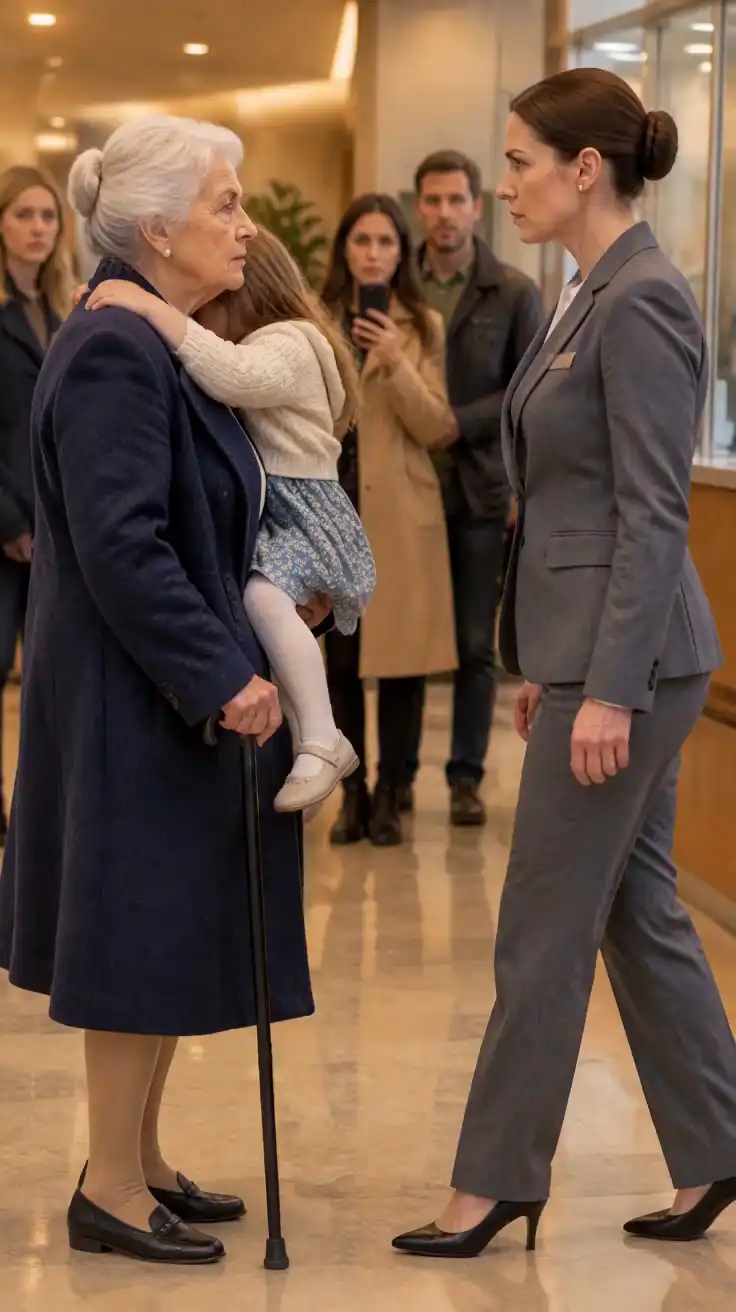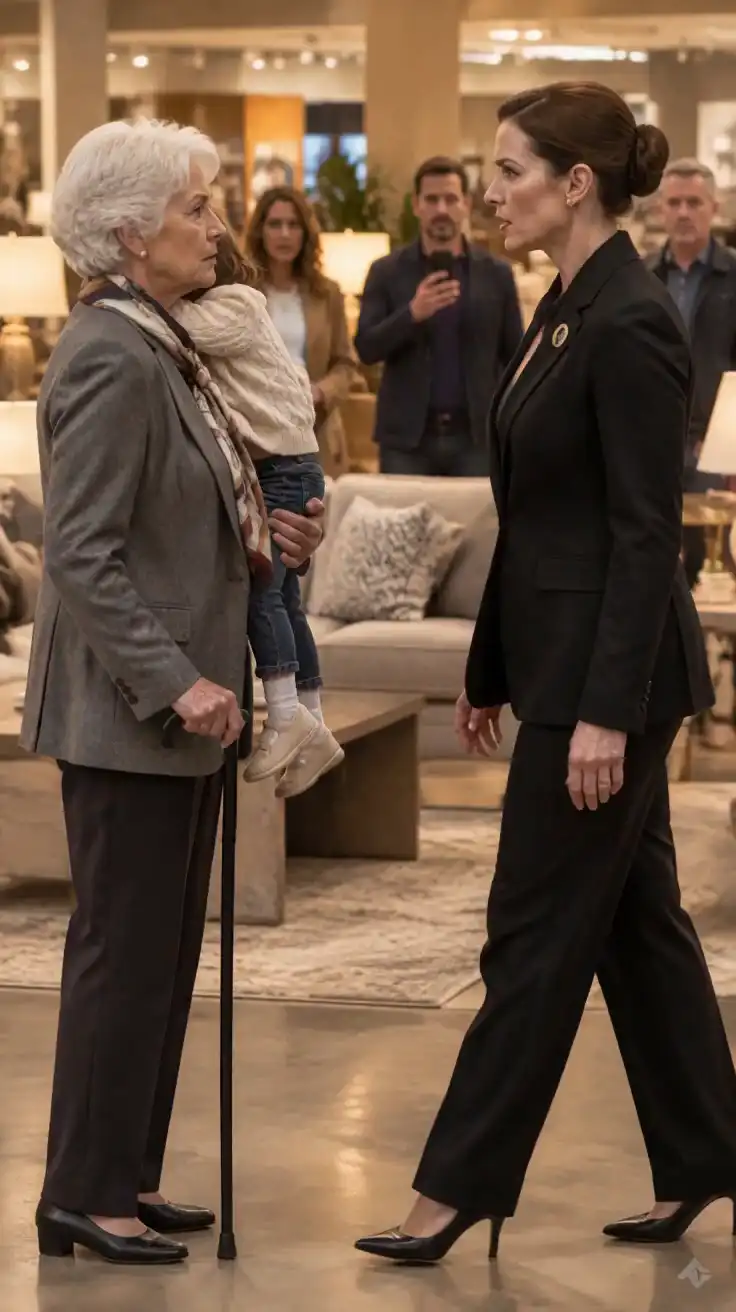
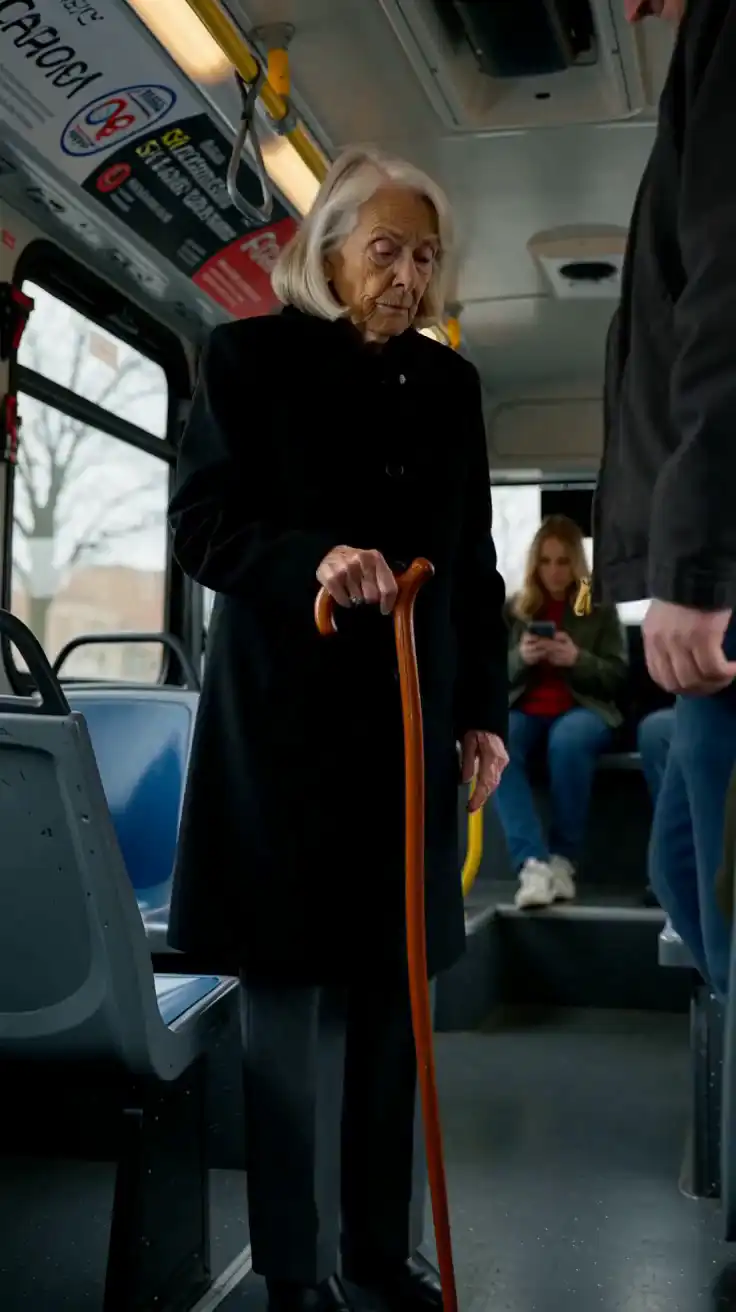
When a bully kicked a retired court clerk’s cane on the bus, a law student stepped forward to retrieve it—unaware that the clerk had recorded the man’s old case fifteen years ago.
The rubber tip of the cane struck the bus floor hard enough to sting Nora’s teeth.
The older woman caught the seat back with both hands. Her coat sleeve dragged across the vinyl. The man in the work boots laughed from his seat, loud enough that passengers near the front turned around.
The woman kept one palm pressed to the seat. Her other hand trembled in the air where the cane had been.
From the back row, Nora lowered her phone.
She was a second-year law student, still wearing the blue badge from the courthouse clinic. She stood, tucked the phone into her coat, and walked up the aisle. The bus rocked beneath her shoes. As she passed the older woman, Nora glanced down at the cane lying beside the man’s boot.
His laughter stopped.
“You got a problem?” he said.
Nora did not answer. She bent and picked up the cane.
The older woman watched her turn it over. A strip of brown tape circled the handle, worn smooth by years of use. Near the rubber grip, a folded paper had slipped from the woman’s handbag and landed under the seat.
Nora pulled it free.
The paper was not a receipt. It was an old court file number, typed in faded black ink. Beneath it, clipped to the same sheet, was a notice stamped by the county clerk’s office.
Nora read the date twice.
“Filed last month,” she said.
The man’s fingers tightened around his knees. “Give me that.”
Nora held the paper just out of reach. She compared the number with the one printed on the notice, then looked at the older woman.
The woman’s mouth opened, but only one quiet word came out.
“Please.”
Nora turned the page over. On the back, in small handwriting, were three names and a line drawn beneath the last one. She lifted her eyes to the man.
“Where did you get this?” he asked.
No one spoke. Even the engine seemed to fade beneath the sudden silence.
Nora looked down at the number again. Her finger followed each digit before she read it aloud.
The number matched an old case in the county records.
The bus sat motionless at the curb, every face turned toward the man.
Why had he appealed?
THE LINE THEY LEFT OUT
The man’s fingers tightened around his knees.
“Elias Vance,” he said.
The name came out flat, as if someone had pulled it from a locked drawer.
The older woman’s hand closed around the back of the seat. “That was not my name then.”
“No,” Elias said. “You were Mrs. Bell.”
Nora kept the paper between two fingers. “You know her?”
“I know what she did.”
The bus remained stopped at the curb. The doors had folded shut, and the driver watched the confrontation in the mirror without turning around.
Nora looked at the older woman. “Is your name Bell?”
The woman’s chin lifted a fraction. “Marjorie Bell.”
Elias laughed once, but there was no humor in it. “There. She remembers.”
Marjorie’s grip tightened until the skin over her knuckles turned white.
Nora glanced down at the page again. The faded number was typed across the top:
C-08-4176.
Beneath it, in a newer font, the notice read: NOTICE OF FILING—PETITION FOR POST-CONVICTION RELIEF.
“C-08-4176,” Nora said. “Elias Vance versus State of Franklin.”
The laughter vanished from the bus.
Elias stared at her. “You read that wrong.”
“I didn’t.”
“You don’t know what you’re talking about.”
“You just said her name.”
His eyes moved to Marjorie. “She was the clerk.”
Marjorie said nothing.
“The courtroom clerk,” Elias continued. “She sat behind the judge and wrote everything down. Every word.”
Nora felt the paper tremble between her fingers. She had spent two years learning how easily a legal file could turn a person into a sequence: defendant, charge, judgment, sentence. The number on the page was no longer ink. It was a door.
She held it out to Elias, but not close enough for him to snatch it.
“Were you convicted in this case?”
His mouth tightened.
Marjorie looked at the floor.
“Answer her,” said a man from the front row.
Elias turned toward him. “Mind your business.”
“You made it everybody’s business when you kicked an old woman’s cane.”
The driver shifted in his seat. “Everybody stay where they are.”
No one moved.
Nora took out her phone, opened a note, and typed the case number exactly as it appeared. She wrote down the date of the filing notice, then the names handwritten on the back.
Marjorie Bell.
Samuel Price.
Lydia Vance.
She looked up. “Who are these people?”
Elias stood so abruptly that his knee struck the seat in front of him. Several passengers flinched. He was broad through the shoulders, his work jacket faded at the cuffs, his boots still wet with salt from the morning sidewalks.
Nora did not step back.
“Sit down,” the driver said.
Elias stared at Nora. Then he looked at the cane in her hand.
“You think that number makes you important?”
“No.”
“You think you know what happened because you found an old piece of paper?”
“No. I think you know.”
His face changed again—not the fear the passengers had seen when Nora walked toward him, but something narrower and more desperate.
“I was seventeen,” he said.
Marjorie finally turned from the window.
Elias pointed at her. “I was seventeen years old when she put my name in that courtroom.”
“I did not put your name anywhere,” Marjorie said.
Her voice was thin, but it carried.
“You wrote it.”
“I recorded what was said.”
“You recorded what the judge allowed.”
The words landed harder than the kick had.
Nora lowered the cane. “What was the judgment?”
Elias looked around the bus. His jaw worked once.
“Convicted of armed robbery,” he said. “Aggravated assault. Eighteen years.”
A woman near the rear whispered, “Eighteen?”
“I served twelve before they released me,” Elias said. “Twelve years for a store I never robbed.”
Marjorie’s fingers slid down the seat back.
Nora stared at the notice. “The petition was filed last month.”
“Yes.”
“By you?”
“By an attorney.”
“Who?”
“Ruth Calder. Northside Legal Clinic.”
Nora’s badge bore the same clinic’s blue emblem.
Elias noticed it. “You work there?”
“I’m a student intern.”
“Then you know what she’s doing.”
“I know what the notice says.”
“You know she found the file.”
Nora’s eyes went to Marjorie. “Did she?”
Marjorie gave a small nod.
Elias let out a breath through his nose. “Of course she did.”
The driver pressed the door control. The bus doors opened with a sigh. Cold air entered, carrying diesel fumes and the smell of wet pavement.
“Anyone getting off?” the driver asked.
Nobody moved.
Elias remained standing. His hand hovered near the pole, but he did not touch it.
Nora folded the notice along its original crease. “You need to explain why this is in her bag.”
“It’s hers.”
“That doesn’t answer the question.”
“It was in the case file. She took it home.”
Marjorie’s eyes sharpened. “I did not take it.”
“You kept it.”
“I was given it.”
“By whom?”
Marjorie’s lips parted.
Elias leaned over the aisle. “Tell her.”
The bus driver looked toward the mirror again. “Sir, take your seat or get off.”
Elias’s head snapped around. “I’m not going anywhere.”
“You can go somewhere else if you can’t sit down.”
For a second, Elias seemed ready to argue. Then he lowered himself into his seat. The springs groaned beneath him.
Marjorie remained standing, one hand on the seat back. Nora offered the cane.
“Here.”
Marjorie took it. Her fingers closed around the taped handle with practiced care.
Nora sat in the empty seat across the aisle. She kept the notice in her lap.
Elias watched her. “You’re going to call the clinic.”
“Yes.”
“Don’t.”
“Why?”
“Because I haven’t finished explaining.”
“You have a court filing and a case number. That makes this more than a bus argument.”
His gaze dropped to the paper. “I filed because I found out she left something out.”
Marjorie’s eyes closed.
“What did she leave out?” Nora asked.
The bus pulled away from the curb.
Elias held the pole as the vehicle lurched forward. “A witness.”
“Who?”
“Lydia Vance.”
Nora looked at the handwritten names. “Your sister?”
“My mother.”
The word seemed to cost him more than the others.
Marjorie stared through the window as the streets slid past.
Elias rubbed both hands over his face. His palms were rough, the nails dark with grease.
“She was in the courtroom,” he said. “She sat behind me. She told the judge she saw me somewhere else that night.”
“An alibi?”
“She saw me at the hospital.”
“What hospital?”
“St. Agnes. My little brother had asthma. He stopped breathing in our apartment. I carried him three blocks because the ambulance took too long. My mother came with us. She stayed there until midnight.”
Nora wrote it down.
“Your mother testified?”
Elias gave a short, bitter laugh. “She tried.”
“What happened?”
“The prosecutor objected. Said she was my mother. The judge said the jury would hear her if the defense called her. My lawyer never called her.”
“Why not?”
“He said the jury wouldn’t believe her.”
Marjorie’s cane made a soft tap against the floor.
Elias turned toward her. “But you wrote it down.”
Marjorie’s face had gone pale.
Nora leaned forward. “Mrs. Bell, what did you record?”
The old woman looked at Nora, then at Elias.
“I recorded Mrs. Vance asking to speak.”
“And?”
“The judge told her to sit down.”
“Was that entered into the transcript?”
“No.”
Elias’s hand closed around the edge of his seat.
Nora stopped writing.
Marjorie continued, “The stenographer was ill that morning. The courtroom reporter had not arrived. The judge asked me to keep the minute record until the reporter came.”
“You were the only person writing?” Nora asked.
“For part of the hearing.”
“Did you record Lydia Vance’s statement?”
“I wrote what I could.”
“Where is it?”
Marjorie looked at the notice in Nora’s lap.
“In a supplemental clerk’s sheet.”
“Was it filed?”
“It should have been.”
“Should have been isn’t the same as was.”
Marjorie lowered her gaze.
Elias leaned toward her. “Say it.”
“I don’t know.”
“You know exactly what happened.”
“I know I put the sheet in the file.”
“And then?”
“The file came back from chambers without it.”
The bus passed under a row of bare trees. Light flashed over the passengers’ faces.
Nora’s pen stopped.
“Without it?”
“I noticed the sheet was missing when I prepared the judgment packet.”
“Did you report that?”
Marjorie looked at Elias. “I told the judge’s secretary.”
“What did she say?”
“She said the judge had corrected the record.”
“Was there a corrected sheet?”
“No.”
“Did you tell the defense attorney?”
“No.”
Elias’s laugh broke apart halfway through. “There it is.”
Marjorie flinched.
Nora kept her voice steady. “Why didn’t you?”
“Because I was twenty-eight years old, and Judge Harlan had been on that bench for twenty-two years. He told me the record was complete.”
“That does not answer why you didn’t tell the lawyer.”
Marjorie’s hand moved to the taped section of the cane. She rubbed it with her thumb.
“I thought the sheet would be restored.”
“But it wasn’t.”
“No.”
“And the judgment was entered.”
“Yes.”
Elias stared at the floor. “Eighteen years.”
The bus rolled over a pothole. The cane slipped against Marjorie’s shoe, and Nora reached out to steady it.
Neither of them looked at Elias.
He said, “My mother died while I was in prison.”
Marjorie’s shoulders drew inward.
“She wrote me letters,” he continued. “Every month. She said she remembered the courtroom. She said she stood up and told them where I was. I thought she was trying to keep me from breaking.”
He looked at Marjorie.
“She wasn’t lying.”
Marjorie’s mouth trembled. “No.”
“Then why didn’t you say anything?”
“I should have.”
“That’s not what I asked.”
The old woman gripped the cane so tightly the brown tape creased under her fingers.
“I was afraid.”
“Of the judge?”
“Yes.”
“After I went away?”
“Yes.”
“You were afraid for fifteen years?”
“Every day.”
Elias turned to the window. His reflection moved over the glass, broken by passing storefronts.
Nora wrote the names again, slower this time.
Lydia Vance. St. Agnes Hospital. Supplemental clerk’s sheet. Judge Harlan. Missing from record.
She knew enough to understand the problem. An unfiled statement was not automatically proof of innocence. A mother’s alibi could be challenged. Memories could shift over fifteen years. But a hidden record was not a small error, especially if it showed that a defense witness had tried to speak and had been silenced.
“Why appeal now?” Nora asked.
Elias didn’t answer.
Marjorie did.
“Because he found my letter.”
Elias turned sharply. “You promised you wouldn’t tell her that.”
“She needs to know.”
“What letter?”
Marjorie reached into her handbag and pulled out a small envelope. Its edges were softened from handling. She did not give it to Nora.
“I wrote to him,” she said.
“When?”
“Three months ago.”
“You wrote me one letter,” Elias said. “After twelve years.”
“I wrote many.”
He looked at her.
Marjorie swallowed. “I never mailed them.”
“Why not?”
“I tore them up.”
“You mailed one.”
“Yes.”
“And you said you found the missing page.”
“I said I remembered the missing page.”
“You said you had it.”
Marjorie opened the envelope. Inside was a single sheet folded twice.
“I found it in an old ledger box after I moved.”
Nora watched the page emerge.
Marjorie held it carefully, as though the paper might split.
“The county sent me boxes when the courthouse renovated the records room,” she said. “This was wedged beneath a drawer in my old desk. I knew what it was.”
“Why keep it?” Elias asked.
“I didn’t know what else to do.”
“You could have brought it to the court.”
“I did not know where to begin.”
“So you sent it to me.”
“I sent a copy.”
Elias’s eyes shone, though his face stayed hard. “You sent it with no name. No return address. You thought I would know what to do?”
“I thought you should have it.”
“You thought I should carry it around and wonder whether it was real?”
“I was sorry.”
He turned away.
Nora looked at the paper. “May I see it?”
Marjorie extended it.
The handwriting was faded blue ink. At the top, a date from fifteen years earlier. Beneath it, in uneven lines:
Lydia Vance appeared in the courtroom and stated that Elias Vance was with her at St. Agnes Hospital at the time of the alleged robbery. The court instructed her to remain seated. Statement not entered into the record.
At the bottom was Marjorie’s signature.
Nora read it twice.
“Is this the original?”
“Yes,” Marjorie said.
“Why didn’t you include it with the appeal?”
“Ruth Calder has it.”
Nora looked at Elias.
He nodded. “She took it when I brought it in.”
“Does the court know?”
“The petition says there is newly discovered evidence.”
“Not what the evidence is?”
“Not yet. The judge has to order the state to respond.”
Nora’s phone buzzed. A message from Ruth Calder appeared.
CALL ME WHEN SAFE. DID YOU FIND THE FILE NUMBER?
Nora typed back: YES. I’M WITH ELIAS VANCE AND MARJORIE BELL.
Three dots appeared immediately, then disappeared.
Ruth called.
Nora answered and held the phone between herself and Marjorie.
“Ruth?”
“Where are you?”
“On the Number Six bus.”
“Is he there?”
Elias leaned closer. “I’m here.”
Ruth went quiet for half a second. “Mr. Vance, this is Ruth Calder. I represent you in the petition.”
“I know who you are.”
“Are you safe?”
He looked at the cane in Marjorie’s hand.
“I’m not the one who needs to be asked that.”
Ruth heard him. “I’m asking because I need to know whether you’re able to talk.”
“I’m able.”
Nora said, “The file number is C-08-4176. The appeal notice was filed last month. Mrs. Bell has an original supplemental clerk’s sheet.”
Ruth inhaled sharply.
“Mrs. Bell,” she said, “are you willing to meet with me today?”
Marjorie looked at Elias.
“I am.”
“Good. I’ll arrange a room at the clinic. Bring the original. Don’t give it to anyone else. Don’t alter it, copy it, or write on it.”
“I understand.”
“Mr. Vance, I need you to do one thing before you leave that bus.”
“What?”
“Do not threaten anyone. Do not touch anyone. Do not say anything that can be described as intimidation.”
Elias looked at Nora. “She already has a description.”
“I heard,” Ruth said. “And I’m not asking whether he deserved it. I’m telling you what the state will use if this becomes a credibility fight.”
Elias’s hand fell away from the pole.
Ruth continued, “We may need a sworn statement from Mrs. Bell. We may need the hospital records, the original docket, and proof that the clerk’s sheet was never included. Nora, can you photograph the notice and the handwritten names?”
“Only with permission.”
Marjorie nodded.
“Not the original sheet,” Ruth said. “Just the notice and the back of the page that has the names.”
Nora took the photographs. She held the paper flat against her notebook so the bus’s movement would not blur the image.
The three names filled the screen.
“Samuel Price,” Ruth said. “Who is he?”
Marjorie answered. “The courtroom reporter.”
“Is he alive?”
“I don’t know.”
“Lydia Vance?”
“Elias’s mother,” he said. “She’s dead.”
“Her brother?”
Elias shook his head. “Samuel Price was the reporter.”
Ruth paused. “Then why is his name on the back?”
Marjorie looked down. “He was the one who told me to make a private note.”
“About what?”
“The judge’s instruction.”
Nora’s pen moved again.
Ruth said, “Mrs. Bell, I need you to tell me exactly what happened, but not on this call. Keep the paper safe and come to the clinic with Mr. Vance.”
The bus driver called from the front, “Next stop, courthouse.”
Nora looked up.
The courthouse was two blocks away, its stone steps visible through the fogged windows.
Ruth said, “Actually, don’t come to the clinic first. Meet me at the courthouse records office. I can request the original file while you’re there.”
Elias’s expression changed. “Today?”
“Today. The petition is pending. If the case number is correct, we need to preserve the file before anyone has a chance to misplace anything else.”
Marjorie’s mouth tightened at the word.
“I’ll be there,” she said.
The bus slowed.
Elias stood first. He moved into the aisle, then stopped beside Marjorie.
For one second, Nora thought he might say something cruel.
Instead, he pointed at the cane.
“Give it to me.”
Marjorie did not move.
“I can carry it down the steps,” he said.
“I can carry my own cane.”
His hand dropped.
The doors opened. The passengers began to leave, but no one pushed past them. One by one, they stepped around the three figures and onto the sidewalk.
Nora waited until Marjorie had descended. Elias followed, keeping several feet between them.
The courthouse doors opened with a heavy brass pull. Inside, the marble floor reflected the gray morning. People moved through security with folders under their arms, their shoes clicking in a rhythm that belonged to the building.
Marjorie slowed at the entrance.
“I haven’t been inside since I retired,” she said.
Elias looked at her. “You walked out of here every day.”
“Not this door.”
“Why?”
“I used the staff entrance.”
“Of course.”
Nora touched the folder in her bag. “The records office is downstairs.”
Marjorie nodded and walked on.
The clerk at the records counter was a young man with a red tie and a stack of transfer forms. He glanced at the case number Nora provided.
“Closed criminal matter,” he said. “We’ll need a written request.”
Ruth Calder arrived behind them, carrying a leather folder. She was in her fifties, with silver hair cut close to her jaw and a raincoat still wet at the shoulders.
“Good morning,” Ruth said. “I’m counsel of record on the post-conviction petition.”
She placed her bar card and a copy of the filing on the counter.
The clerk read the caption, then looked at Elias.
“Mr. Vance?”
“Yes.”
“Identification?”
Elias reached into his wallet.
Marjorie stood behind him, both hands resting on the cane.
The clerk looked from Elias to Marjorie. “Are you a party?”
“I’m a former court clerk,” Marjorie said.
The clerk straightened. “Name?”
“Marjorie Bell.”
His fingers stopped on the keyboard.
“You worked here?”
“Not anymore.”
He typed her name into the system. The screen faced away from them, but his expression changed.
Ruth noticed. “What do you see?”
“Nothing I can disclose without a request.”
“You’re looking at a public docket.”
“I’m looking at an internal index.”
Ruth slid a form across the counter. “Then accept the request.”
The clerk took the form. “The file may be off-site.”
“Where?”
“Records annex.”
“How long?”
“Two to three business days.”
Ruth’s voice stayed calm. “The petition alleges that a material defense statement was omitted from the trial record. We are requesting immediate preservation and inspection of the original file, including clerk’s sheets, docket envelopes, minute books, and transfer logs.”
The clerk looked at the form again.
“I can place a hold,” he said.
“Place it now.”
He typed.
Elias watched the screen as if he could see the file being locked away.
The clerk printed a receipt and stamped it. “Preservation hold entered at 9:42 a.m.”
Ruth took the receipt. “Now the file.”
“I’ll submit the retrieval.”
“Submit an emergency retrieval.”
The clerk hesitated.
Ruth pointed to the notice. “The state has been served. The petition is active. We have an original document that may be part of the missing record. If your office moves or reboxes that file after receiving this request, the transfer itself becomes evidence.”
The clerk’s face tightened. He entered another command.
“Emergency retrieval,” he said. “It may take an hour.”
“We’ll wait.”
A security guard glanced over from the elevator, but Ruth had already moved aside.
Elias sat on a wooden bench. Marjorie lowered herself beside him, leaving a careful gap.
Nora stood across from them.
For several seconds, the only sound was the tapping of the records clerk’s keyboard.
Elias broke the silence.
“You knew I was on that bus.”
Marjorie turned toward him. “I didn’t know you would be.”
“You recognized me.”
“Yes.”
“Immediately.”
“Yes.”
“You recognized me before I kicked the cane.”
“I recognized your voice.”
“You never heard me speak.”
“In court you did.”
“I was seventeen.”
“You had a scar near your left eyebrow.”
His fingers went to the scar without thought.
“You got it in the holding cell,” Marjorie said. “You fell against the bench.”
Elias lowered his hand.
“You were crying,” she continued. “You kept asking whether your mother was allowed to testify.”
Nora watched his face.
“I wasn’t crying,” he said.
“You were.”
“I was seventeen.”
“Yes.”
He looked at the floor.
Marjorie’s voice dropped. “You asked me if I had written down what she said.”
“I remember.”
“I told you I had.”
“You did.”
“I meant it.”
“But it disappeared.”
“Yes.”
“And you never came to tell me.”
“I went to the prison once.”
Elias looked up.
Marjorie folded both hands over the cane. “I stood outside the visiting room. I couldn’t make myself go in.”
“Why?”
“Because I had the sheet with me.”
“You had it then?”
“No. I had a copy of the minute record. I thought I could explain.”
“And?”
“I saw your mother through the glass. She was holding your brother’s coat. I turned around.”
Elias stared at her, his breathing shallow.
“You left,” he said.
“Yes.”
“For fifteen years, you carried that?”
Marjorie’s thumb traced the seam of the tape.
“Yes.”
Ruth sat beside Nora and opened her folder. “Mrs. Bell, I need to ask you questions.”
Marjorie nodded.
“Did you prepare the handwritten statement?”
“I prepared the original supplemental sheet.”
“Was it made contemporaneously?”
“Yes. Before the jury returned.”
“Why did you make a separate sheet?”
“Because the official reporter had not arrived. The judge told me to keep minutes.”
“Who else knew you were doing that?”
“Judge Harlan. The bailiff. Mr. Price, when he arrived.”
“Was Samuel Price the reporter?”
“Yes.”
“Did he review your sheet?”
“He looked at it.”
“What did he say?”
“He said the judge did not want it in the transcript.”
Ruth’s pen stopped.
“Exact words?”
“He said, ‘Harlan wants the mother kept out. Put it where it won’t be found.’”
Elias’s head turned.
Marjorie’s voice shook, but she did not lower it. “I asked him what that meant. He said he was talking about the storage drawer.”
“Did he sign anything?”
“No.”
“Is he alive?”
“I don’t know.”
Ruth wrote the name.
“After Mr. Price spoke to you, what did you do with the sheet?”
“I put it in the case file.”
“In which section?”
“The clerk’s envelope. Behind the arraignment minutes.”
“Did you see it there afterward?”
“When I prepared the judgment packet, it was gone.”
“Who had access to the file?”
“The judge’s chambers. The prosecutor’s office. Defense counsel. The records desk.”
“Did you report the missing sheet?”
“I told the secretary.”
“Name?”
“Ellen Wray.”
“Is she alive?”
“She moved to Arizona years ago.”
Ruth looked at Nora. “Write that down.”
Nora did.
“Mrs. Bell,” Ruth said, “why did you sign the letter you sent Mr. Vance?”
Marjorie’s eyes moved to Elias.
“Because the paper had my signature. I couldn’t pretend it had not existed.”
“Why now?”
“Because I found it.”
“That explains the timing, not the decision.”
Marjorie sat straighter. “I saw his name in the newspaper.”
Elias’s face hardened.
“It was a small article,” she said. “About his petition.”
“You saw the article before filing?”
“Yes.”
“And you contacted him?”
“I called the number listed for the clinic.”
Ruth nodded. “That is how we connected.”
Elias looked at Nora. “I thought the clinic wanted to make me into a case.”
Ruth closed the folder. “We want the court to decide whether the state denied you a fair trial. That is the case. Your anger does not make the evidence disappear, and her guilt does not automatically prove the verdict wrong.”
Marjorie took the words without protest.
Ruth continued, “But the evidence has to be preserved. That is why we are here.”
The records clerk appeared carrying a gray archive box.
“C-08-4176,” he said.
Every head in the lobby turned.
Ruth stood. “Is that the original file?”
“It’s what the annex sent.”
“Who opened the box?”
“It was sealed.”
“Was the seal intact?”
The clerk looked down at the box. A strip of clear tape crossed the lid. At one end, the tape had been cut and replaced.
Ruth saw it. So did Nora.
“Get your supervisor,” Ruth said.
The clerk’s face paled. “The box arrived like this.”
“Then document it.”
He set the box on the counter.
Ruth photographed the seal before touching it. Nora wrote down the transfer label, the time, and the clerk’s name.
Marjorie remained on the bench, staring at the box.
Elias stood beside her.
“You don’t have to look,” he said.
“I do.”
Ruth opened the box.
Inside were file folders, a trial transcript, a sentencing sheet, and a thin brown envelope marked CLERK’S MINUTES.
Ruth lifted the envelope. It was empty.
Nora saw Marjorie’s face change.
“Was the supplemental sheet in that envelope?” Ruth asked.
“Yes.”
The records clerk leaned over. “Maybe it was filed separately.”
“Then the transfer index should show where.”
Ruth removed each document, laying them on the counter in order.
The official transcript began with jury selection. The first page was dated the day after Lydia Vance had allegedly tried to speak.
Nora read the docket sheet.
Defendant: Elias Vance.
Charge: Armed robbery. Aggravated assault.
Disposition: Guilty.
Sentence: Eighteen years, concurrent terms.
She turned to the trial transcript. The prosecutor’s opening statement described Elias as a “known street offender” who had entered Price’s Market with a revolver.
Elias stood behind her, reading over her shoulder.
“That wasn’t true,” he said.
“Was there a revolver?” Nora asked.
“No.”
“What was recovered?”
“Nothing.”
Ruth looked at the sentencing sheet. “The state’s evidence was the cashier’s identification?”
“And the owner’s,” Elias said. “He was in the back room.”
“Any physical evidence?”
“No.”
Nora looked at the transcript. “Where is your defense?”
“My lawyer asked three questions.”
“Of whom?”
“The cashier.”
“What about your mother?”
“He never called her.”
Ruth found a notation in the docket.
Defense witness list filed: Lydia Vance.
She tapped the line.
“Your mother was listed.”
Elias’s mouth opened, then closed.
Marjorie leaned forward. “That is why I made the sheet.”
Ruth looked at the clerk. “Are there pages missing from the transcript?”
The clerk frowned. “It’s certified.”
“That is not what I asked.”
He compared the page numbers. The transcript jumped from page 118 to page 127.
Nora’s pulse kicked.
“Eight pages,” she said.
Ruth turned the pages over. “The numbering may be a reporter error.”
“Or testimony was removed,” Elias said.
“Don’t decide that yet,” Ruth told him.
The clerk looked uncomfortable. “The reporter’s certification says complete.”
“Who certified it?”
“Samuel Price.”
Marjorie’s hand rose to her mouth.
Ruth read the certification aloud. “‘I certify that the foregoing is a true and accurate transcript of all proceedings in the above-captioned matter.’”
Elias said, “He told her to hide the sheet.”
“He may have been covering for the judge,” Marjorie said.
“Or he may have been lying to you,” Ruth said. “We need proof, not the most painful explanation.”
The clerk searched the transfer log. “There’s an entry here.”
“What entry?”
“Supplemental clerk’s materials. Sent to chambers. Returned to records. Date missing.”
“Why is the date missing?”
“Damaged log.”
Ruth took a photograph.
The gray box sat open under the courthouse lights. The file that had controlled Elias’s life for twelve years looked too small to carry the weight of it.
Nora turned another page.
At the bottom of the sentencing transcript, Judge Harlan had written: Defendant’s mother not called as witness by defense.
Elias read the line.
“She was called,” he said.
“No,” Marjorie said. “She was not allowed to testify.”
Ruth pointed to the sentence. “That distinction may matter.”
Elias looked at her. “To whom?”
“To the court.”
“And if the court says the same thing? That she wasn’t called, so nothing was lost?”
“Then we appeal that decision.”
“You make it sound simple.”
“I make it sound like a process.”
He stepped away from the box. “The process already sent me away.”
Ruth didn’t reach for him. “Then we use the process to show what it did.”
Marjorie stood. “I will testify.”
Elias turned toward her.
Ruth said, “That is not a decision to make in a hallway.”
“It is,” Marjorie said. “I am seventy-four years old. I have waited long enough to be careful.”
The records clerk looked at her.
She continued, “I will tell the judge what I wrote, who saw it, where it went, and why I failed to speak sooner.”
Ruth’s expression softened, but her voice remained precise. “You understand the state will question your memory, your conduct, and your reasons for coming forward?”
“Yes.”
“They may say you are trying to repair your own mistake.”
“I am.”
“They may say the original sheet proves only that you wrote something, not that it was true.”
“I know.”
“They may ask why you watched a boy go to prison.”
Marjorie looked at Elias.
“I know.”
Elias said, “You don’t have to do it for me.”
“I am not doing it for you.”
“Then why?”
“Because I wrote it down.”
The answer left no room around it.
Ruth closed the file. “We’ll need a formal affidavit first. Then a hearing request.”
“How long?” Elias asked.
“That depends on the state and the court.”
“You said today.”
“Today is the day we preserve the evidence. It is not the day a judge decides the case.”
He turned away.
Nora picked up the appeal notice. “The petition was filed last month. Has the state responded?”
“Not yet,” Ruth said. “Their deadline is Friday.”
“What happens then?”
“The attorney general may move to dismiss. They may argue the petition is too late, that the evidence is not new, or that the missing testimony would not have changed the verdict.”
Elias’s shoulders lowered.
Ruth looked at him. “That is why Mrs. Bell’s testimony matters. So do the hospital records.”
“I went to St. Agnes,” Nora said. “It closed.”
“The records may have been transferred.”
“To where?”
“County medical archive or the hospital system that bought the property. We’ll find out.”
Elias gave her a tired look. “You’re taking notes like you believe me.”
“I’m taking notes because you have a claim that needs evidence.”
“That’s not the same thing.”
“No,” Nora said. “It’s better. Belief doesn’t get a hearing. Evidence can.”
For the first time, something in his face loosened.
Ruth handed Nora a blank evidence form. “Write down the hospital lead. Contact the archive with me present. We need a certified custodian, not a story from a receptionist.”
Nora nodded.
Marjorie touched Elias’s sleeve. He flinched before he could stop himself.
She pulled her hand back.
“I’m sorry,” she said.
He looked at her fingers. “You’ve said that.”
“I know.”
“It doesn’t give me the years back.”
“No.”
“It doesn’t give my mother back.”
“No.”
“It doesn’t make me seventeen again.”
Marjorie’s eyes filled, but she did not wipe them.
“No,” she said. “It doesn’t.”
Elias stood with the gray file box between them.
“What does it give me?”
Marjorie glanced at Ruth, then Nora.
“A chance to put the missing words in the record,” she said.
He looked at the empty brown envelope.
“That’s not a life.”
“No.”
“But it’s more than I had yesterday.”
Marjorie nodded.
The courthouse supervisor arrived to document the seal. Ruth stayed with the box while Nora and Elias went with Marjorie to a small conference room near the records office.
The room contained a table, four chairs, and a wall clock that ran two minutes slow.
Ruth placed a recorder in the center.
“This is not the affidavit,” she said. “It is an interview. I will ask questions. If you don’t remember, say you don’t remember. Do not fill gaps because you think I need an answer.”
Marjorie sat with her hands folded.
Elias took the chair beside the door.
Nora sat opposite him, her notebook open.
Ruth pressed record.
“State your full name.”
“Marjorie Anne Bell.”
“Former occupation?”
“Deputy clerk of the Franklin County Superior Court.”
“Years of service?”
“Thirty-one.”
“Did you serve as clerk during the trial of State versus Elias Vance?”
“Yes.”
“Do you know Mr. Vance personally?”
“I did not before the trial.”
“Did you recognize him on the bus this morning?”
“Yes.”
“How?”
“His voice and the scar over his left eyebrow.”
Elias looked at the table.
Ruth asked, “Did you recognize him before he kicked your cane?”
“Yes.”
“What did you do?”
“Nothing.”
“Why?”
“Because I was frightened.”
The room was silent except for the recorder.
Ruth did not rescue her.
“Why were you frightened?”
“Because I knew he remembered me.”
“Did you believe he recognized you?”
“Yes.”
“Did you believe he might hurt you?”
“He kicked the cane from my hand.”
“That occurred after you recognized him.”
“Yes.”
Ruth moved to the trial.
“Tell me what happened when Lydia Vance entered the courtroom.”
Marjorie’s gaze settled on a scratch in the table.
“She came in during the defense case. She was carrying a hospital visitor’s pass. She asked the bailiff if she could speak to the judge. He told her to wait. When the defense attorney rested, she stood.”
“Did the judge hear her?”
“He said, ‘The defense has rested.’”
“What did Mrs. Vance say?”
“She said, ‘My son was at St. Agnes with me.’”
“Did she identify herself?”
“She said, ‘I’m Lydia Vance, his mother. I was with him when the ambulance came.’”
“Did the judge allow her to continue?”
“No.”
“Did the defense attorney object?”
Marjorie shook her head. “He said, ‘We have no more witnesses.’”
“Did Mrs. Vance respond?”
“She said, ‘You didn’t ask me.’”
Elias closed his eyes.
Ruth asked, “What happened next?”
“The judge told the bailiff to remove her if she interrupted again.”
“Was she removed?”
“No. She sat down.”
“Did you make a written note?”
“Yes.”
“Show us where.”
Marjorie opened her handbag and removed the original sheet. Ruth had warned her not to mark it, and it remained folded in the same creases.
She placed it on the table.
Nora leaned toward it without touching.
The handwriting was unmistakably older than the letter. The ink had bled at the edges, but the words remained legible.
Ruth read the final line. “‘Statement not entered into the record.’”
“Did you intend this as an official record?”
“Yes.”
“Why did you sign it?”
“Because I made it.”
“Who saw it?”
“Judge Harlan. Mr. Price. The judge’s secretary. I believe the defense attorney saw the envelope.”
“Believe?”
“I saw him holding the file.”
“Did you see him read the sheet?”
“No.”
Ruth asked, “What did Judge Harlan say when he saw it?”
“He said, ‘This does not belong in the trial record.’”
“Did he explain why?”
“He said the defense had rested.”
“Did you object?”
“No.”
“Did you tell him Mrs. Vance had spoken?”
“He had heard her.”
“Did you tell anyone outside chambers?”
“No.”
“Why?”
Marjorie’s fingers pressed into the table.
“Because I believed the judge had authority to decide what belonged in the record.”
“Did you believe it was lawful?”
“I believed it was his decision.”
“That is not the same answer.”
Marjorie looked up. “I knew it felt wrong.”
Ruth let the silence remain.
Elias said quietly, “You knew.”
Marjorie turned toward him. “Yes.”
The word was small and clean.
“I knew it felt wrong,” she said. “I did not know how to stop it.”
“You could have told my lawyer.”
“Yes.”
“You could have told my mother.”
“Yes.”
“You could have told me.”
“Yes.”
“And you didn’t.”
“No.”
He looked away.
Ruth stopped the recorder.
“We’ll continue tomorrow,” she said.
Elias stood.
Marjorie remained seated.
At the door, he paused. “Why send the letter?”
Marjorie lifted her eyes.
“Because you wrote back.”
“I never wrote to you.”
“You did, when you were in prison.”
“I sent a request for the transcript.”
“You wrote my name on it.”
He frowned.
“You asked for the page with your mother’s statement,” Marjorie said. “The request came to the clerk’s office. I saw it.”
“I didn’t know you were there.”
“I know.”
“I thought the prison lost it.”
“It was denied.”
“Why?”
“They said the page did not exist.”
His hand gripped the doorknob.
Marjorie said, “I kept the denial.”
“You kept everything except the courage to speak.”
She accepted that.
Elias opened the door.
Nora followed him into the hall. Ruth stayed with Marjorie to secure the document.
The courthouse corridor seemed longer than before.
“Are you going to leave?” Nora asked.
“From the building?”
“From the petition.”
He gave her a sideways look. “You think I’m going to quit because the first day made me angry?”
“I don’t know.”
“I quit a lot of things before. School. The apprenticeship program. A job at the warehouse because the manager found the conviction and wouldn’t let me near the cash office.”
Nora said nothing.
“I didn’t quit because of today,” he continued. “Today is the first thing that has made sense in fifteen years.”
They reached the elevator.
“What do you mean?”
He looked at the courthouse doors at the end of the hall.
“I spent all that time thinking everyone had forgotten. Turns out someone remembered every word.”
The elevator arrived.
Inside, Nora asked, “Did you really rob the store?”
“No.”
“Did you know Samuel Price?”
“No. I knew his name because he owned the market.”
“Why did he identify you?”
Elias watched the floor numbers descend.
“He didn’t.”
Nora turned toward him.
“The cashier identified me,” he said. “Price told the police he couldn’t see the robber’s face. At trial, he said I looked like the person who ran past him.”
“Why would he change his testimony?”
“His son was the prosecutor’s campaign treasurer.”
The elevator stopped.
Nora wrote that down.
Elias looked at her notebook. “That’s why I kept the old file. Not because I like reading it.”
“Did you tell Ruth?”
“She knows.”
“Can you prove the connection?”
“I don’t know.”
“Then we find out.”
He almost smiled. “You say that like you’ve done it before.”
“I’m learning.”
Outside, the rain had stopped. The bus waited at the corner, its route sign glowing through the mist.
Marjorie and Ruth emerged from the courthouse a few minutes later. Ruth carried no file. The original sheet was sealed in an evidence envelope.
Elias stepped toward Marjorie.
She stopped.
“Your bus,” he said.
“I can take the next one.”
“It’s the same route.”
“I know.”
He looked at the Number Six. “You should get on.”
Marjorie studied him. “Are you?”
“Yes.”
They boarded separately.
The driver recognized them and said nothing.
Marjorie walked toward the front. Elias took a seat near the middle. Nora sat beside him, while Ruth remained standing near the fare box to make a call.
The bus moved through the city.
For the next two days, nothing happened quickly.
The hospital archive took hours to locate the correct records custodian. The first search found no patient file under Elias’s name because he had been listed as a minor under his mother’s account. A second search located an emergency intake ledger from St. Agnes, preserved in a county storage facility.
The entry showed Lydia Vance arriving at 8:17 p.m. with two children. One child, Samuel Vance, was admitted for acute respiratory distress. The accompanying adult remained until 12:46 a.m.
Elias had been convicted of entering Price’s Market at 9:05 p.m.
The archive custodian signed a certification.
Ruth attached it to the petition.
The prosecutor’s office filed a motion to dismiss, arguing that the claim was untimely and that Marjorie Bell’s memory was unreliable.
Ruth answered with the original sheet, the hospital ledger, the missing pages in the certified transcript, the transfer log, and Marjorie’s recorded statement.
She also found Samuel Price.
He was eighty-one and living in a nursing home two counties away. When Ruth called, he refused to speak.
Then Nora sent a subpoena request through the court.
Price’s attorney contacted Ruth that afternoon.
“He says he has no memory of the Vance trial,” the attorney told her.
“Then he can say that under oath.”
The attorney paused. “He also says he has a box of old reporter’s notes.”
Ruth’s eyes narrowed. “Where?”
“His daughter is looking for it.”
“Tell her not to destroy anything.”
The box arrived a week later.
Inside were carbon copies of courtroom notes, most of them faded. One page contained a notation in Price’s handwriting:
LV—mother asks to testify. H says no. MB makes separate note. Keep out of transcript.
Ruth placed the copy beside Marjorie’s original.
The same initials appeared in both.
Elias sat at the clinic conference table, staring at the words.
“Can he deny this?” he asked.
“He can say the handwriting isn’t his,” Ruth said.
“It is.”
“We’ll have it examined.”
“Why does everyone get to say what they remember except me?”
Ruth met his eyes. “You get to say what you remember. The court is required to test it.”
He leaned back.
Nora sat beside the evidence box, wearing the same blue clinic badge. “The handwriting examiner can compare his trial notes with later notes. If they match, it supports authentication.”
Elias looked at her. “You really are still taking notes.”
“Your file is now three binders.”
“Three?”
“Two and a half.”
He looked toward the shelves. “I thought lawyers just argued.”
“They argue after they spend weeks proving what paper is.”
Marjorie sat near the window. She had come every day, carrying the cane with the brown tape.
Elias glanced at her. “And she has to testify in public?”
“Yes,” Ruth said.
Marjorie answered before him. “I will.”
“They’ll ask why you waited,” Elias said.
“I know.”
“They’ll call you unreliable.”
“I know.”
“They’ll say you’re doing it because you feel guilty.”
“I am.”
He looked down.
Marjorie’s voice remained steady. “But guilt is not the evidence. The evidence is what I wrote.”
The hearing was scheduled for a Thursday morning.
The courtroom was smaller than the one where Elias had been sentenced. The judge assigned to the petition was Judge Lena Ortiz, who had never sat with Judge Harlan. Harlan had retired years earlier and died before the petition was filed.
The state attorney, Mark Reddick, arranged three folders on his table. He was young enough to have been in elementary school when Elias was convicted.
Elias sat beside Ruth. Marjorie sat behind them with Nora.
When the judge entered, everyone stood.
Judge Ortiz reviewed the docket. “This is a petition for post-conviction relief filed by Elias Vance. The petitioner alleges that material exculpatory testimony was excluded from the trial record and that the omission was concealed.”
Reddick stood. “The state moves to dismiss on procedural grounds.”
Ruth stood. “The petitioner opposes.”
Judge Ortiz looked at Marjorie. “Is that the former clerk?”
“Yes, Your Honor,” Ruth said. “She is a witness.”
“Not yet,” Judge Ortiz said. “Today concerns whether the petition warrants an evidentiary hearing.”
Elias’s hands tightened around the edge of the table.
Reddick argued first.
“The conviction is fifteen years old,” he said. “The petitioner had counsel, a direct appeal, and multiple opportunities to challenge the judgment. The current petition is based primarily on the recollection of a retired clerk who admits she failed to report an alleged irregularity. The state does not concede that the document is authentic, complete, or relevant.”
Ruth stood.
“The state’s own certified transcript contains an unexplained eight-page gap. The clerk’s transfer log identifies supplemental materials sent to chambers and returned without a date. A hospital ledger places the petitioner at St. Agnes at the time of the robbery. The former court reporter’s notes reference the excluded witness and the missing clerk’s sheet. These are not merely changed memories. They are documents that the trial record says do not exist, while the surviving paperwork shows they once did.”
Judge Ortiz looked at Reddick. “Why does the transcript jump from page 118 to page 127?”
“Reporter error is possible.”
“Has the state located the reporter?”
“Mr. Price is elderly and claims no present memory of the trial.”
“That was not my question.”
Reddick glanced at his folder. “We have not taken his deposition.”
“Why not?”
“The petition was filed last month.”
“And the state has had a month to review the record.”
“Yes, Your Honor.”
Judge Ortiz looked at the hospital certification. “Does the state dispute the ledger?”
“We dispute its conclusiveness. It does not prove that Mr. Vance remained there continuously.”
“No evidence proves anything conclusively at this stage,” the judge said. “The question is whether he is entitled to a hearing.”
Reddick sat.
Ruth called Marjorie.
Marjorie rose slowly. Elias turned to help her, but she shook her head. She walked to the witness stand under her own strength.
The clerk swore her in.
Ruth approached.
“Please state your name.”
“Marjorie Anne Bell.”
“Did you serve as clerk in the trial of State versus Elias Vance?”
“Yes.”
“Do you recognize the document in front of you?”
Marjorie looked at the evidence envelope.
“Yes.”
“What is it?”
“A supplemental clerk’s sheet I prepared during the trial.”
“Is it an accurate copy?”
“It is the original.”
Ruth offered it to the judge.
Judge Ortiz read the sheet in silence.
Ruth asked, “Did you write the words on that page?”
“Yes.”
“When?”
“During the defense portion of the trial.”
“Who made the statement recorded there?”
“Lydia Vance.”
“What did she say?”
“That Elias was at St. Agnes Hospital with her when the ambulance brought his brother in.”
“Was she permitted to testify?”
“No.”
“Why not?”
“The judge said the defense had rested.”
“Did the defense attorney call her?”
“He did not.”
“Did Mrs. Vance ask to speak?”
“Yes.”
“Did you record that?”
“Yes.”
Reddick stood. “Objection to the witness’s characterization.”
“Overruled for the purpose of this hearing,” Judge Ortiz said.
Ruth held up the page. “Was this sheet included in the official record?”
“No.”
“Where did you put it?”
“In the clerk’s envelope behind the arraignment minutes.”
“Was it there when you prepared the judgment packet?”
“No.”
“Did you tell anyone?”
“I told the judge’s secretary.”
“Did you tell the defense?”
“No.”
“Why not?”
Marjorie looked at Elias.
“Because I was afraid.”
“Afraid of whom?”
“The judge.”
“Did anyone instruct you not to disclose the sheet?”
“Judge Harlan told me the statement did not belong in the record.”
Reddick approached for cross-examination.
“Mrs. Bell, you were twenty-eight at the time, correct?”
“Yes.”
“And you were not a lawyer?”
“No.”
“You did not understand the rules of evidence?”
“Not all of them.”
“You did not believe you had the authority to challenge the judge?”
“No.”
“You made no report to law enforcement?”
“No.”
“You made no report to an appellate court?”
“No.”
“You made no report to the defendant’s mother?”
“No.”
“You made no report to Mr. Vance?”
“Not then.”
“Yet fifteen years later, you sent him a letter.”
“Yes.”
“After learning he had filed a petition?”
“Yes.”
“Because you felt guilty?”
“Yes.”
Reddick looked toward the judge. “So your testimony today is influenced by guilt.”
Marjorie faced him. “My guilt is why I am here. It is not why I wrote the page.”
Reddick picked up the evidence envelope. “You claim this document was made fifteen years ago. It contains no court stamp, no filing number, and no witness signature.”
“It has my signature.”
“You could have written it later.”
“I did not.”
“Your handwriting has changed?”
“My hand has changed.”
“But you cannot prove when the ink was placed on the page.”
“No.”
“Your memory of the trial has changed?”
“I remember some things more clearly than others.”
“Do you remember the robbery?”
“No.”
“Do you remember what the cashier testified?”
“No.”
“Do you remember whether the judge actually prohibited Mrs. Vance from testifying, or only that the defense did not call her?”
“Yes.”
“Because you feel guilty?”
“Because I was there.”
Reddick’s jaw tightened.
He held up Samuel Price’s note. “This was written by a court reporter who now says he has no memory of the matter.”
“He wrote it.”
“You recognize his handwriting?”
“Yes.”
“You are not a handwriting expert.”
“No.”
“You are not a medical records expert.”
“No.”
“You are not a lawyer.”
Marjorie looked at him.
“I was a court clerk for thirty-one years.”
Reddick lowered the paper.
“That will be all.”
Ruth called Elias.
He walked to the stand and sat.
Ruth asked, “How old were you when you were arrested?”
“Seventeen.”
“Were you present at St. Agnes Hospital on the night of the robbery?”
“Yes.”
“Who was with you?”
“My mother and my little brother.”
“Did you see your mother in the courtroom?”
“Yes.”
“Did she try to speak?”
“Yes.”
“Did you understand why she was not allowed to testify?”
“I thought she was afraid.”
“Did you ask for the transcript afterward?”
“Yes.”
“Did you receive a complete transcript?”
“No.”
“What did you receive?”
“The first part and the judgment.”
“Did you know about the clerk’s sheet?”
“No.”
“When did you learn of it?”
“When Mrs. Bell sent me the letter.”
Reddick stood.
“Mr. Vance, you were convicted of armed robbery.”
“Yes.”
“You served twelve years.”
“Yes.”
“You have been angry about that conviction for fifteen years.”
“Yes.”
“You kicked Mrs. Bell’s cane this morning.”
“Yes.”
“Was that because you believed she had hidden evidence?”
Elias looked at Marjorie.
“It was because I recognized her.”
“Did you intend to frighten her?”
“I intended to make her remember me.”
Reddick’s expression hardened. “By kicking her cane?”
“Yes.”
“Would you agree that your anger affects your memory?”
“No.”
“You have no independent proof that you were at St. Agnes.”
“The hospital ledger.”
“You did not preserve it.”
“I was seventeen.”
“You have no witness who can testify that your mother tried to speak, because she is dead.”
Elias’s hands closed.
“Mrs. Bell says she heard it.”
“Mrs. Bell says many things now.”
Ruth rose. “Argumentative.”
“Sustained.”
Reddick changed direction. “Your mother was your only alibi witness?”
“Yes.”
“And your trial attorney chose not to call her?”
“He did.”
“Perhaps he believed the jury would not accept her testimony.”
“Perhaps.”
“Perhaps there was no conspiracy.”
“I didn’t say there was.”
“Perhaps your conviction was based on evidence you have not challenged here.”
Elias looked at him. “The cashier couldn’t identify me at first.”
“That is not my question.”
“The owner said he couldn’t see the robber.”
“Mr. Vance—”
“The prosecutor told the jury I had a gun. No gun was found.”
Judge Ortiz lifted a hand. “Answer only the question asked.”
Elias swallowed.
Reddick asked, “Isn’t it true that the jury heard the state’s witnesses and convicted you?”
“Yes.”
“And isn’t it true that your attorney did not call your mother?”
“Yes.”
“Then what, exactly, was hidden from the jury?”
Elias looked toward the judge.
“My mother tried to tell them I was somewhere else, and the judge stopped her.”
Reddick sat.
Judge Ortiz asked Ruth, “Anything further?”
“One question.”
Ruth returned to the stand.
“Mr. Vance, why did you file the petition now?”
He looked at the old woman behind Ruth.
“Because I finally got proof that I wasn’t imagining it.”
The courtroom went still.
Ruth returned to her table.
Judge Ortiz reviewed the documents for several minutes. The old wall clock ticked above the bench.
Finally, she said, “The petition presents a substantial question regarding the omission of material defense evidence from the trial record. The court is not deciding the merits today. It is deciding whether an evidentiary hearing is warranted.”
Elias held his breath.
“The motion to dismiss is denied.”
Reddick’s pen stopped.
Judge Ortiz continued, “The petition is accepted for an evidentiary hearing. The court will issue subpoenas for the former court reporter, the records custodian, and the hospital records custodian. Mrs. Bell’s affidavit and the original clerk’s sheet shall be admitted for purposes of the hearing subject to authentication.”
Marjorie’s hand covered her mouth.
Elias did not move.
Judge Ortiz looked at him. “The hearing will address whether the testimony of Lydia Vance was excluded, whether the omission was material, and whether the conviction can stand in light of the newly produced records.”
Ruth placed a hand on Elias’s shoulder.
He lowered his head.
Judge Ortiz added, “The petitioner is not released today. This order does not vacate the conviction. It permits the claim to proceed.”
Elias nodded.
“I understand.”
Outside the courtroom, he stood beneath the courthouse columns while Marjorie joined him.
“You heard the judge,” he said. “It isn’t over.”
“No.”
“It could still go against me.”
“Yes.”
“You’re supposed to say something better.”
Marjorie looked toward the courthouse doors. “I don’t know how to say something better without lying.”
He studied her.
She held out her hand, not to touch him, but to offer the folded copy of the order.
Elias took it.
“Thank you,” he said.
Marjorie blinked.
He looked at the paper. “That doesn’t mean I forgive you.”
“I know.”
“It doesn’t mean I trust you.”
“I know.”
“It means you finally did something.”
Marjorie nodded.
The evidentiary hearing lasted three days.
Samuel Price testified by video from the nursing home. He denied remembering the trial until Ruth showed him his old notes. Then he began to cry.
Judge Ortiz asked him whether the initials H and MB referred to Judge Harlan and Marjorie Bell.
“Yes,” he said.
“Did Judge Harlan instruct you to omit testimony?”
Price looked away from the camera.
“He said the defense had rested.”
“That was not my question.”
Price rubbed his face.
“He said the mother was not a witness.”
“Did she attempt to speak?”
“Yes.”
“Did you record her words?”
“I recorded what I could.”
“Why did you remove the pages?”
“I didn’t.”
“Who did?”
Price’s silence lasted long enough for the courtroom recorder to capture it.
“I gave them to the clerk,” he said.
“Which clerk?”
“Mrs. Bell.”
“She testified she placed them in the file.”
“She did.”
“Then how were they removed?”
Price’s voice thinned. “Judge Harlan had the file.”
Ellen Wray, the former secretary, testified by deposition that Judge Harlan had ordered her to “clean up” the Vance file before the judgment packet was sent to records.
The state objected to hearsay.
Judge Ortiz admitted the testimony for its effect on the record’s handling, not as proof of the judge’s motive.
The hospital custodian authenticated the ledger.
A handwriting examiner authenticated the note.
The cashier, now retired, testified that she had been unsure of her identification in 2008. She remembered the prosecutor showing her a photograph of Elias before trial.
“I was told they had caught him,” she said.
“Did you identify him before seeing the photograph?” Ruth asked.
“No.”
“Did you tell anyone you were unsure?”
“I told the police.”
“Was that statement in the trial record?”
“I don’t know.”
It was not.
When the state presented its final argument, Reddick did not call the old conviction unquestionable. He argued that the jury had heard enough evidence to convict and that memories had weakened with time.
“An omission is not automatically a constitutional violation,” he said. “The court must determine whether the missing testimony would probably have changed the verdict.”
Ruth stood after him.
“The question is not whether the state can imagine a reason the jury might still have convicted. The question is whether the jury was allowed to hear the defense it was entitled to hear.”
She lifted the hospital ledger.
“Mr. Vance was seventeen. His mother was present in the courtroom. The court knew she had an alibi statement. The clerk recorded it. The reporter noted it. The file lost it. The transcript skipped it. The judgment described her as never called, when the record shows she was prevented from speaking.”
She turned toward Judge Ortiz.
“That is not a minor clerical error. It is a door closed before the jury could see what was behind it.”
Marjorie sat in the gallery, her cane between her knees.
Elias did not look at her during the argument.
Judge Ortiz took the matter under advisement.
Three weeks later, the decision arrived.
Ruth called Elias at work. He was repairing a loading dock hinge when his phone vibrated.
“Mr. Vance,” Ruth said, “the court granted the petition.”
He lowered the wrench.
“What does that mean?”
“The conviction is vacated.”
The warehouse noise continued around him—forklifts beeping, chains rattling, someone shouting for a pallet jack.
Elias pressed the phone to his ear.
“Vacated,” he repeated.
“The court found that the excluded testimony was material and that the trial record was altered or incomplete in a way that prevented meaningful review.”
“Am I free?”
“You were already free physically. Legally, the judgment is gone.”
He sat on an overturned crate.
“What happens now?”
“The state has to decide whether to retry you.”
“After fifteen years?”
“They have a short period to announce their position.”
“And if they retry me?”
“We defend you.”
“And if they don’t?”
“Then there is no conviction.”
He stared at the concrete floor.
“What did the judge say about Mrs. Bell?”
“She found her credible. She specifically said the court could not ignore the record she maintained and the risk she accepted by testifying.”
Elias shut his eyes.
Ruth continued, “The prosecutor’s office has agreed not to retry. The evidence is too old, and the original trial cannot be reconstructed fairly.”
He did not speak.
“Mr. Vance?”
“I’m here.”
“Do you understand?”
He looked at the wrench in his hand.
“I think so.”
Ruth’s voice softened. “You should call Mrs. Bell.”
Elias ended the call and stood in the middle of the warehouse.
He did not call Marjorie that day.
He called the next morning.
She answered on the fourth ring.
“Hello?”
“It’s me.”
“I know.”
“How?”
“You’re the only person who calls this number before nine.”
He sat at his kitchen table. The court order lay beside his coffee.
“They dismissed the case.”
“They did.”
“You knew.”
“Ruth called me.”
“I thought she’d call me first.”
“She did.”
He rubbed the edge of the order.
“I don’t know what to do now.”
Marjorie breathed quietly on the other end.
“That is not a bad thing,” she said.
“It feels like one.”
“You spent twelve years knowing what you had to do every day. Now you don’t.”
“I have to go to work.”
“Yes.”
“I have to pay rent.”
“Yes.”
“I have to explain to my employer why the record changed.”
“Ruth can give you the order.”
“I know.”
A pause.
“Did you sleep?” Marjorie asked.
“No.”
“Neither did I.”
He almost laughed. “You’re seventy-four.”
“I can still lose sleep.”
He looked toward the window. A bus passed on the street below, its brakes sighing.
“I’m taking the Number Six,” he said.
“So am I.”
“Today?”
“If you are.”
He found her at the courthouse stop.
She wore a green coat and held the cane in her right hand. The brown tape had been replaced with fresh tape, but a small strip of the old remained near the handle.
Elias stopped several feet away.
“Good morning,” Marjorie said.
“Morning.”
The bus arrived.
They boarded together.
The driver glanced at them, then looked back at the road.
Marjorie moved toward the front. Elias reached the first row and stepped aside.
“You go ahead,” he said.
She looked at him.
“The step,” he added. “It’s steep.”
“I can manage it.”
“I know.”
She climbed aboard.
Elias followed, then stood in the aisle while she settled into a seat. He did not take the seat beside her. He waited until she had placed the cane securely between her knees.
The bus began moving.
At the next stop, a young man boarded carrying two grocery bags. He paused in the aisle.
Elias moved to the side and held the pole so the man could pass.
Marjorie watched him.
“What?” he asked.
“Nothing.”
“You’re looking.”
“I’m allowed.”
He sat across from her.
For several blocks, neither spoke.
Then Marjorie said, “Ruth told me the court wants the original sheet sent to the archives.”
“It should be.”
“They’ll keep it with the case.”
“Not with my case.”
She looked at him.
“The case is gone,” he said. “The record stays.”
Marjorie nodded.
“That’s what you wanted, isn’t it?”
“Yes.”
“You wanted someone to read it.”
“Yes.”
“They did.”
“Yes.”
The bus turned onto Main Street. Sunlight came through the windows, catching dust above the seats.
Marjorie ran her thumb over the new tape on the cane.
“I’m still sorry,” she said.
Elias looked at her.
“I know.”
“I will keep saying it.”
“I know.”
“I don’t expect you to forgive me.”
“I know.”
She looked toward the courthouse as it disappeared behind them.
“Do you hate me?”
Elias considered the question.
“I hated the version of you who disappeared.”
Marjorie waited.
“I don’t know this version yet.”
Her lips pressed together.
“That’s fair.”
The bus slowed for the next stop.
A woman with a stroller stood at the curb. The driver opened the doors.
Elias rose and moved into the aisle. He held the pole while the woman boarded, then stepped back so she could fit through.
Marjorie stood after her.
Elias turned toward the steps.
“You first,” he said.
She looked at him, then at the open door.
This time, he did not reach for the cane.
He simply moved aside.
Marjorie descended.
At the curb, she waited while Elias came down behind her. The bus doors closed. The driver pulled away, leaving the two of them beside the courthouse route sign.
Elias looked at the cane.
“I won’t kick it again.”
Marjorie’s eyes met his.
“I know.”
The bus disappeared into traffic.
For fifteen years, the number C-08-4176 had named the room where Elias Vance was convicted. Now it named the record that had finally been opened, the missing words returned, and the person who had been written out allowed to be heard.