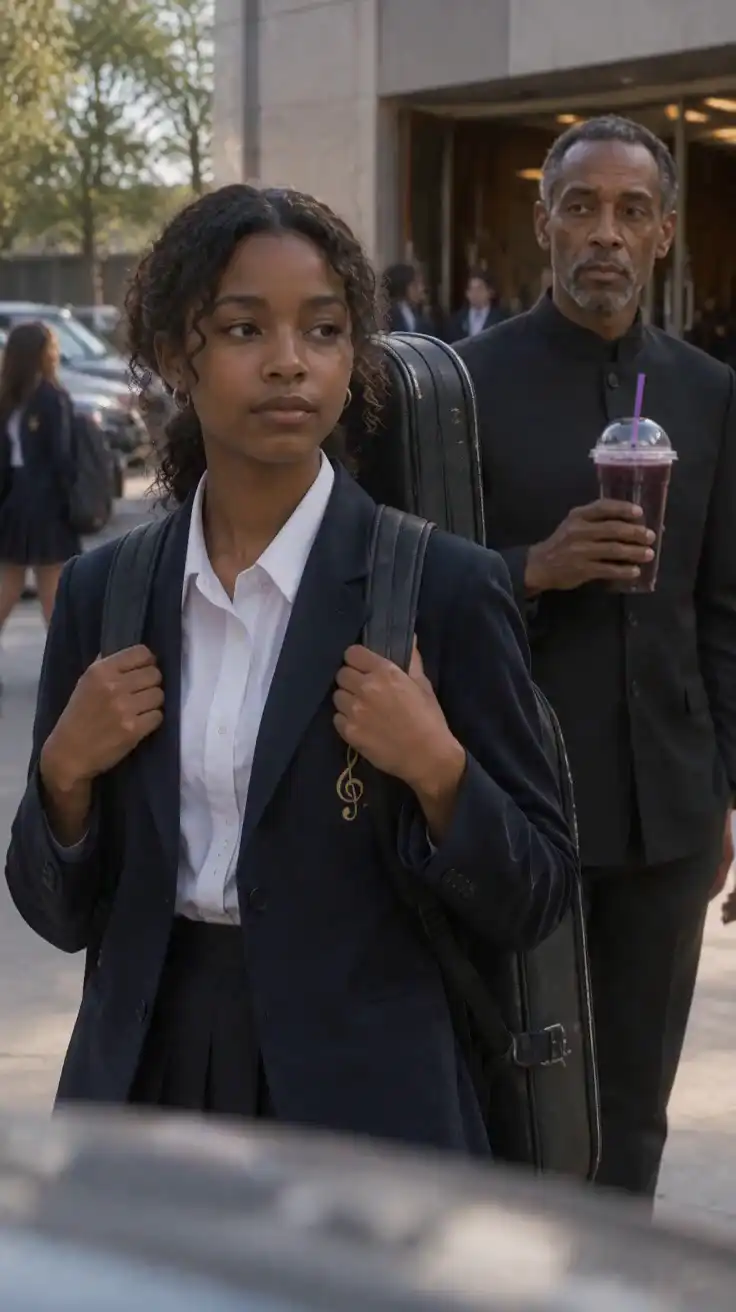
THE NAME IN BLACK INK
Mr. Adler’s name was on the withdrawal. Three days earlier, he had taken the team fund out of the account, and now he wanted me to sign a form saying I was the reason it was gone.
He wasn’t protecting the team. He was protecting himself.
The organizer looked from the signature to Mr. Adler. “Why was this withdrawn?”
“It was for registration,” he said.
Dad pointed to the amount in the ledger. “All of it?”
“We had other expenses.”
“Which ones?” Dad asked.
Mr. Adler drew his hand back from the page. “I don’t have the receipts with me.”
The organizer glanced at the clock over the lobby doors. “Our registration desk has been trying to reconcile payments all morning. A withdrawal could be an entry payment that hasn’t been recorded yet.”
“Then there should be a payment to you,” Dad said.
Mr. Adler set the paper napkin on the table. “This isn’t the place to go through every expense.”
My teammate Jada stepped up beside me. “You said Nia took the money.”
“I said the money was missing,” he replied.
“You said she took the fees.”
Jada’s voice wasn’t loud, but the organizer heard her. She put her hand over the withdrawal form so Mr. Adler couldn’t pull it away.
“What exactly are you asking Nia to sign?” she said.
“That she’s withdrawing from the tournament.”
The organizer turned the form toward herself. “It says the captain accepts responsibility for the missing entry funds.”
Mr. Adler’s jaw moved. “She handled the collection envelopes.”
“I counted them with you,” I said. “You took them to the bank.”
“You were responsible for keeping track.”
“I kept the list. You had the account.”
He looked at me the way he did when I made a move he thought was foolish: head tilted, waiting for me to take it back. I pressed my wet fingers against my skirt.
The organizer lifted the form. “Nia, don’t sign this.”
Mr. Adler reached for it. She folded it once and kept it in her hand.
Dad opened his coat. “I have the bank statements too.”
Mr. Adler’s eyes went to Dad’s inside pocket. “You had no right to get those.”
“I’m an authorized parent treasurer for the club,” Dad said. “The school asked me to reconcile the fundraising account last month. The statements come to me as well as to you.”
“You were supposed to help with the books, not bring private records into the lobby.”
“You accused my daughter in the lobby.”
The organizer held out her hand. Dad took a thin envelope from his coat and passed it to her.
The younger players had stopped whispering. Malik stood with his backpack straps wrapped around his fists. Beside him, Tessa held our box of spare pieces against her chest, the lid slipping open.
Mr. Adler noticed the envelope and stepped toward the organizer.
“Those papers are for the school,” he said.
“So is the money,” Dad answered. “And the tournament needs to know whether the entry was paid.”
The organizer opened the envelope and slid out the statement. A second sheet, covered in Dad’s neat pencil marks, came with it.
“What’s this?” she asked.
“My reconciliation. The deposits match the amounts the team collected. The withdrawal matches the balance in the ledger.”
Mr. Adler said, “That doesn’t prove what I did with it.”
“No,” Dad said. “It proves who took it out. If you paid the tournament, show her the receipt.”
Mr. Adler’s face tightened. He lifted his bag onto the registration table and unzipped a side pocket. Papers, a pack of score sheets, and a pen spilled out.
I watched the organizer scan the bank statement. I knew she was looking at numbers, but I kept thinking about the sentence Mr. Adler had wanted me to sign. I had almost taken the pen when he first pushed the form toward me. The younger kids were listening, and he had said the rest of them could play if I signed.
He sorted through the papers, turning them over one by one.
“Here,” he said at last.
He handed the organizer a printed invoice. She checked its number against a sheet on her clipboard.
“This is our invoice,” she said. “It isn’t a receipt.”
“It shows what we owed.”
“I know what you owed. I’m asking how you paid it.”
Mr. Adler took the invoice back. “I may have left the receipt at school.”
Dad pointed to the statement. “The withdrawal was cash. Is that how you paid?”
“I don’t remember.”
“You withdrew the entire balance three days ago.”
“I have more to do than memorize every transaction, Alan.”
Dad’s hand stayed flat on the table. “The entry deadline was yesterday. I asked you Wednesday whether you needed help getting the payment in. You told me it was handled.”
“It was being handled.”
“You said it was handled.”
The organizer held the statement closer. “Our office hasn’t recorded a cash payment from your school. The treasurer has the deposit log upstairs. I can ask him to check it.”
Mr. Adler closed his bag. “There’s no need to delay the tournament over this. Nia should withdraw, and I’ll settle the account with the school on Monday.”
“Why should I withdraw?” I asked.
“Because your name is on the collection list, and the team needs to move on.”
“My name is on the list because I’m captain.”
“And a captain takes responsibility.”
Dad turned toward him. “A captain doesn’t sign a false statement to make an adult’s problem disappear.”
Mr. Adler looked past Dad at me. “Nia, think about your teammates. If we stand here arguing, none of you will play.”
Malik loosened one backpack strap. “We can wait.”
“You don’t understand the situation,” Mr. Adler said.
“I understand you told us she took it.”
The organizer raised a hand before Mr. Adler could answer. “The team is currently marked ineligible because we have no payment. No individual withdrawal fixes that. I need the school and our treasurer involved.”
She pulled a phone from her jacket and walked a few steps away, close enough that I could still hear her.
“This is Denise at registration,” she said. “Can you bring the cash deposit log down? And please call Principal Harris at Coleman’s school. Tell her we need her on the phone before we remove a team from the pairings.”
Mr. Adler followed her. “There’s no reason to call the principal. I’m the faculty adviser.”
Denise turned back toward him. “That’s why she needs to know.”
He stopped.
A man with a hotel badge approached the red puddle with a mop and a yellow caution sign. He looked at me, then at the sticky floor.
“I’m sorry,” I said, moving out of his way.
“You don’t have to apologize to me,” he said. He set the sign down and began pushing the mop around my shoes.
Dad took off his coat. “Here.”
“You’ll get it dirty.”
“I have a washing machine.”
He held the coat open until I put my arms into it. The lining caught on my damp sleeve, and he helped me pull it free. The coat hung almost to my knees.
Mr. Adler watched us. “We should speak privately.”
Dad buttoned the top button of the coat. “You can speak in front of the people who heard you accuse her.”
“This is a school matter.”
“You made it their matter when you told them she took the fees.”
Denise returned and set her phone on the table. “Principal Harris is joining us in a few minutes. Our treasurer is bringing the log.”
Mr. Adler exhaled through his nose. “You’re making an embarrassment out of a misunderstanding.”
Jada opened her mouth, but I touched her arm. I didn’t want him turning on her next.
“I’d like to change,” I said.
Dad looked down at the wet edge of my skirt. “Of course. I’ll come with you.”
“I can take her,” Jada said. “My mom packed an extra shirt for me.”
Denise glanced toward the hallway. “There’s a restroom just past the elevators. Take your time. Pairings aren’t final yet.”
Mr. Adler said, “If she leaves, we’ll lose the chance to resolve this.”
“I’m not signing anything,” I told him.
His mouth opened. I walked away before he could answer.
Jada followed me with our team bag. Inside the restroom, she set it on the counter and pulled out a folded blue T-shirt.
“It’s clean,” she said. “My mom thinks tournament hotels are always freezing.”
I took off Dad’s coat and hung it over the stall door. My blouse had stuck to my skin. When I peeled it away, it made a faint ripping sound, and I stared at the red streaks across the white fabric.
“Do you want me to wait outside?” Jada asked.
“No.”
She turned on the faucet and wet a wad of paper towels. “Here.”
I rubbed at my arms. Pink ran into the sink. My hair felt stiff near the ends, and I tried to separate the strands with my fingers.
“I should’ve said something sooner,” Jada said.
“You did say something.”
“When he first started asking about the envelopes. At school.”
I looked at her in the mirror.
“He asked me if you ever took one home,” she said. “Yesterday, after practice. I told him no. I thought he was asking everybody because he was trying to find it.”
“Did he ask anybody else?”
“I don’t know. I didn’t want to make you worry before today.”
I pulled the blue shirt over my head. It smelled like laundry detergent. “He asked me whether I’d counted everything right. I told him I had.”
“He made you count it twice.”
“Three times.”
“And he watched every time.”
I rinsed the last paper towel and dropped it in the trash. “Will you tell Denise he asked you that?”
“Yeah.”
“You don’t have to if you don’t want to.”
Jada gave me a look in the mirror. “I want to.”
She handed me Dad’s coat. I put it on again, even though my arms were mostly dry. The wet blouse went into a plastic bag from the team kit. Jada tied the handles in a knot.
When we came out, a second tournament official stood at the table. He had a gray beard and a stack of papers tucked under one arm. Denise introduced him as Mr. Patel, the treasurer.
He shook Dad’s hand. Mr. Adler kept his hands in his pockets.
“Principal Harris is on her way,” Denise said. “She lives nearby. She asked us not to make a decision until she gets here.”
Mr. Patel placed the deposit log beside the statement. “I checked our records from the day the invoice went out through this morning. We have no payment from the school, cash or otherwise.”
Mr. Adler leaned over the table. “Did you check under my name?”
“Yes.”
“Could it have gone to someone else at registration?”
“Cash payments have to be entered here and receipted. The staff members on yesterday’s desk both say they didn’t take one from you.”
Mr. Adler tapped the invoice. “Then there’s been an error.”
“There may have been,” Mr. Patel said. “A receipt would help us find it.”
“I told you, it’s at school.”
“You said it might be.”
Mr. Adler looked at the lobby doors. “I can go get it.”
Dad said, “The school office is locked on Saturday.”
“I have a key.”
Denise held out her hand. “Before you leave, may I have the withdrawal form?”
She still had the folded paper. Mr. Adler stared at it.
“I mean I’d like to keep it with the account documents,” she said. “Principal Harris asked to see everything.”
He didn’t answer.
Denise placed the form under her clipboard. “Thank you.”
My teammates crowded around the equipment bags again. A few players from other schools had begun to arrive, carrying boards and rolling suitcases. They slowed when they saw our group, then moved on toward registration.
Tessa tugged on my coat sleeve. “Are we still playing?”
“I don’t know yet.”
She looked at the ballroom doors. “My grandmother said she’d come back for the second round.”
“Then we’ll tell her as soon as we know.”
Tessa nodded, but she kept her hand on my sleeve.
Mr. Adler stepped closer to me. “Nia, can I have a word with you?”
Dad shifted so he stood beside me, not between us. “You can speak to her here.”
Mr. Adler lowered his voice anyway. “I don’t want you to feel attacked. I know you’ve had a difficult morning.”
I held the coat closed. “You said I took the fees.”
“I was trying to get an answer.”
“You already had one.”
He glanced at the bank statement. “There’s still money unaccounted for.”
“You took it out.”
“I withdrew it for club business.”
“What club business?”
His eyes moved to the younger players. “This is precisely why we should talk in private.”
Jada came up on my other side. “You asked me if Nia took an envelope home.”
Mr. Adler frowned. “I asked whether anyone had seen the collection records.”
“You asked if she took an envelope.”
“I was checking every possibility.”
“You only asked me about her.”
Denise picked up a pen. “When was this?”
“Yesterday after practice,” Jada said. “He called me back when everyone else was packing up.”
Mr. Adler gave a short laugh. “Are we taking notes on a conversation with a child now?”
“I’m taking notes on how the accusation was made,” Denise said.
Jada folded her arms. “I told him Nia didn’t take anything home. I was there when we handed him the envelopes.”
Denise wrote that down. “Did anyone else see you hand them over?”
“Malik did,” I said.
Malik stepped forward, still wearing his backpack. “And Tessa. We were waiting for the late bus.”
Tessa let go of my sleeve. “He put the envelopes in his briefcase.”
Mr. Adler said, “Nobody disputes that I took the deposits to the bank.”
Dad answered, “You disputed where the money went.”
The hotel doors opened. A woman in a dark raincoat hurried in, carrying her shoes in one hand and a phone in the other. She stopped to put the shoes on, then crossed the lobby toward us.
“Principal Harris,” Denise said.
Principal Harris gave me a quick look, taking in Dad’s coat and the bag in Jada’s hand. “Nia, are you all right?”
“I’m okay.”
“Do you need a nurse?”
“No, ma’am.”
She turned to Dad. “Mr. Coleman.”
“Principal.”
“I understand there’s a problem with the entry payment.”
“There’s more than that,” Dad said.
Mr. Adler pulled a chair away from the registration table. “We can discuss this somewhere the students don’t have to listen.”
Principal Harris didn’t sit. “I’d like to hear from Nia first.”
Mr. Adler’s hand stayed on the chair back. “She’s upset.”
“I’m standing here,” I said.
Principal Harris looked at me again. “Tell me what happened with the money.”
I took a breath. There were other teams checking in behind her now. I could hear a suitcase wheel rattling over the tile.
“We collected the fees at school. I made a list of who paid and how much. Mr. Adler took the money to the bank. Yesterday he said it was missing and asked if I’d made a mistake.”
“Did you have access to the account?”
“No.”
“Did you make the withdrawal shown in this ledger?”
“No.”
Principal Harris looked at Mr. Adler. “Did you?”
“I withdrew funds for the tournament.”
“Did you pay the tournament?”
“I’m trying to establish that.”
Mr. Patel slid the log toward her. “We haven’t found a payment. We asked for a receipt.”
Mr. Adler said, “I may have it at school.”
“Then we’ll check,” Principal Harris said. She held out her hand for the ledger.
He hesitated only a second before giving it to her.
Dad offered his reconciliation and the bank statement. “I’m authorized on the account as parent treasurer. These are the copies I receive for the monthly review.”
Principal Harris read the pencil marks first, then the statement. “The deposits match?”
“Yes. The team’s collection list matches the deposits. The withdrawal cleared three days ago. It was the remaining balance.”
“And there are no other payments from the account after that?”
“No. The account was empty.”
Mr. Adler leaned toward the papers. “You can’t tell from the statement where the cash went.”
“That’s right,” Dad said. “You’re the person who can tell us.”
Principal Harris looked up. “Where is it?”
Mr. Adler rubbed his thumb against the side of his index finger. “Some was for the entry. Some was for expenses.”
“What expenses?”
“Supplies. Transportation.”
Tessa’s head came up. “My grandma paid for the van.”
Mr. Adler turned. “There are other transportation costs.”
Principal Harris asked, “Do you have those receipts?”
“At school.”
“You just said the entry receipt might be at school. Are all the receipts there?”
“I keep club paperwork in my office.”
“Then I’ll have the office opened with you present. But right now, we have a withdrawal, no tournament payment, and an accusation against a student. Denise, what is the status of the team?”
Denise checked her clipboard. “They’re marked ineligible for the unpaid entry. We haven’t released the final pairings.”
“How much time do we have?”
“Twenty minutes before we need to post them.”
Principal Harris looked down at the invoice. “The school will authorize the entry fee. Can you accept a purchase authorization now and payment from our office on Monday?”
Mr. Patel considered it. “We can accept a signed school authorization. We’ve done that for schools before. I’ll need your name and the school’s billing information.”
Mr. Adler said, “If you pay again, you’ll make it look as if I didn’t.”
Principal Harris met his eyes. “The tournament has no record of receiving the first payment. These students are not losing their entry while we sort that out.”
Denise drew a blank form from under the table. “I’ll bring this to the desk. Once the authorization is signed, we can restore the team.”
Mr. Adler put his hand on the form before Denise could lift it. “Nia’s withdrawal should still stand.”
The lobby seemed to narrow around the table. Principal Harris looked at his hand until he removed it.
“She hasn’t withdrawn,” Dad said.
“I’m her adviser. I’m recommending that she do so.”
“On what grounds?” Principal Harris asked.
“The team needs a captain who can account for the funds.”
“I can account for the funds,” I said. “I wrote down every collection. You signed for the withdrawal.”
“You’re speaking out of turn.”
“No,” Principal Harris said. “She’s answering you.”
Mr. Adler picked up the folded withdrawal form from beneath the clipboard. Denise caught the edge before he could take it.
“I need that,” she said.
“It was never signed.”
“That’s why I need it.”
He let go.
Principal Harris held out her phone. “Denise, may I have a photograph of the form and the ledger page? I’ll need them for the school’s report.”
Denise flattened the pages while Principal Harris photographed them. Dad moved his reconciliation into the frame when she asked, then passed her the bank statement.
“I’ll send you a clean copy of the statement,” he said. “This one has my notes in the margin.”
“The notes are useful,” she said. “Please send both.”
Mr. Adler watched the phone camera. “I’ve advised this club for six years.”
Principal Harris lowered the phone. “Then you know our rules about handling student funds.”
“I have never had a problem before.”
“I’m dealing with the one in front of me.”
She handed Denise the phone. “Can you call the school office manager? Her number is on the screen. Ask her to bring the authorization form up on her computer. I’ll sign what the tournament needs here.”
Denise went to the end of the table and made the call. Mr. Patel began filling in the tournament’s form.
Dad gathered the statement and reconciliation into a neat stack. “These are yours,” he told Principal Harris. “I have copies.”
She took them. “Thank you.”
Mr. Adler said, “You’re accepting his version without hearing mine.”
“I’m asking for your version,” she replied. “You haven’t told me where the cash is.”
“I need to look at my records.”
“Then you’ll do that with the school. For now, you’re relieved of your duties as adviser.”
He stared at her. “You can’t suspend me in a hotel lobby.”
“I can direct you not to supervise students while I make the report and contact the district. You are suspended from advising the club effective now.”
The words carried farther than she seemed to intend. A parent at the next table stopped filling out a registration card. One of the other coaches looked over.
Mr. Adler lowered his voice. “You’re doing this in front of them?”
“You accused one of them in front of everyone,” Principal Harris said.
He looked at me. For a moment I thought he might tell me to explain that it had all been a mistake. Instead, he bent to collect the papers he had spilled from his bag.
Principal Harris said, “Leave the ledger.”
“It’s mine.”
“It’s the club’s.”
He set it down so hard the blue tape on the spine lifted. Dad didn’t reach for him. He smoothed the loose tape back against the plastic cover.
Mr. Adler slung the bag over his shoulder. “Who’s going to supervise them?”
“I am,” Principal Harris said.
“You don’t know the tournament rules.”
“I can read them. If I need help, I’ll ask the organizers.”
Denise ended her call and returned. “The office manager is sending the school authorization to Mr. Patel. She’ll confirm it by phone.”
Mr. Patel checked his device, then nodded. “There it is.”
He passed the screen to Principal Harris. She read the authorization carefully, signed with the stylus, and returned it.
“I’ll confirm with the office,” Mr. Patel said. “Then Denise can update the entry.”
Mr. Adler stood beside his bag. “You’re going to let them play under her?”
Principal Harris looked at me. “Nia is the registered captain.”
“She’s been in the middle of this all morning.”
“Yes,” Dad said. “She has.”
Mr. Adler’s hand tightened around the bag strap. “You’re setting her up to fail.”
I looked at the ballroom doors. We had practiced openings on the bus, and Tessa had spent half the ride asking whether she could use the clock we had bought with the last of the bake-sale money. Our boards were still packed. None of us had even seen the pairings.
“I want to play,” I said.
Principal Harris waited. “Do you want to remain captain?”
“Yes.”
“Then that’s your answer.”
Mr. Adler started to speak again, but Principal Harris pointed toward the chairs by the far wall.
“Please wait there until I’ve spoken with the district,” she said. “Do not approach the students.”
He looked at the chairs, then at the people around the table. Finally he walked away and sat with his bag on his knees.
Tessa watched him go. “Is he coming into the room with us?”
“No,” Principal Harris said.
Tessa pressed the chess-piece box against her stomach. “Okay.”
Denise returned to her clipboard. “I need to verify the roster. Nia, would you help me?”
I stepped beside her. Dad gave me a small nod and stayed where he was.
Denise read the names one by one. Each player answered. When she reached mine, she looked up from the page.
“Your entry is in the captain’s position. No withdrawal has been submitted.”
Mr. Adler was close enough to hear. He kept his eyes on the floor.
“That’s correct,” I said.
Denise marked the roster. “I’m taking the ineligible flag off now. Mr. Patel has confirmed the authorization.”
She carried the sheet to a laptop at the registration desk. The keys clicked beneath her fingers. For a few seconds, nobody in our group moved.
Then Denise turned the screen toward me.
Our school’s name had changed from gray to black. Every player was listed underneath it. My name was still at the top.
“We’re back in?” Malik asked.
“We’re back in,” Denise said.
Malik let his backpack slide to the floor. Tessa opened the box of pieces and looked inside as though she needed to count them again.
Principal Harris took the roster. “I’ll be your school representative today. You can come to me or Mr. Coleman if you need anything.”
Dad said, “I can stay through the rounds.”
“You don’t have to miss work,” I told him.
“I called before I left the office. Someone else is covering for me.”
“You didn’t tell me.”
“You had a few other things to think about.”
Mr. Patel came back from the desk. “I need to make one more correction.” He looked toward the nearby teams and raised his voice enough for the registration area to hear.
“The entry issue for Coleman’s school has been resolved. The students are eligible, and there is no basis in our records to say Nia Coleman took the fees.”
My face grew warm. I wanted everyone to stop looking, but I also wanted them to hear every word.
Mr. Patel continued, “The matter involving the account is being handled by the school. Please direct any questions to the organizers, not the players.”
A parent who had been standing near the puddle nodded at me. Another turned her child back toward the registration line. The noise in the lobby slowly picked up again: zippers, shoes on tile, someone asking where to find the restrooms.
Jada bumped her shoulder against mine. “You heard him.”
“I heard him.”
She smiled, then pulled her phone from her pocket. “Can I tell my mom we’re playing?”
“Please do. She’s going to want her shirt back eventually.”
“She has six like it.”
“Then I’ll borrow this one for today.”
Dad’s phone buzzed. He checked the screen and stepped aside to answer. I heard him give the school office manager the account details she needed, spelling out the numbers slowly. He didn’t move away from us.
Principal Harris spoke with Mr. Patel about the supervision rules. She signed another line on the roster, then called us together.
“Players, opening instructions start in ten minutes,” she said. “Is there anything you need before we go in?”
“A board,” Malik said.
“We have boards,” Jada replied.
“A clean captain,” he added, then clapped a hand over his mouth.
I looked down at the borrowed shirt. One red stain showed at the collar where my damp hair had touched it.
“Best I can do,” I said.
Malik grinned. Tessa giggled into the box of pieces.
Dad came back and held out my water bottle. “I filled it for you.”
I hadn’t noticed him take it from my bag. I unscrewed the cap and drank. My throat hurt less afterward.
“Do you have the score sheets?” I asked Jada.
She unzipped the team bag. “Pens, too. Tessa, will you take one for each of us?”
Tessa set the piece box on a chair and began counting pens into a row. She chose a blue one for herself, then held up a green one.
“Nia?”
“Green is good.”
She handed it to me. Her fingers were sticky from the box, and she wiped them on her pants.
At the ballroom entrance, Denise posted the pairings. Players hurried toward the sheet, and the crowd closed around it. I stayed back until Jada found a gap.
“We’re on boards twelve through fifteen,” she called. “Nia, you’ve got board twelve.”
I joined her and checked each name. All four of us were there. No blank beside mine, no withdrawal written across the team roster.
Tessa pointed at her opponent’s name. “How do you say that?”
“Ask when you sit down,” I said. “And tell them yours.”
“What if I forget to press the clock?”
“You’ve played with a clock before.”
“What if I forget anyway?”
“Then press it when you remember. Watch your pieces first.”
She nodded and tucked the blue pen behind her ear.
Principal Harris gathered our equipment bags. “I’ll leave these along the wall where the officials tell me. Mr. Coleman and I will be in the spectator area.”
Dad came up beside me. “Do you need anything else?”
I checked my pockets: green pen, hair tie, the small folded list of openings I liked to review before a round. I had written them out on the back of an old car-wash flyer.
“No,” I said. Then I caught the cuff of his coat. “Actually, can you hold this?”
He helped me slip out of it. The lining was damp, but he folded the coat over his arm without looking at the stain.
“I’ll be right there,” he said.
“I know.”
Jada picked up the bag of boards, and Malik took the clocks. Tessa carried the pieces with both hands. I held the door while they went inside.
The ballroom smelled like carpet and coffee. Rows of tables stretched beneath the lights, each set with a board number. Players found their places while parents and coaches gathered behind the rope at the far end.
At board twelve, I set my pen beside the score sheet. My opponent was already seated, arranging the white pieces. I took the black ones from the bag and lined them up, rooks in the corners, knights beside them.
Across the room, Principal Harris found space for our bags. Dad stood next to her with his coat folded over his arm. When he saw me looking, he raised one hand.
I raised mine back.
Tessa reached her board and set down the box. She looked over at me. I pointed to the empty chair opposite her, then to the clock. She took a breath, sat down, and offered her opponent her hand.
The tournament director called for quiet. Chairs scraped, then settled. My opponent and I shook hands across the board.
“Good game,” she said.
“You too.”
She moved her first pawn. I wrote it on my score sheet, touched my own pawn, and made my move.