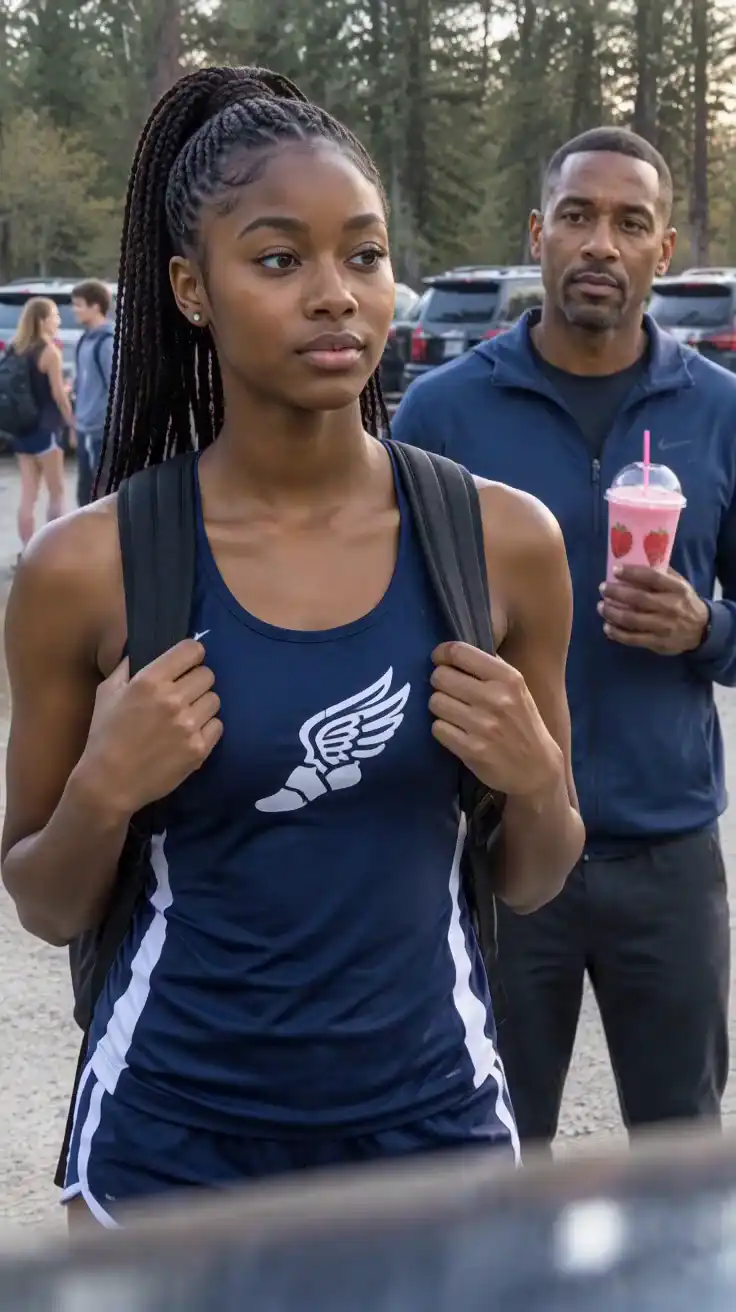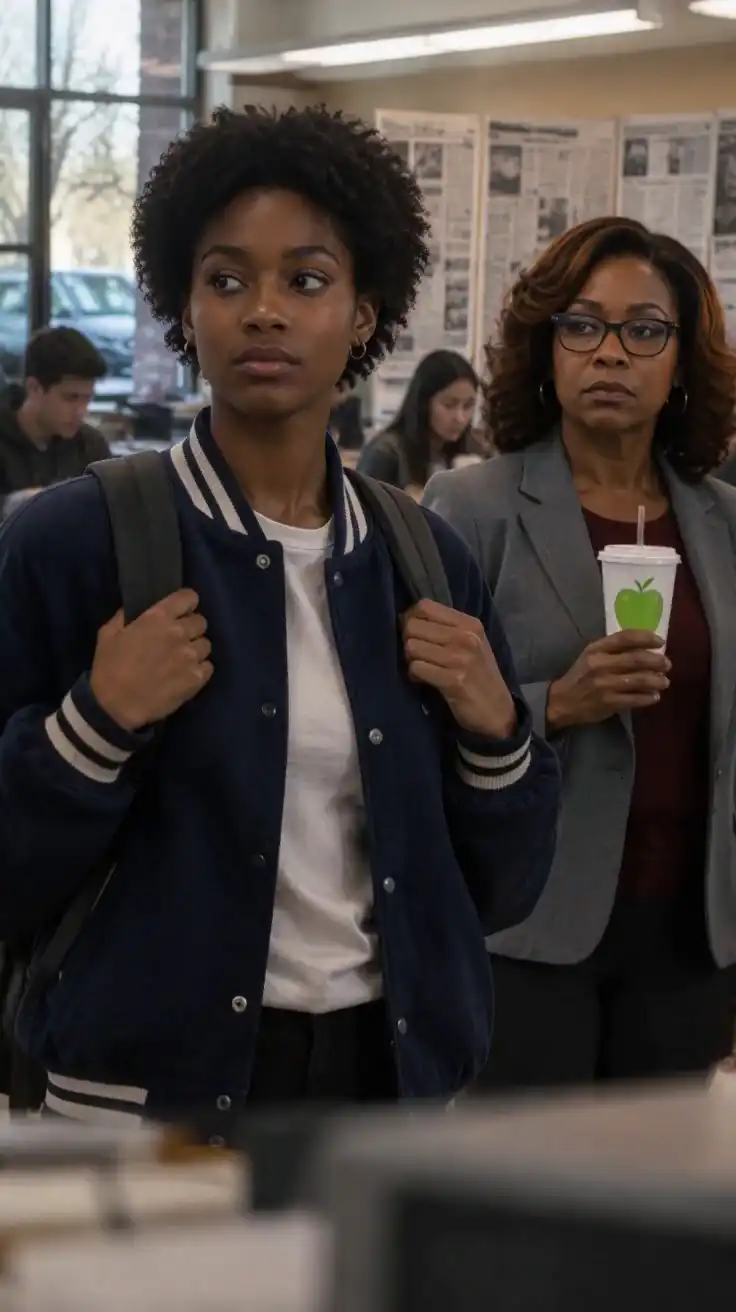
THE FIRST DRAFT
Two days earlier. That was the number Mr. Hollis had been counting on.
I looked from the screen to his face. “You read my essay before he submitted it.”
He uncrossed his arms. “I read a lot of essays.”
“Mine was in your draft folder.”
The assistant principal, Ms. Alvarez, glanced at him. “What draft folder?”
“The one he made us use for feedback,” I said. “I uploaded mine on Monday. He handed it back Wednesday.”
My father leaned toward the laptop, keeping his hands on the edge of the desk.
“When did your son submit his?” he asked Mr. Hollis.
“The screen tells you.”
“It tells me when he submitted it. I asked when he got it.”
Mr. Hollis picked up the empty cup from where he had left it on the filing cabinet. A drop of melted slush fell onto Ms. Alvarez’s carpet. He set the cup down again.
“My son wrote his own paper,” he said.
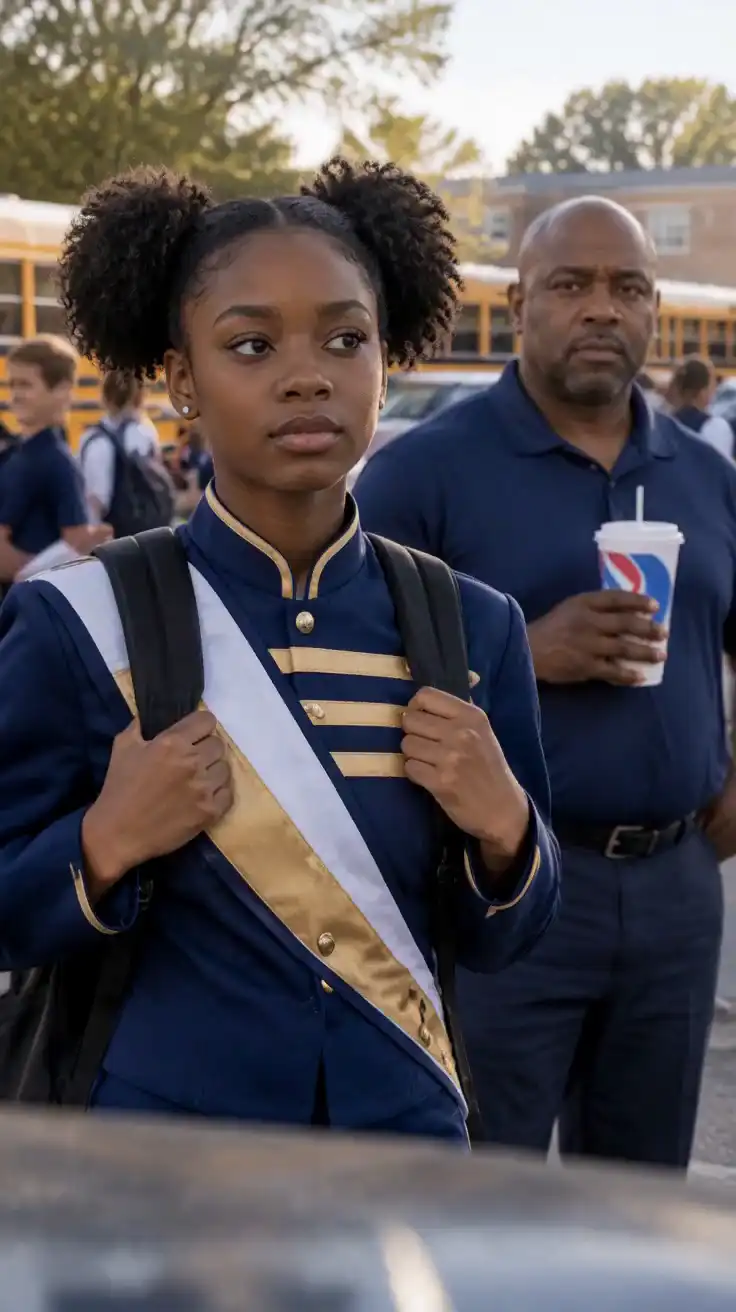
I could still feel syrup drying along my hairline. I wanted to scratch, but my hands were shaking, and I kept them in my lap.
“He couldn’t have written that opening,” I said. “It’s about my grandmother.”
Mr. Hollis’s mouth tightened. “The assignment was oral history. Plenty of students interviewed grandparents.”
“Mine worked nights at the hospital. She carried her shoes home in a grocery bag because her feet hurt. That’s in the first paragraph.”
Ms. Alvarez looked at the screen again. “The copy here says the interview was with his grandmother.”
“He changed her name,” I said. “He didn’t change the shoes.”
My father took a pen from his jacket. “May I have a copy of that record?”
Ms. Alvarez hesitated. “It contains another student’s name.”
“Then cover his name. You can see I already know whose submission it is.”
She opened a drawer and found a sticky note. After placing it over the name on the printed page, she slid the record across the desk. My father read the time, wrote it down, and gave the page back.
“I also want the draft she submitted to Mr. Hollis,” he said.
Mr. Hollis reached for his phone. “The committee can review whatever it needs.”
“Where is the draft?” my father asked.
“In the class folder.”
“Can Ms. Alvarez open it?”
“The hearing starts in fifteen minutes,” Mr. Hollis said. “We don’t have time to go digging through every version she claims to have made.”
I turned to Ms. Alvarez. “I can open it.”
She shifted the laptop away from me. “You’ll have a chance to present your side.”
“My side is in that folder.”
“And we’ll look at it during the hearing.”
Mr. Hollis’s phone buzzed. He glanced at the screen, then put it facedown. The skin above his collar had turned red.
I pulled the borrowed sweatshirt closer around me. Its sleeves were too long, and the cuffs stuck to my wrists.
“You wrote on my draft,” I said. “You told me the part about the grocery bag was distracting.”
“I give feedback to all my students.”
“You circled it.”
He looked at Ms. Alvarez. “She’s trying to make this about my grading.”
“No,” my father said. “She’s telling you how you got the essay before your son submitted it.”
For a moment, nobody spoke. Then Ms. Alvarez closed the laptop halfway.
“I’ll ask the technology office to retrieve the draft,” she said. “For now, we need to move to the conference room.”
She stood and opened the door. The secretary waited outside with a small plastic bag.
“I found these in the nurse’s office,” she said, handing it to me.
Inside were two wet paper towels and a comb with several teeth missing. I thanked her. My father carried the bag while I wiped the sticky spots from my neck.
At the end of the hallway, two students looked up from a bench. One of them was in my history class. She stopped talking when she saw us. I kept my eyes on the floor until we passed.
The conference room had a long table and a window looking out at the parking lot. Three adults were already seated: the honors coordinator, a counselor I recognized from the ninth-grade assembly, and a district employee with a visitor’s badge.
Ms. Alvarez introduced the district employee as Dr. Ellis. Her badge said STUDENT SERVICES.
My father pulled out a chair for me. Mr. Hollis took a seat at the opposite end of the table, beside Ms. Alvarez. He put a folder in front of him and aligned its edges with the table.
Dr. Ellis laid a yellow pad beside her water bottle. “Before we begin, Sanaa, would you like a few minutes to clean up?”
I touched the edge of the sweatshirt. There was pink on the cuff where I had wiped my face.
“I want to see the draft first.”
“That can be arranged,” she said.
Ms. Alvarez sat down. “I’ve asked technology to retrieve it.”
Mr. Hollis opened his folder. “We should be clear about the purpose of this meeting. The committee has two matching submissions. One was uploaded two days before the other. Sanaa’s honors placement requires original work.”
My father uncapped his pen. “And her teacher had her draft before either final submission.”
“He had everyone’s drafts,” I said.
Mr. Hollis gave a short nod. “That’s how feedback works.”
“Then yours is an important account,” Dr. Ellis said. “When did you receive Sanaa’s?”
He looked down at his folder. “I don’t have those dates memorized.”
“I do,” I said. “Monday morning. You told us to upload by eight.”
“And when did you return it?” she asked.
“Wednesday, in class. It had his comments on it.”
My father wrote both days on his notepad. “His son’s submission was Tuesday?”
Ms. Alvarez nodded.
The counselor looked at Mr. Hollis. “You had access to Sanaa’s paper when your son submitted the matching essay.”
“I had access to thirty papers,” he said. “That doesn’t mean my son saw them.”
“Did you discuss Sanaa’s essay with him?” Dr. Ellis asked.
“No.”
“Did you show it to him?”
“No.”
My father wrote those answers down too. Mr. Hollis watched the pen move.
Dr. Ellis turned to me. “Tell us how you prepared your essay.”
“I interviewed my grandmother at her apartment. I used the notes from my phone, then wrote the draft on my school account.”
“Do you still have the notes?”
“Yes.”
“Do they have dates?”
“I think so.”
“Could you bring them?”
My phone was in my backpack, which the secretary had set beside the door. I started to stand, but Mr. Hollis spoke first.
“Notes are easy to make after the fact.”
I sat back down.
My father put his pen across the pad. “So are accusations.”
Mr. Hollis looked at him. “I’m not accusing you.”
“You accused my daughter in a hallway full of students. You can answer questions about the draft.”
The counselor folded her hands. Ms. Alvarez opened the folder in front of her and shuffled the pages without looking at them.
Mr. Hollis leaned forward. “Victor, I understand you’re upset, but your daughter has been struggling with the language in class. The final essay doesn’t sound like her usual work.”
My father’s chair moved a few inches as he turned toward me. “Do you want to answer that?”
I hated that Mr. Hollis had made me do it in front of everyone, but I nodded.
“You told me to use the writing lab,” I said. “I went twice. Ms. Bell helped me cut sentences that repeated the same thing.”
Mr. Hollis tapped his folder. “There’s a difference between editing and producing an essay for someone.”
“She didn’t write it.”
“Can she verify that?”
“Yes.”
“Then give the committee her name,” he said.
“I just did.”
Dr. Ellis wrote something on her pad. “We can speak with Ms. Bell. Sanaa, please get your phone if you’re comfortable sharing the notes.”
I went to my backpack. My history notebook was inside, its cover damp from the sleeve of my shirt. I took out my phone and brought the notebook too.
The interview notes were in an app I used for vocabulary. My grandmother had answered some questions in English and some in the language she had spoken as a child. I had typed both, then added my own translations underneath.
I handed the phone to Dr. Ellis.
She read the first screen. “May I scroll?”
I nodded.
The date appeared at the top of each note. My father watched her without asking to take the phone.
“This entry is from the week before the draft was due,” Dr. Ellis said. “There are several entries over the next three days.”
Mr. Hollis held out his hand. “I’d like to see.”
Dr. Ellis passed the phone to him. He scrolled quickly, stopped, and then turned the screen toward me.
“Your grandmother called the hospital a factory?”
I leaned forward. “No. The word above it means factory. I wrote the wrong English word, and she corrected me.”
He gave the phone back. “Interesting.”
“It’s in the notes because I was trying to get it right.”
“I didn’t say it wasn’t.”
“You made that face.”
“Sanaa,” Ms. Alvarez said.
I looked at her. “He did.”
My father touched the corner of my notebook, not my arm. “Show them the notebook.”
I opened it to the page where I had worked out the order of the interview. Arrows crossed the paper. The phrase SHOES IN BAG was boxed twice. In the margin I had written, Ask why she didn’t leave them at work.
“My grandmother said people took things from the lockers,” I explained. “I didn’t put that part in the essay because it made the paragraph too long.”
The counselor leaned over to see. “Was that before or after your writing lab appointment?”
“Before the second one. Ms. Bell said I had too many details in the middle.”
The counselor made a note.
A knock came at the door. Ms. Alvarez opened it to a young man carrying a district laptop. He introduced himself as Evan from technology services.
“I was told there’s a question about an assignment folder,” he said.
Ms. Alvarez moved a chair aside. “We need the draft Sanaa Reed submitted to Mr. Hollis’s history class.”
Evan set the laptop on the table. “I’ll need the class and assignment names.”
Mr. Hollis supplied them. His voice had gone flat.
Evan typed for a while. The room was quiet except for the keys and the hum of the air vent. My father tore a corner off his notepad and used it to clean a streak of pink from the back of my phone.
“Here’s the folder,” Evan said. “There are student uploads and teacher feedback files.”
“Can you see mine?” I asked.
He turned the laptop slightly. My name was on a row near the bottom. Beside it was the date I had uploaded the draft.
“Monday,” Dr. Ellis said.
Evan clicked the file. The first paragraph appeared, including my grandmother’s shoes and the grocery bag.
My father sat back. Mr. Hollis stared at the screen.
“Is there a record of who accessed it?” Dr. Ellis asked.
“Not on this page. We have some activity records, but I’d need an administrator request to pull those.”
“Can you see the feedback?” I asked.
Evan opened another file. Mr. Hollis’s comments appeared in the margin. Beside the sentence about the shoes was a small yellow box: Is this detail necessary?
I pointed. “That’s what I told you.”
The counselor read the date on the feedback file. “Wednesday morning.”
“It was returned in class that afternoon,” I said.
Mr. Hollis adjusted his glasses. “Yes. I read the draft.”
My father looked at him. “Before your son submitted the essay?”
“Yes. I read it Monday evening.”
“And your son never saw it?”
“That’s what I said.”
Evan glanced between them. “Is the question whether the files are duplicates?”
Ms. Alvarez answered before anyone else could. “That’s part of it. We’ve had assignments appear twice when students resubmit.”
“They’re under different accounts,” I said.
“A system error could still be involved,” she said. “We don’t know enough yet.”
Evan clicked back to the folder. “A resubmission by the same student would normally stay under that student’s account.”
“Normally?” Mr. Hollis said.
“I’d have to look at the records before ruling anything out.”
Ms. Alvarez turned to Dr. Ellis. “It may be best not to draw conclusions until technology determines whether the system duplicated something.”
My father picked up his pen. “If the system duplicated Sanaa’s draft under your son’s name, Mr. Hollis, why did you say he wrote it?”
Mr. Hollis’s gaze moved to Ms. Alvarez, then back to my father.
“I said there were matching submissions,” he replied.
“You said your son wrote his own paper,” I said.
Dr. Ellis looked at the notes she had made. “That is what I heard.”
Mr. Hollis closed his folder. “I’m not a technology expert.”
“Neither am I,” my father said. “But you read her draft before the other submission existed. We can start there.”
Ms. Alvarez asked Evan to send the draft and feedback to the committee. He said he would need a district administrator to authorize the release because the records involved two students.
Dr. Ellis took out her badge and turned it so he could see. “I can make that request. Please preserve the access records as well.”
Evan wrote down her name and the time. Before he left, he looked at me.
“Don’t delete anything from your account,” he said. “Even if you think it’s a duplicate.”
“I won’t.”
After the door closed, Ms. Alvarez placed both palms on the table.
“The honors decision can wait until we have the records,” she said. “But Sanaa still has to attend history class in the meantime.”
“I don’t want to go back there today,” I said.
Mr. Hollis let out a breath through his nose. “That’s understandable after the disruption.”
I stared at him. There was still a sticky patch beneath my ear.
He turned to my father. “She could transfer out of my class. There’s another section, although it isn’t honors. If she withdraws voluntarily, we can avoid a prolonged dispute.”
My father did not answer immediately. He opened my notebook to the page with the boxed words.
“Would she lose her place in the honors program?” he asked.
“The committee would still have to review that,” Ms. Alvarez said.
“So you want her to give up the class before you’ve checked the records.”
“I want her to have a workable schedule,” Mr. Hollis said.
“You wanted that in the office too,” I said. “Before anyone looked at my draft.”
His fingers tightened around the edge of his folder. “You don’t have to make every suggestion into an attack.”
“I don’t want your suggestion.”
Ms. Alvarez looked at me. “We can arrange a temporary supervised study period while this is investigated. That isn’t a withdrawal.”
“Will my assignments count?” I asked.
“We’ll make sure you have access to the work.”
“From who?”
She glanced at Mr. Hollis. “I’ll ask the department chair to coordinate.”
My father wrote that down. “Please put it in writing.”
Ms. Alvarez’s mouth opened, then closed. “I’ll send an email.”
Dr. Ellis looked around the table. “The honors decision is postponed. No finding will be entered today. I’ll notify the district office that we need the submission and access records preserved.”
Mr. Hollis stood.
“I have another class,” he said.
Dr. Ellis did not stand with him. “I need you to remain available to answer questions about the draft.”
“I’m scheduled to teach.”
“I’ll speak with the principal about coverage.”
He looked at Ms. Alvarez as if waiting for her to disagree. She stared at the notes in front of her.
My father gathered my notebook and phone. I started to follow him out, but Dr. Ellis called my name.
“Sanaa, would you like to speak with the nurse before you go?”
“I want to wash my hair.”
“The nurse can help you call home.”
My father lifted the plastic bag with the comb in it. “I’m already here.”
For the first time since we had sat down, Dr. Ellis smiled. It disappeared when she turned back to her notes.
In the nurse’s bathroom, I bent over a small sink while my father waited outside the door. The water ran pink at first. I scrubbed my hairline with paper towels and school soap, then tried to comb through the wet strands.
The comb caught. I pulled it free and heard two teeth snap off into the sink.
“You all right?” my father called.
“Yes.”
I tried again, more slowly. When I came out, he was holding my backpack by the dry strap.
“We can go home,” he said.
“I have math after lunch.”
“You can miss math.”
“I have a quiz.”
“Then we can ask about the quiz.”
I took the backpack. “If I leave, everybody gets to decide what happened without me.”
He studied my face. “Staying doesn’t mean you have to sit in his classroom.”
“I know.”
The nurse came around her desk. She had found a clean towel and a bottle of water. My father thanked her and asked whether there was somewhere I could sit until Ms. Alvarez arranged the study period.
“You can stay here,” she said. “I’ll get the counselor.”
My father checked his phone. There were three missed calls from the court office.
“I told them I’d call after the meeting,” he said. “I need to let them know I won’t be back this afternoon.”
“You don’t have to stay.”
“I know.”
He stepped into the hallway to make the call. Through the partly open door, I heard him say, “My daughter needs me at school.” Then he lowered his voice, and I couldn’t hear the rest.
The counselor arrived with a hall pass and a sheet of paper. The department chair had arranged for me to work in the library during history. I could take the math quiz in a small room near the counselor’s office.
“Ms. Alvarez will send the details to your father,” she said.
I read the pass. The line for reason said SCHEDULE ADJUSTMENT.
“Can it say temporary?” I asked.
The counselor took it back and wrote TEMPORARY above the line.
When my father returned, I showed him. He nodded, but he asked the counselor for a copy of the email too.
I took the math quiz with wet hair against the collar of the borrowed sweatshirt. Halfway through, I found a dot of pink syrup on the corner of the paper. I rubbed it with my thumb until the counselor slid a tissue across the desk.
After school, my father and I went to my grandmother’s apartment.
She opened the door before I knocked a second time. My father had called from the car. Her slippers made a soft scraping sound as she stepped aside.
“What did he pour on you?” she asked.
“Strawberry slush.”
She touched the sleeve of the sweatshirt. “Did it stain your uniform?”
“I don’t know yet.”
She went straight to the kitchen and returned with a dish towel, as if I might still be dripping. Then she set it on the arm of the couch and looked at my father.
“Tell me what they need.”
I sat beside her and opened the notes on my phone.
“I wrote down what you said about the hospital. Do you remember when I came over?”
“The day your uncle brought the oranges.”
“That was Sunday,” my father said.
My grandmother nodded. “You left your notebook here. I called you before you got to the bus stop.”
“I came back for it.”
“You also ate the last piece of cake.”
“That part isn’t in the essay.”
“It should be.”
My father smiled, then opened his notepad. “Would you be willing to tell the district you spoke with Sanaa that day?”
“Of course.”
“They may ask you questions. You can answer in whichever language you prefer.”
My grandmother looked at him. “I know what you do at court, Victor. You don’t have to make me practice.”
He held up the pen. “I wasn’t going to interpret for you. I’m her father.”
“Good. You always try to improve my answers.”
“I do not.”
“You do.”
For a moment I could hear the refrigerator and the television in the next apartment. My grandmother reached for my hand. Her thumb stopped at the edge of the pink stain on my wrist.
“Did he ask you about my shoes?” she said.
“Not you. He asked why I put them in.”
“And what did you tell him?”
“I told him you carried them home because your feet hurt.”
She squeezed my hand once. “That’s why.”
My father asked whether she had any photographs from the hospital years. She found an envelope in a drawer, but he told her to keep the originals. We took a picture of one photograph on her kitchen table: my grandmother standing outside the hospital in her uniform, holding a bag at her side.
“That isn’t proof you wrote the essay,” my father said to me. “It’s something you can show them when you explain your interview.”
“I know.”
He looked at the photograph again. “We need the writing records too.”
At home, I signed into my school account at the kitchen table. My father sat beside me with his laptop, a glass of water, and the notepad from the hearing.
“Start with the first document you made,” he said.
There were four versions in the folder where I kept schoolwork. The first was called History Interview, and the second was History Interview New. The third was History Interview New 2. My father read the names without commenting.
“I was going to rename them,” I said.
“I didn’t say anything.”
“You were about to.”
He pointed to the first file. “Open that one.”
It was mostly notes and unfinished sentences. I had written the hospital paragraph twice, once with the grocery bag and once without it. Below that was a list of questions for my grandmother, including one I hadn’t used.
The document showed a creation date before the draft deadline. Its version history showed the times I had added and changed text.
My father took out his phone.
“Don’t just photograph the screen,” I said. “We can download the history.”
“Show me.”
I showed him where the version history opened. We saved copies of the early versions and printed the page showing their dates. I also downloaded the draft I had uploaded to Mr. Hollis’s folder, along with the feedback file.
My father compared the dates to the notepad.
“You made this before you uploaded the draft,” he said.
“Yes.”
“And he read the uploaded draft Monday evening.”
“That’s what he said.”
He drew a line beneath the two entries. “The district needs both the submission record and these original timestamps.”
He opened an email to Dr. Ellis. He attached the files one at a time, naming each attachment in the message.
I watched him type: Sanaa created the original document before the teacher’s son submitted the matching essay. Mr. Hollis confirmed at the meeting that he read her draft before that submission.
“Put in what he said about the system,” I told him.
“Ms. Alvarez raised that possibility.”
“Put that in too.”
He added a sentence asking the district to compare the separate account records and preserve any access history.
At the bottom he wrote that Sanaa’s honors status remained on hold, and that she had not agreed to withdraw from the class.
“Read it,” he said.
I leaned over his shoulder. The email was careful and plain. It did not mention that he worked in court until the signature, where he had included his job title under his name.
“Will they listen because of that?” I asked.
“I don’t know. It tells them what I do, not what they have to decide.”
He moved the cursor to the signature. “I can take it off.”
“Leave it.”
He sent the email and printed a copy. Then he made a second folder on his laptop and saved every attachment there.
“Why two folders?” I asked.
“One for what we send. One for what we keep.”
“Do you do that at work?”
“At work, I’m not the one collecting evidence.”
He tapped the printed email. “I listen to people say exactly what they mean. Today, when someone says they’ll do something, I want to know what they said and when.”
His phone buzzed. Dr. Ellis had replied that she had received the files and forwarded them to the district’s records office.
I read the reply twice. It did not say when they would decide anything.
The next morning, my father drove me to school. He had left his interpreter’s badge at home, but he wore the same dark jacket. The pocket still held the handkerchief he had offered me in the hallway. It had come out of the wash with a faint pink edge.
At the entrance, a girl from my history class stood with two friends. She looked at my father and then at me.
“Is it true you’re leaving honors?” she asked.
“No.”
“Someone said you took your name off the class list.”
“I didn’t.”
She shifted her backpack higher. “Okay.”
I wanted to ask who had said it, but the warning bell rang. The girl went inside with her friends, and my father walked me to the office.
Ms. Alvarez met us there. She had a printed schedule with LIBRARY written beside the history period.
“Your assignments will be posted by the department chair,” she said. “You can turn them in through the same portal.”
“What will it say on my attendance?” I asked.
“Present, in supervised study.”
“And my honors status?”
“Still pending.”
My father held out a hand for the schedule. He read it and returned it to me.
“Has Mr. Hollis been told not to discuss the accusation with students?” he asked.
Ms. Alvarez glanced toward the secretary’s desk. “I’ll remind him that student matters are confidential.”
“A student asked Sanaa whether she had left honors.”
“I can’t control what students say.”
“I’m asking what you’ll tell the teacher.”
“I’ll speak with him today.”
My father thanked her, but he wrote it down before we left the office.
In English, my teacher asked me to stay after the bell. I worried she had heard something, but she only handed me a worksheet I had missed while I was in the nurse’s office.
“Your presentation is still on Friday,” she said. “Would you like more time?”
“No.”
“If that changes, tell me.”
I folded the worksheet and put it in my binder. At the door she said, “Sanaa?”
I turned.
“Ms. Bell from the writing lab asked me to tell you she received a call from the district. She’s happy to speak with them.”
My shoulders dropped a little.
“She remembers my essay?”
“She said she remembers you arguing with her about a sentence.”
“I didn’t argue.”
My teacher raised an eyebrow.
“I explained why I wanted to keep it.”
“That sounds like what she said.”
At lunch, I went to the writing lab. Ms. Bell was sorting folders at a round table.
“I heard they called you,” I said.
“They did.”
“What did you tell them?”
“That you brought in a draft about your grandmother. I showed them the appointment log and the notes I made during our sessions.”
She opened a folder and took out a photocopy. Her handwriting ran down one side of the page.
“See here? I suggested you cut the sentence about the shoes. You said it showed how tired she was without having to say it.”
“Mr. Hollis wanted me to cut it too.”
“Did you?”
“No.”
“I remember.”
She gave me the copy. At the top was the date of our second appointment, before my final submission.
“Will they believe that I wrote it?” I asked.
“They have your drafts and my notes. I can’t make the decision for them, but I can tell them what I saw.”
A student came in behind me, holding a paper with red marks all over it. Ms. Bell pulled out a chair.
“Take that copy,” she told me. “Keep the original in my folder.”
At the library, I opened the first history assignment posted by the department chair. It was a set of questions about local migration. I answered the first three, then stopped at the fourth because I kept seeing Mr. Hollis’s comment box beside my grandmother’s shoes.
A message appeared in my school inbox. It was from him.
Sanaa, I hope you will reconsider transferring to the other section. Remaining in my class during this process will be uncomfortable for everyone. Ms. Alvarez can help you complete the withdrawal form.
I read it twice. Then I forwarded it to my father and Dr. Ellis.
My father called during the last ten minutes of the period.
“Did you answer?” he asked.
“No.”
“Do you want to?”
“I want to tell him he’s the one who should leave.”
“You can tell Dr. Ellis that you’re not withdrawing.”
“I already told them.”
“Tell her again, with the message attached.”
I typed: I am not withdrawing. Please make sure I can complete the honors work while the investigation is pending.
Dr. Ellis replied before the bell. She said she had received Mr. Hollis’s message and would address it. She also confirmed that the department chair would grade my work during the review.
When I got home, my father had printed the message too. It lay beside the other papers on the kitchen table.
“You don’t have to print everything,” I said.
“I know.”
He put it in the folder anyway.
Two days later, Dr. Ellis called my father and asked us to come to the district office. The records review was complete enough for another meeting, she said. Ms. Alvarez and the principal would attend. Mr. Hollis had been asked to come as well.
My father asked whether I had to be there.
“No,” Dr. Ellis said through the speaker. “But Sanaa can attend with you, and she can bring a support person.”
I looked at the phone. “I want to hear it.”
The district office was in a low brick building across from the bus depot. The conference room smelled like coffee, though nobody offered us any. A pitcher of water sat in the middle of the table beside a stack of paper cups.
Dr. Ellis had a district records specialist with her. The specialist, Ms. Chen, carried a thin binder. She waited until everyone had sat down before opening it.
Mr. Hollis was already there when we arrived. He did not look at me. His folder was on the table, but he kept both hands beneath it.
The principal introduced himself to my father, then to me. I had seen him at assemblies, but he had not been at the first meeting.
“I’m sorry we’re meeting under these circumstances,” he said.
My father pulled out my chair. “We’d like to know what the records show.”
Ms. Chen placed three pages in the center of the table.
“The first is Sanaa’s original document history,” she said. “The district confirmed the creation date and the sequence of edits in her school account.”
She pointed to the second page.
“This is the draft she uploaded to Mr. Hollis’s assignment folder. It was received Monday morning.”
The third page had a different account identifier. Ms. Chen covered the student’s name with a strip of paper before turning it toward us.
“This is the separate submission made from Mr. Hollis’s son’s account on Tuesday. It was not a duplicate created by a system resubmission. The system recorded an upload from that account.”
Ms. Alvarez leaned forward. “Could a file have been placed there by mistake?”
“An upload was made while that account was signed in,” Ms. Chen said. “The records don’t establish who was physically at the device.”
“But it wasn’t the system copying Sanaa’s submission?” my father asked.
“No. The two uploads came from different accounts at different times.”
Mr. Hollis moved one hand onto the table. “That still doesn’t prove where my son got his paper.”
Ms. Chen opened the binder again. “We also reviewed the access history for Sanaa’s draft and the district email records Mr. Hollis was asked to preserve.”
I looked at him. His hand had stopped moving.
Ms. Chen placed another page in front of Dr. Ellis.
“Mr. Hollis opened the draft Monday evening, as he stated in the first meeting. Later that evening, he sent an attachment from his district account to a personal email address.”
Mr. Hollis’s chair creaked.
“The attachment had the same file identifier as Sanaa’s draft,” Ms. Chen continued. “The personal address belonged to Mr. Hollis’s household. He confirmed that when we asked him yesterday.”
My father turned to him. “Why did you send it there?”
Mr. Hollis looked at Dr. Ellis. “I take work home.”
“Your district account can be accessed from home,” she said.
“I had trouble with the login.”
Ms. Chen slid a final page across the table. “The records show you accessed your district account from home that evening. You also replied to a message from the same personal address the following morning.”
Mr. Hollis picked up the page. His eyes moved over it.
“My son uses that computer,” he said.
Nobody interrupted him.
“He was working on the same assignment. He must have opened the attachment.”
“You told us he never saw it,” I said.
“I didn’t know he had.”
“You told us he wrote his own paper.”
“I believed he had.”
My father opened his folder. “Did you recognize Sanaa’s essay when you read his submission?”
Mr. Hollis put the page down. “They were similar.”
“It has my grandmother’s shoes in it,” I said.
“It’s a common detail.”
“My grandmother’s interview is in the notes. Ms. Bell saw my draft before your son submitted it. You saw my draft before he submitted it.”
He rubbed his forehead. “I didn’t compare every line.”
“You gave me feedback on the first paragraph.”
“I read a great many papers.”
Dr. Ellis opened a separate folder. “After the first meeting, you were asked not to contact Sanaa about withdrawing. You sent her a message the following day.”
“I was offering an option.”
“You described remaining in your class as uncomfortable for everyone.”
“It would be.”
I looked at him. “You made it uncomfortable.”
The principal held out his hand to Dr. Ellis, who passed him a sheet. He read it, then placed it in front of Mr. Hollis.
“We also spoke with your son,” he said. “He told us you saw his submission before the allegation against Sanaa was made.”
Mr. Hollis’s face changed. He reached for the sheet, but the principal kept one finger on its corner.
“His statement isn’t being distributed here,” the principal said. “I’m telling you what he reported. He said he showed you the essay Tuesday night.”
Mr. Hollis looked down at the table.
“Did you recognize it then?” the principal asked.
“I recognized parts.”
“Parts from Sanaa’s draft?”
“Yes.”
My father’s pen stopped moving.
“Why didn’t you tell the committee?” Dr. Ellis asked.
Mr. Hollis folded his hands. “My son said he’d written it. He said Sanaa must have taken it from him.”
“After he had access to her draft?” my father said.
“I didn’t know he’d opened the file.”
“You knew I’d sent it to you first,” I said.
Mr. Hollis looked at me. “A draft isn’t always a student’s own work.”
“You wrote comments on it. You handed it back. You didn’t say I copied anything until after your son turned it in.”
He opened his mouth, then closed it.
The principal took the sheet back. “You also confronted Sanaa outside the hearing.”
Mr. Hollis looked at Ms. Alvarez. “I lost my temper.”
My father’s hand rested on the folder. He did not move toward him.
“You poured a drink on my daughter,” he said. “She had to sit in that meeting wearing a borrowed sweatshirt.”
Mr. Hollis stared at the water pitcher.
The principal said, “You were instructed to bring your concerns to the committee. Instead, you confronted a student in the hallway and contacted her afterward about withdrawing.”
“I apologized to Ms. Alvarez for the incident.”
I waited.
He did not look at me.
Dr. Ellis closed the records binder. “Sanaa’s original document history, the draft submission, the writing lab records, and the account logs support her authorship. The separate upload from your son’s account was not a system duplicate.”
Ms. Alvarez folded her hands. “I should have waited for those records before discussing a transfer.”
I looked at her. “You said it might be a system error.”
“I did. I was trying not to draw a conclusion.”
“You let him tell me to leave.”
She looked down at the table. “Yes.”
My father turned to Dr. Ellis. “What happens to the honors hold?”
“The committee will receive the findings today,” she said. “I’m recommending that the allegation against Sanaa be removed and her honors standing restored.”
“Today?” I asked.
“Yes. I can’t speak for the committee until it votes, but they’re meeting this afternoon.”
Mr. Hollis pushed his chair back. “Am I supposed to sit here while you decide all of this?”
The principal said, “You’re being placed on administrative leave while the district completes its personnel process. You won’t teach or contact students during that time.”
Mr. Hollis looked at him. “Over an investigation that isn’t finished?”
“Effective now.”
For the first time, he looked directly at me. His eyes dropped to the folder in my lap, where the corner of Ms. Bell’s notes was sticking out.
The principal stood. “A district administrator will walk you through the next steps. You may collect personal items from your classroom after students have left.”
Mr. Hollis remained seated.
“I have papers to grade,” he said.
“The department chair will handle them.”
“My students have an exam next week.”
“Another teacher will cover it.”
Mr. Hollis picked up his folder. He slid the pages inside, but one caught on the edge and bent. He straightened it with his thumb.
“I want a copy of everything,” he said.
“You’ll receive the records you’re entitled to through the personnel process,” the principal replied.
Mr. Hollis walked out with the administrator. No one raised a hand to stop him or followed him into the hallway except the administrator.
My father waited until the door had closed.
“Will Sanaa have to return to his class if he comes back?” he asked.
Dr. Ellis said, “The district will decide the teaching arrangement. For now, she can remain in the honors section with the department chair as her instructor.”
“I want that in writing,” my father said.
“I’ll send it.”
He nodded. “And the hallway incident?”
“The principal is addressing it as part of the personnel matter.”
“Will the students who saw it be told she wasn’t found responsible for plagiarism?” I asked.
The adults looked at one another.
“I don’t want you to tell everyone about his son,” I said. “I just don’t want people thinking I copied.”
The principal pulled a chair closer to the table. “We can correct the information about you without discussing another student’s records. What would you be comfortable with?”
I thought of the girl at the entrance asking whether I had left honors.
“Tell my class I’m still in it,” I said. “And that the accusation against me was withdrawn.”
Dr. Ellis wrote it down. “We’ll work out the wording with you.”
On the drive home, my father pulled into a grocery store parking lot and turned off the engine.
“Do we need something?” I asked.
He looked through the windshield. “I need a minute before I drive.”
I sat beside him. A shopping cart rolled slowly across an empty space and bumped against a curb.
“He said he recognized it,” I said.
“Yes.”
“He let me sit there while everybody asked if I could have written it.”
My father’s fingers tightened on the steering wheel. Then he took them away and put both hands in his lap.
“I heard him.”
“I thought if I explained it clearly enough, he’d stop.”
“You explained it clearly.”
“He still didn’t stop.”
“No.”
I pulled a loose thread from the cuff of my sweatshirt. It was my own sweatshirt that day, washed so many times the gray had gone pale.
My father took the clean handkerchief from his pocket and unfolded it. The pink edge showed.
“I washed this twice,” he said.
I took it from him. “You missed a spot.”
“I can see that.”
I pressed the stained corner between my fingers. “Can we go to Grandma’s?”
He started the car.
My grandmother listened without interrupting while I told her about the records and Mr. Hollis admitting he recognized the essay. When I finished, she went to the kitchen and brought back a plate of sliced oranges.
“Did you eat lunch?” she asked.
“Not much.”
She put the plate in front of me. My father took a slice, and she tapped his hand.
“Those are for her.”
“You brought the whole plate.”
“I know how many I brought.”
He put the slice back. I took two and handed him one.
Dr. Ellis called while we were still at my grandmother’s table. The honors committee had voted to remove the plagiarism finding. My award and my place in the history program were restored.
“I’ll send the formal notice tonight,” she said. “The principal will also arrange the correction we discussed.”
I put the call on speaker so my grandmother could hear. When it ended, she held out her hand for the phone.
“Show me where it says restored.”
“The email isn’t here yet.”
“Then we’ll wait.”
We did. My father checked his phone twice before it arrived. He read the message, then passed it to me.
The notice named my honors program and said my standing had been restored without penalty. It also confirmed that the department chair would teach the section while Mr. Hollis was suspended on administrative leave.
My grandmother put on her glasses and read the screen slowly.
“Print it,” she told my father.
“I was going to.”
“I know.”
The following Monday, the department chair stood at the front of the history classroom. My seat was still beside the window. Someone had left a pencil shaving on the desk, curled into a tight little ring.
The chair waited until the bell rang.
“Before we begin,” she said, “I have a correction to make. An allegation that Sanaa copied her history essay was reviewed and withdrawn. She remains in the honors program.”
The girl who had asked me about leaving turned around in her seat.
“I’m sorry,” she said quietly.
I nodded. She faced the front again.
The department chair handed back an assignment I had completed in the library. At the top she had written, Good use of the interview detail. Underneath, she had asked one question about the source I used in the second paragraph.
I took out my pencil and wrote the source in the margin.
After school, my father waited by the entrance. He had come straight from court again, his badge tucked inside his jacket. I held up the returned assignment before I reached him.
“The department chair graded it,” I said.
He looked at the mark, then at the question in the margin. “Did you answer her?”
“Yes.”
“Good.”
We walked past the language wing. A custodian had polished the tiles, and a strip of late sunlight lay across the floor. My father kept pace beside me without reaching for my backpack.
At the doors, I took the printed honors notice from my folder. The fold had already gone soft from being opened so many times.
“Grandma wants a copy for her refrigerator,” I said.
“We can print another.”
“I want to give her this one.”
He held the door while I tucked the notice safely back into the folder. Then we went outside, and I called my grandmother to tell her I was bringing it over.