THE NAME ON THE AGREEMENT
“Lena Mercer,” I read.
Mr. Lang’s own student. The sponsor’s daughter.
Mom held the agreement steady beneath the light. Lena’s initials, L.M., sat beside a second signature marked 3:40 p.m.
Mr. Lang reached for the paper. Mom drew it back before he could take it.
“That’s a checkout record,” he said. “It doesn’t prove Lena did anything.”
“It proves she handled the violin,” Mom said. “A moment ago, you told us Aisha was responsible for it.”
“She was responsible for returning it.”
“I never had it,” I said.
My stand partner, Maya, shifted her bow to her other hand. “I saw Lena with a case after rehearsal.”
Mr. Lang turned toward her. “Go warm up.”
Maya didn’t move.
The manager folded the towel over her hands. “Could we lower our voices? People are beginning to gather.”
Two members of the viola section had stopped by the doorway. One of them looked at the wet floor, then at my jacket. I pulled the towel from the manager and pressed it against my sleeve.
Mom put the contract on top of the case, keeping it clear of the damp lining.
“Lena signed for the instrument at the shop this morning,” she said. “And she signed again at three-forty when she returned to exchange the bow. I remember her coming in.”
Mr. Lang’s mouth tightened. “I sent her. The orchestra needed a spare.”
“Then you knew whose name was on the agreement.”
“I didn’t know what she’d done with the paperwork.”
Mom tapped the line with one finger. “You knew who had the violin.”
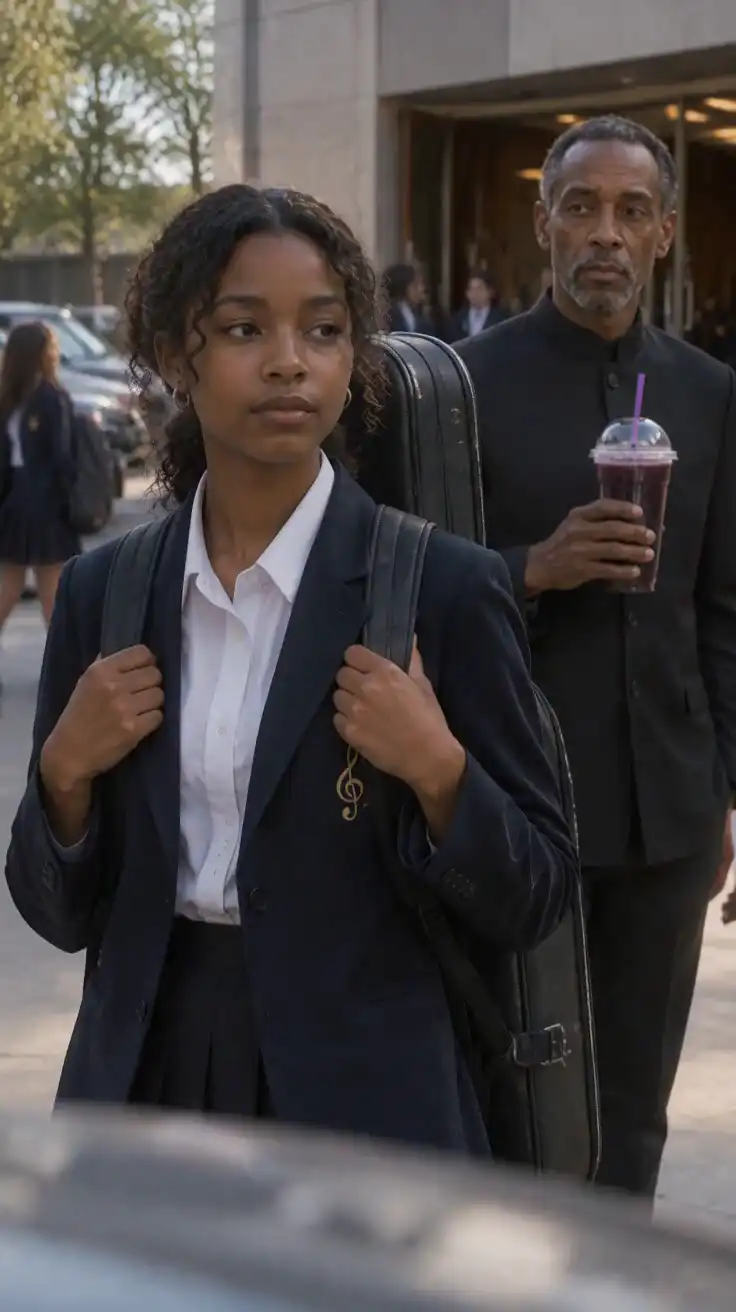
Lena stood at the far end of the corridor, half hidden behind a rack of garment bags. She was already dressed in black. Her bow case hung from one shoulder, and her father stood beside her with his phone in his hand.
Mr. Mercer lowered the phone when he saw us looking.
“Lena,” Mom called. “Would you come here, please?”
Mr. Lang stepped into the corridor. “There’s no need to involve her in this.”
“She’s already involved,” Mom said. “She signed for the violin.”
Mr. Mercer put a hand on his daughter’s shoulder. “What exactly is going on?”
The manager answered before any of us could. “There appears to be some confusion about a rental instrument. We’re handling it.”
“By putting it on Aisha?” Maya asked.
Mr. Lang pointed toward the rehearsal room. “Maya. Now.”
She looked at me. I wanted to tell her to go, to keep her place and let me deal with mine. But my chair had already been moved, and Mr. Lang had told everyone I couldn’t play. If Maya left, there would be one less person standing there who had seen anything.
“I’m staying,” she said.
Lena took a step forward. Her father’s hand fell away.
“I signed for it,” she said. “Dad, I told you I was picking it up.”
Mr. Mercer looked at Mr. Lang. “You said Aisha had borrowed it.”
“I said Aisha had it when the problem was discovered.”
“That’s not what you told the manager,” Mom said.
Mr. Lang looked past her at me. “Aisha, did you or did you not have the violin when I came to the stage door?”
I looked down at the case. The violin inside was not my own. Mine was in my locker, where I had left it after rehearsal. This one had appeared outside the practice rooms in an open case, with its bridge crooked and one string slack. I had picked it up because I knew what could happen if someone shut the lid on it.
“I had it because you asked me to look at it,” I said.
“You were carrying it.”
“You put it in my hands.”
Mr. Lang gave a short laugh. “I certainly did not.”
Maya lifted her chin. “I heard you ask her.”
“You heard a conversation from down the hall,” he said.
“I was right beside her.”
The manager held out her hands. “All right. We can sort out who carried it after the concert. For now, the violin is damaged, the floor is wet, and we have an audience.”
Mom looked at her. “You offered to call this an accident before you knew what happened.”
“I was trying to keep the evening from falling apart.”
“Then don’t put the wrong name on a claim.”
The manager glanced at Mr. Mercer. His family’s name was printed on the program cover beneath the orchestra logo. It was also on the banner hanging in the lobby. I had walked past it on my way in, carrying my music folder and trying not to catch my dress shoes on the hem of my pants.
Mr. Mercer took the agreement from Mom when she offered it. He studied the signatures, then passed it to Lena.
“Did you bring it here?” he asked.
“Yes.”
“What happened to it?”
Lena rubbed the edge of the paper with her thumb. “I don’t know exactly.”
Mr. Lang stepped closer. “You don’t have to answer that in the corridor.”
Mom kept her voice level. “She doesn’t have to answer me at all. But the board will need to know who signed for the instrument if the orchestra intends to file a claim.”
“The board is not going to interrupt a concert over a rental,” Mr. Lang said.
Mom looked at the manager. “Who’s here from the board?”
The manager hesitated.
“Evelyn Reed,” she said finally. “The chair. She’s greeting guests.”
“Please ask her to come backstage.”
Mr. Lang shook his head. “Absolutely not. We have ten minutes.”
“Then she can decide what to do with ten minutes,” Mom said.
The manager took out her phone but didn’t dial. “Mrs. Foster, I understand why you’re upset. I also have a hall full of families, a conductor who needs to be onstage, and an instrument we can have repaired. Let us put it down as accidental damage tonight. We can discuss the rest tomorrow.”
“And what happens to Aisha tonight?” Mom asked.
The manager’s eyes moved to my sticky jacket.
“We have Lena ready to sit in,” she said. “Just until things are settled.”
My stomach dropped. Lena had been sitting second chair for the last two concerts, but she had never led our section. Mr. Lang had been giving her extra lessons for months. I knew because I waited outside his studio every Thursday for my own lesson, and Lena often came out as my time was supposed to begin.
Last week, after auditions for concertmaster, he had told me I won by one point.
“You played well,” he had said, stacking the judges’ sheets. “Don’t become comfortable. Lena’s improving.”
I had taken that as a challenge and gone home to practice.
Now Lena stood with my mother’s rental agreement in her hands while my chair waited somewhere offstage.
“I auditioned for that seat,” I said.
Mr. Lang didn’t look at me. “This is not the time.”
“You moved it before anyone looked at the contract.”
“The orchestra requires a concertmaster who can be trusted.”
“You asked me to check the violin.”
“And I am asking you to step aside.”
He said it quietly, but the violists heard him. One of them turned and disappeared through the door.
Mom held out her hand to Lena. “May I have the agreement back?”
Lena gave it to her. Mr. Mercer watched as Mom slid it into a clear folder.
“Call Ms. Reed,” Mom told the manager.
The manager tapped her phone. “She may not answer.”
“Then leave her a message.”
She called. While the phone rang, Mr. Lang leaned against the wall and crossed his arms. Lena stared at the floor.
“Evelyn,” the manager said when the call connected. “Could you come to the stage door? We have a situation involving one of the rental violins and a student.”
She listened, then added, “Yes. Before the concert.”
When she hung up, Mr. Lang pushed away from the wall.
“You’ve made your point,” he told Mom. “The board chair is coming. Now take Aisha to get cleaned up.”
I wanted to get cleaned up. Syrup had dried along my neck, and every time I moved, my sleeve stuck to my wrist. But I didn’t want to leave him with Lena and the manager.
Mom seemed to know.
“We’ll stay here,” she said.
Mr. Mercer pulled Lena a little farther down the corridor. I could still hear him.
“Did you damage it?”
“I don’t think so.”
“That isn’t an answer.”
“I brought it back to the hall. Mr. Lang took it into the practice room. Later he said the bridge was crooked.”
“Did you tell him you’d signed for it?”
“Of course I did.”
Mr. Mercer’s voice dropped. “Why didn’t you say something when he blamed Aisha?”
Lena looked toward us. “He said he was going to work it out.”
“By putting you in her chair?”
“He said she couldn’t play tonight.”
My fingers tightened around the towel. Lena had heard him. She had seen my chair moved. She had still put on her concert clothes and waited.
Mr. Mercer opened his mouth, but Ms. Reed came through the stage door before he could speak.
She wore a dark blue dress and carried a stack of programs against her chest. The manager went to meet her, speaking quickly. Ms. Reed listened without interrupting, then looked at me.
“Aisha, are you hurt?”
“No, ma’am.”
“Do you need a nurse?”
“No. I just need a dry jacket.”
Ms. Reed looked at the floor, the towel, and the violin case. Then she looked at Mr. Lang.
“What happened?”
He held out a hand toward the instrument. “There was an incident with a rental violin. Aisha was carrying it when the damage was found. I decided Lena should lead tonight while we get the details.”
“That doesn’t answer my question,” Ms. Reed said.
Mr. Lang’s eyes flicked to my sleeve. “There was a drink. It spilled.”
Maya made a noise in her throat.
Ms. Reed turned to her. “Did you see it?”
“Yes.”
“Did it spill?”
Maya looked at Mr. Lang, then back at Ms. Reed. “He poured it on Aisha.”
The corridor went quiet enough that I could hear the audience beyond the stage wall. A burst of laughter came from the lobby, followed by the low hum of people finding their seats.
Mr. Lang said, “That is an unfair description.”
“It’s what happened,” Maya said.
Ms. Reed shifted the programs into one arm. “Aisha?”
I could feel everyone watching me. I kept the towel against my wrist.
“He poured it over my head,” I said. “Then he told me I couldn’t play.”
“I told you that you couldn’t play in that condition,” Mr. Lang said.
Mom’s hand settled on my shoulder for a moment. She didn’t squeeze. She just left it there until I stopped pulling at the towel.
Ms. Reed handed her programs to the manager. “I’m going to need another board member here.”
“We don’t have time for a hearing,” Mr. Lang said.
“No,” Ms. Reed replied. “We have time to decide whether you should go onstage with these students.”
He stared at her. “You can’t make that decision based on a child’s accusation.”
“Two children have described what they saw. You’ve acknowledged the drink. I’m not dismissing anyone in this corridor, but I am responsible for what happens next.”
Mr. Mercer cleared his throat. “My daughter signed for the violin. I’ve just seen the agreement.”
Mr. Lang turned to him. “Richard, surely you understand that a signature doesn’t establish damage.”
“I understand that. I also understand you told me Aisha had borrowed it.”
“I said she had it.”
“You let me believe she’d borrowed it.”
Lena pulled at the strap of her bow case. “Dad, please.”
“No,” Mr. Mercer said. “I want to know why he put you in her place.”
Mr. Lang’s voice sharpened. “I put her there because she is prepared.”
“So am I,” I said.
He finally looked at me. “You are standing in a ruined jacket with an instrument in question.”
“My own violin is in my locker.”
“Your conduct is in question too.”
“What conduct?” Mom asked.
“She interfered with an instrument that wasn’t hers.”
“You told me to look at it,” I said again.
“And she’s been disruptive ever since,” he said.
Maya stepped closer to me. “You’re the one who—”
Ms. Reed raised a hand. “One at a time.”
She asked the manager to call another board member and the orchestra’s assistant conductor. The manager went down the hall, already speaking into her phone.
Mr. Lang watched her leave. “You’re going to embarrass this organization in front of its largest sponsor.”
Mr. Mercer looked at him. “I’m standing right here.”
“Then you know what’s at stake.”
“My daughter’s name is on that form,” Mr. Mercer said. “I’d rather know why you didn’t mention it.”
Lena pressed her lips together. I couldn’t tell whether she was angry at him or at us. Maybe both.
Mom opened her folder and took out a second sheet.
“This is our copy of the agreement,” she said to Ms. Reed. “The shop keeps one whenever an instrument leaves. The orchestra has the other. I brought ours because Aisha called and said there was a question about a rental.”
I remembered the call. I had made it from the practice-room hallway when I first saw the crooked bridge. Mom had asked me not to adjust it. She said she would come after closing the shop’s front counter.
“I didn’t know she was coming inside,” I said.
“You told me a violin from my store might be damaged,” Mom replied. “I wasn’t going to leave you to sort that out alone.”
Mr. Lang pointed at the folder. “You’ve had your say. We can inspect the violin tomorrow.”
“We can inspect it now,” Mom said. “I have a clean cloth and a light in my bag. But I won’t agree to an insurance claim that names Aisha as the person responsible when we don’t know what happened.”
Ms. Reed nodded. “Please inspect it.”
Mom knelt beside the case. I moved to make room. She took a small flashlight from her bag and shone it along the violin’s body, careful not to touch the damp lining. Her fingers worked under the instrument, lifting it by the neck and lower edge.
“The bridge is out of position,” she said. “The E string is loose. I don’t see a crack from here, but I’ll need to examine it properly at the shop.”
“Could the bridge have moved while it was being carried?” Ms. Reed asked.
“It could have moved for several reasons. Someone could have bumped it. The case could have been closed on it. I can’t tell you which just by looking.”
Mr. Lang spread his hands. “There. An accident.”
Mom set the violin on the dry side of the case. “I said I can’t tell you what caused it.”
“And I’ve said we can resolve the claim,” he replied.
“You’ve also said Aisha was responsible.”
“She had it in her hands.”
“After you handed it to her,” I said.
Mr. Lang exhaled through his nose. “This is getting us nowhere.”
“Then perhaps Lena can tell us where it was before that,” Ms. Reed said.
Lena looked at her father. He nodded once.
“I picked it up this morning,” she said. “Mr. Lang asked me to because Mom was already driving past the shop. The orchestra wanted a spare in case someone’s instrument had a problem.”
“That’s right,” Mom said. “Your mother called ahead. Lena signed when she collected it.”
Lena glanced at the contract. “At three-forty I went back because the bow latch wasn’t closing. Mrs. Foster gave me another bow.”
“And the violin?” Ms. Reed asked.
“It stayed with me. I carried it back here.”
“Where did you put it?”
“In the practice room beside the piano. Mr. Lang was there.”
Mr. Lang said, “I was teaching.”
“I know. You told me to leave it.”
“Did you open the case?” Ms. Reed asked.
“Not then.”
“What happened after your lesson?” she asked Mr. Lang.
“I moved it out of the way.”
“Where?”
“Onto the chair by the wall.”
“Did you open it?”
“No.”
Lena frowned. “You opened it when I came back.”
Mr. Lang turned to her. “You’re mistaken.”
“You asked me if the bridge looked straight.”
“Lena,” he said.
She stopped.
Mr. Mercer’s hands closed around the phone he was holding. “Let her finish.”
Lena looked from her father to Mr. Lang. “It was crooked when he opened it. I said I didn’t know how it happened. He told me to go get ready.”
“Did you tell him you’d signed for it?” Ms. Reed asked.
“Yes.”
Mr. Lang rubbed his forehead. “We were trying not to alarm her over a small repair.”
“You were trying not to alarm me?” Lena asked.
“You had a performance to prepare for.”
“You told me Aisha had knocked it over.”
I looked at him. “I wasn’t even in that room.”
“I said she may have,” Mr. Lang replied.
“You said she did,” Lena said.
The second board member arrived then, a gray-haired man named Mr. Ellis who usually introduced the orchestra’s fundraisers. The assistant conductor, Ms. Alvarez, came behind him, carrying a score.
The manager followed them. “The house is seated,” she said. “They’re asking whether we should hold the curtain.”
Ms. Reed looked at Ms. Alvarez. “Can you conduct tonight?”
Ms. Alvarez glanced at Mr. Lang. “I know the program.”
“That wasn’t my question.”
“Yes,” she said.
Mr. Lang laughed once. “You’re replacing me?”
“For the moment, I’m asking whether we have an alternative.”
“You can’t run an orchestra like this.”
Ms. Alvarez held her score against her chest. “We can’t run it from this hallway either.”
Mr. Ellis asked for a brief explanation. Ms. Reed gave him one: the rental agreement, the disputed damage, the drink, and Mr. Lang’s decision to remove me from my chair. She did not call any of it resolved.
Mr. Ellis looked at me. “Aisha, do you feel able to perform?”
“Yes.”
“Do you have your instrument?”
“In my locker.”
“Can you get it?”
“I can,” Maya said.
“I should get it,” I told her. “It’s locked.”
Mr. Lang stepped toward the door. “She’s not going onstage.”
Ms. Reed moved into his path. “You don’t get to make that decision until we’ve addressed what happened here.”
“I’m the conductor.”
“And I’m the board chair. I’m asking you to remain backstage.”
He stared at her, then at Mr. Mercer. “Richard, say something.”
Mr. Mercer looked at Lena before he answered. “I’m not deciding who conducts the orchestra.”
“You helped fund this program.”
“I did. That doesn’t give me your job.”
Mr. Lang’s face reddened. “Your daughter has worked hard for this opportunity.”
Lena’s head snapped up. “What opportunity?”
Mr. Lang didn’t answer her.
Ms. Reed said, “We’ll speak with everyone after we’ve dealt with the concert.”
Mom touched my elbow. “Go get your violin. I’ll stay with the rental.”
I looked at Ms. Reed. “Am I playing?”
“I’m not ready to promise that yet,” she said. “I need to know you have what you need if the decision is made.”
That wasn’t the answer I wanted, but it was more than Mr. Lang had given me.
Maya came with me to the lockers. My shoes stuck slightly to the floor as we walked.
“I’m sorry I didn’t say anything sooner,” she said.
“You did.”
“I mean when they moved your chair. I should have stopped them.”
“You couldn’t have stopped them.”
“I could have asked why.”
I unlocked my locker. My own case was dry. I ran my palm over the handle before taking it out.
“Did you see Lena bring the rental in?” I asked.
“I saw her with it after school. Then I saw it outside the practice room later. I didn’t see who put it there.”
“That’s what you can tell them.”
“I will.”
She leaned against the locker next to mine while I opened my case and checked the bridge. Everything was where it belonged. My bow was tucked into its clips, my rosin in the little cloth bag Mom had sewn from an old piece of curtain.
I touched the bag and thought about the first time Mom had let me rosin a bow by myself. She had stood behind me at the shop counter, watching my hand. When I pressed too hard, she had taken the bow and shown me how to let its weight do the work.
“She knows what she’s doing,” Maya said.
“Who?”
“Your mom.”
I shut the case. “She’ll tell you that.”
Maya smiled for the first time since the stage door.
At the restroom sink, I dampened paper towels and wiped my neck and hands. The water turned pink. My hair was sticky near my collar, and there was no fixing all of it in a few minutes. Maya found a clean black cardigan in her bag.
“It’s not a concert jacket,” she said. “But it’s black.”
“It’s yours.”
“I have my jacket. I brought it because the rehearsal room gets cold.”
I slipped off my ruined jacket and put on the cardigan. The sleeves were a little short, but I could move my arms.
When we returned, the corridor had changed. The manager had set two chairs against the wall for the board members. Mom’s folder lay open on one of them. Mr. Lang stood near the stage door with his baton in his hand, though no one had asked him to take it out.
Ms. Alvarez was speaking to the section leaders. She stopped when she saw me.
“How are your hands?” she asked.
“Clean.”
“Can you play?”
“Yes.”
“Good. Wait here.”
She went to Ms. Reed and Mr. Ellis. I couldn’t hear everything, but I heard my name, then Lena’s.
Lena sat on a bench with her father. Her bow case rested across her knees. She looked at Maya’s cardigan, then at my violin case.
“I didn’t ask him to pour anything on you,” she said.
“I know.”
“I didn’t know he was going to.”
“You knew he moved my chair.”
Her fingers picked at the seam of the case. “He told me you weren’t playing.”
“And you didn’t ask why?”
“He said you’d damaged the violin.”
“You knew it was damaged before I touched it.”
“I knew he’d found the bridge crooked. I didn’t know when it happened.”
“You knew I didn’t have it when you brought it in.”
She looked down. “Yes.”
Mr. Mercer shifted beside her, but he didn’t interrupt.
“I thought he’d tell them,” Lena said.
“He told them it was me.”
“I know that now.”
“You knew when you heard him.”
She opened her mouth and closed it again. Finally she said, “I wanted the seat.”
There it was. She hadn’t taken it by herself. But she had sat ready while Mr. Lang cleared it for her.
“I wanted it too,” I said. “That’s why I auditioned.”
“I know.”
“I won it.”
“I know that too.”
Mr. Mercer rested his elbows on his knees. “Lena, tell them what you told me about the practice room.”
“I already did.”
“All of it?”
She looked toward Mr. Lang. He was watching us.
“He told me not to talk about the rental until after the concert,” she said.
“Why?” I asked.
“He said people would get distracted.”
“And what did he say about my chair?”
“That you couldn’t lead tonight and I should be ready.”
“Did he say why?”
Lena swallowed. “He said the board would see I could do it.”
Mr. Mercer stood. “Evelyn needs to hear that.”
Lena caught his sleeve. “Dad.”
“You’re not in trouble for telling the truth.”
She let go, but she didn’t look convinced.
He took her to the board members. I stayed by the lockers with Maya while Lena spoke. Mr. Lang took a step toward them, but Ms. Reed held up her hand without turning around. He stopped.
The manager came over to us. She held a folded black cloth.
“I found a spare jacket in wardrobe,” she said. “It may be too large, but it’s dry.”
I took it. “Thank you.”
She watched me unfold it. “I’m sorry I suggested we call it an accident before we knew.”
I looked at the jacket instead of her. It was plain, with a small orchestra label inside the collar.
“You were trying to keep the concert going,” I said.
“I was. I should have asked what happened to you first.”
Maya took the cardigan when I slipped it off. The spare jacket hung loose at my shoulders, but the sleeves reached my wrists.
The manager adjusted the collar without touching my hair. “There. Can you move?”
I lifted my arms as though I were holding my violin. The jacket pulled a little at the back but not enough to stop me.
“Yes.”
“Good.”
From the stage came the squeak of a chair and the low sound of instruments tuning. The concert was late now. The audience would know something was wrong.
Mr. Ellis approached with a small notebook.
“Aisha, could you walk me through what happened before your mother arrived?” he asked.
I glanced toward Mom. She nodded.
“I was outside the practice rooms,” I said. “Mr. Lang called me over. The rental was in an open case on a chair. He said the bridge didn’t look right and asked me to check it.”
“Did you touch the bridge?”
“No. I lifted the violin to see it better. Then I called my mom because I recognized the shop label inside the case.”
“What happened next?”
“He said I shouldn’t have been handling an instrument that wasn’t mine. I told him he’d asked me to look. Then he took the case and told me to bring the violin to the stage door.”
“Why the stage door?”
“He said the light was better there.”
Maya nodded. “I went with her.”
“Was the slushie there already?” Mr. Ellis asked.
“It was on the ledge by the door,” I said. “Someone had brought drinks for the volunteers.”
Mr. Lang called from across the corridor, “This is ridiculous. She’s describing an accident as though I planned it.”
Mr. Ellis turned. “Please wait.”
Mr. Lang stayed where he was, but his baton tapped against his leg.
“I was holding the violin,” I continued. “He said I’d damaged it. I said I hadn’t. He picked up the cup and poured it over my head.”
Mr. Ellis wrote something down.
“He told me I couldn’t play. Then Mom came through the door.”
“Did anyone else see?”
“Maya did. The stagehand was coming through. I don’t know if he saw the beginning.”
“I’ll find him,” Mr. Ellis said.
Mom closed her folder and walked over. “There may be another way to establish what happened before the stage door.”
Mr. Lang stopped tapping his baton.
Mom reached into her bag and took out a small flash drive. “The shop’s delivery entrance camera faces the hall’s rear loading area. The hall’s backstage camera covers the practice-room corridor. I asked the security supervisor for the relevant footage when I arrived.”
The manager frowned. “You already have it?”
“He saved a copy while I was bringing the contract up. I told him there might be a dispute about the rental. He said the board could review it.”
Ms. Reed came closer. “Does it show the stage door?”
“The corridor camera shows the practice-room door and the chairs outside it. I haven’t watched it. The supervisor said it would need a hall computer.”
Mr. Lang put his baton away. “You can’t just circulate footage of students.”
“I’m not circulating it,” Mom said. “I’m giving it to the board.”
Ms. Reed held out her hand. Mom placed the drive in it.
“Is the security supervisor still here?” Ms. Reed asked.
The manager nodded. “In the office.”
“Let’s go.”
Mr. Lang stepped forward. “I should be present.”
“You may give us your account,” Ms. Reed said. “The board will review the recording first.”
“I’m entitled to know what you’re looking at.”
“And you will be told. For now, stay here.”
He looked at Mr. Ellis, but Mr. Ellis followed Ms. Reed and Mom toward the office. The manager went with them.
I started after Mom.
She turned. “Aisha, wait with Maya.”
“I want to see it.”
“I know. Let them check it first.”
“What if it doesn’t show anything?”
“Then they still have to listen to the people who were here.”
She disappeared into the office. The door shut behind her.
Mr. Lang leaned against the wall again, but he no longer looked comfortable. Lena sat rigidly on the bench. Her father stood in front of her, facing Mr. Lang.
“You told her to be ready for Aisha’s chair,” Mr. Mercer said.
“I told her to be ready to lead if necessary.”
“After telling her Aisha damaged an instrument.”
“I believed that was possible.”
“You knew Lena had brought it in.”
“Yes.”
“And you knew she told you she hadn’t opened the case.”
“Yes.”
“Then why tell her Aisha did it?”
“I was mistaken.”
Lena looked up. “You weren’t guessing. You said you saw her do it.”
Mr. Lang’s gaze moved to the closed office door. “Lena, this isn’t the place.”
“You said it right here.”
“I was trying to protect you from being blamed.”
“By blaming her?”
He didn’t answer.
Mr. Mercer’s voice was quiet. “Was that all you were trying to do?”
Mr. Lang looked at me, then at Lena. “I wanted the orchestra to have a concertmaster who would represent it well.”
“I won the audition,” I said.
“By one point.”
“From three judges.”
“You know how close those scores were.”
“And you know who won.”
Ms. Alvarez appeared at the end of the corridor. “The orchestra needs an answer. They’re waiting onstage.”
“Then give them one,” Mr. Lang said. “Lena is ready.”
Ms. Alvarez looked at me. “So is Aisha.”
He turned toward her. “You’re undermining me in front of the students.”
“I’m asking which student earned the chair.”
“The chair is mine to assign.”
“The audition rules say the panel’s result determines concertmaster for this program,” she said. “You signed those rules.”
“Unless there is a reason to remove the student.”
“Then the board is examining your reason.”
A door opened, and one of the violists leaned into the corridor. “Ms. Alvarez? The audience is getting restless.”
“Tell everyone to stay seated,” she said. “We’re handling it.”
The violist’s eyes landed on me. “Aisha, are you coming?”
“I hope so.”
She nodded and went back.
Lena stood. “I’ll tell them I’m not taking the chair.”
Mr. Lang reached out, not touching her, but blocking her path with his arm. “You are not responsible for this.”
She looked at his arm until he lowered it.
“I didn’t say I was,” she replied. “I said I’m not taking her chair.”
Mr. Mercer stepped aside, and she walked toward the stage. Mr. Lang called her name once. She kept going.
I watched her disappear through the door.
Maya let out a breath. “That took long enough.”
I didn’t answer. I was glad Lena had gone, but my chair still wasn’t mine again. The board was in an office with a recording I had never seen, and Mr. Lang was still standing ten feet away.
The office door opened.
Mom came out first. Ms. Reed and Mr. Ellis followed her. The security supervisor stayed inside.
Ms. Reed held the flash drive in one hand and a printed sheet in the other.
“Mr. Lang,” she said, “we need you in the office.”
He didn’t move. “What did you see?”
“The recording shows Lena bringing the closed case into the practice room. It shows you carrying it out later and placing it on the chair. It also shows you calling Aisha over and handing her the violin.”
Mr. Lang’s jaw worked. “There’s no sound.”
“No,” Ms. Reed said. “There isn’t.”
“Then it doesn’t show what I said.”
“It does not. But it contradicts your statement that you did not put the instrument in her hands.”
“I may have passed it to her.”
“You said you certainly did not.”
“I was trying to remember.”
Ms. Reed glanced at the sheet. “The camera also shows you moving the case after Lena left. The violin was inside the practice room before that, so the recording does not establish how the bridge became crooked.”
Mom nodded. “That’s why I won’t assign a cause without an examination.”
Mr. Lang seized on that. “You have no proof I damaged it.”
“We haven’t said you did,” Mr. Ellis replied. “We’re asking why you blamed Aisha.”
“I didn’t blame her. I said she was responsible.”
“You told Lena she had seen Aisha damage it,” Mr. Mercer said.
“I said I believed—”
“You told her you saw it.”
Mr. Lang looked toward the stage door. “Lena misunderstood.”
Ms. Reed held the office door open. “Please come in.”
He walked past her. Mr. Ellis followed. Ms. Reed turned to the manager.
“Keep the recording secure. No copies go to anyone outside the board’s inquiry without approval.”
“Yes,” the manager said.
Mom came to me. “The footage shows you didn’t take it from that room.”
“Does it show the slushie?”
“No. The camera doesn’t cover the stage-door alcove.”
Maya spoke up. “I saw that.”
“I know,” Mom said.
The stagehand who had carried the music stand returned with Mr. Ellis’s notebook in his hand. He looked unsure whether he should interrupt.
“The board member asked me to write down what I saw,” he said. “I came through just as the cup tipped. I saw Mr. Lang holding it over her.”
“Will you tell them?” I asked.
He held up the notebook. “I already did.”
The office door shut. We waited.
Ms. Alvarez went back to the orchestra. The manager called the front of house and asked them to announce a short delay. Through the wall, I heard the announcement begin, muffled and polite.
Mom opened the rental case again and checked that the violin was secure for the trip back to the shop. She put a folded cloth under the neck so the loose string wouldn’t catch on the lining.
“Can you fix it?” I asked.
“I can set the bridge and check the instrument for other damage. I won’t know the cost until I do.”
“Will Lena have to pay?”
“That depends on the agreement and what the board establishes. Her signature means she checked it out. It doesn’t automatically mean she caused the damage.”
I watched her close the dry side of the case. “I don’t want them to blame her if they don’t know.”
“Neither do I.”
“She could have spoken sooner.”
“Yes,” Mom said. “She could have.”
The office door opened again. Mr. Lang came out first. He carried his baton case, his face stiff. Ms. Reed followed.
“Mr. Lang has been directed not to conduct tonight,” she said. “The board is placing him on temporary suspension while we complete our inquiry.”
He looked at Mr. Mercer. “You’re going to let them do this?”
Mr. Mercer stood beside the bench where Lena had been. “You told my daughter Aisha damaged that violin when you hadn’t seen it happen.”
“I was trying to give her a chance.”
“She had a chance. She auditioned.”
“She deserved more than second chair.”
“Then she can earn it.”
Mr. Lang turned to me. “You’ve made this much bigger than it needed to be.”
Mom moved beside me, but she didn’t answer for me.
“You poured a drink on me,” I said. “You told everyone I couldn’t play.”
“I made a mistake.”
“You told them I broke the violin.”
“I said I made a mistake.”
Ms. Reed stepped forward. “You need to leave the student area now.”
For a moment I thought he might refuse. Then he picked up his coat from the hook by the stage door.
The stagehand opened the door for him. Mr. Lang passed through without looking at anyone else.
Ms. Reed waited until the door closed.
“Aisha,” she said, “the board has not completed its inquiry into the violin. But we have no basis to remove you from your chair. If you still want to play, Ms. Alvarez will conduct and you will lead.”
My hand was already on my case handle. “I want to play.”
The manager gave a shaky laugh. “Then we should get you onstage.”
I looked at Mom. A pink drop had dried on the cuff of her coat where she had touched me. She saw me looking and rubbed at it with her thumb.
“Go on,” she said. “I’ll bring the violin to the shop after the concert.”
“You’re staying?”
“I closed early. I’m not missing it.”
Maya picked up her bow. “Come on, concertmaster.”
I followed her toward the stage door, then stopped. “My chair.”
The manager understood. “I’ll take care of it.”
“I can move it,” I said.
“You shouldn’t have to move it back yourself.”
She went ahead of us. Through the doorway, I saw her speak to a stagehand. He carried a chair from the side of the stage and set it at the front of the first violins, next to Maya’s stand.
Lena was already seated one row back. She stood when she saw me.
“I told them,” she said.
“I heard.”
“I told them you won the audition and I wasn’t taking your place.”
“Okay.”
She held out my music folder. “They put this on the other stand.”
I took it. The corner was bent, but the pages were in order.
“Thank you,” I said.
She nodded and sat down.
The other players watched me cross the stage. Some looked away quickly. One of the cellists lifted her bow in a small salute. I put my case behind my chair and took out my violin.
My hands were steady until I reached for the bow. Then my thumb slipped against the frog.
Maya leaned close. “Breathe.”
“I am.”
“Not very well.”
I took a breath that filled my ribs. The spare jacket creaked at the shoulders.
Ms. Alvarez came onstage and spoke briefly to the audience. She said there had been a delay backstage, that she would conduct the program, and that the orchestra was ready. She did not explain the rental violin or the board’s inquiry to a room full of strangers.
Then she turned to me.
I stood, faced the orchestra, and lifted my bow for the tuning note. The oboe sounded. One by one, the strings joined it.
My A was a little low. I turned the peg, listened, and adjusted the fine tuner. When the sound settled, I lowered my bow.
Ms. Alvarez raised her hands.
The first entrance was mine. I had practiced it until Mom could hum it from the shop counter. Still, for a second, I could feel syrup drying along the back of my neck and hear Mr. Lang saying I couldn’t play.
Maya’s bow hovered beside mine.
I looked at the score, then at Ms. Alvarez. Her hand came down.
I played.
The note came out clear. Maya joined me, then the rest of the section. Across the stage, the cellos answered. My fingers found the next position, and I stopped thinking about the wet case and the corridor and the empty space where my chair had been.
At the end of the first piece, the audience applauded. I stood with the orchestra, my bow hanging at my side. Near the middle of the hall, Mom rose halfway from her seat and lifted one hand.
I lifted mine back.
After the concert, the board members waited backstage. Ms. Reed told me they would speak with witnesses again and review the rental repair report before closing the inquiry. The temporary suspension would remain in place while they did.
The manager brought my jacket in a plastic bag. “We’ll pay for cleaning,” she said. “And replace it if the stain doesn’t come out.”
Mom accepted the bag. “Thank you.”
Lena came over with her father. She still had her violin tucked under her arm.
“I told Ms. Reed what Mr. Lang said about the board seeing me lead,” she told me. “I should have said it before.”
“Yes,” I said.
She looked at the floor, then back at me. “I’m sorry.”
I believed she meant it. I also knew I would remember her sitting ready while my chair was moved.
“Next rehearsal,” I said, “bring the marked part for the second movement. You missed the bowing change last week.”
Her eyebrows rose.
“Maya marked it in hers,” I added. “We can copy it.”
“Okay,” Lena said. “I will.”
Mr. Mercer thanked Mom for bringing the agreement. She told him the shop would send the repair estimate to the orchestra, not to him personally, until the board determined how to handle the claim.
“That’s fair,” he said.
Mom carried the rental case out to the car. I carried my own. She put the damaged violin carefully on the back seat, then waited while I buckled in beside her.
For a moment neither of us started the car. Through the windshield, families crossed the lot with programs tucked under their arms.
Mom held out her hand. “Let me see.”
I gave her my wrist. A narrow pink line remained under the cuff where I had missed a spot. She opened her bag, found a clean cloth, and dampened it with water from her bottle.
“You got most of it,” she said.
“I had help.”
She wiped the last of the syrup away. I flexed my fingers.
“Any stiffness?” she asked.
“No.”
“Good.” She folded the cloth and put it back in her bag. “You sounded good too.”
“You could hear me?”
“I could hear the whole orchestra.”
“That wasn’t my question.”
She smiled. “Yes, Aisha. I could hear you.”
I rested my violin case against my knees. The front-seat heater began to hum when she started the engine.
“Mr. Lang wanted Lena in my chair,” I said.
“He did.”
“He was trying to protect her.”
“He was trying to protect her from being connected to that violin,” Mom said. “And he was trying to give her a seat you had earned.”
I watched a family pass in front of the car. A little girl held her program over her head against the cold.
“He didn’t even know who damaged it.”
“No.”
“And he told everyone it was me.”
Mom put the car in drive. “The board knows what he did now.”
At the next rehearsal, my name was on the seating chart beside concertmaster. Ms. Alvarez stood at the front with her score, and the manager handed me the repaired rental violin’s report before the others arrived.
Mom had reset the bridge and found no crack in the body. The board had accepted the repair bill without naming me as responsible. Mr. Lang remained suspended while the board completed its review.
I folded the report and put it in my folder.
Lena arrived with her marked part. She stopped beside my stand.
“I brought it,” she said.
Maya pulled a pencil from behind her ear and made room. Lena opened her music between us, and I showed her where the bowing changed.
When Ms. Alvarez asked us to tune, I stood in front of the orchestra again. My chair was behind me, exactly where it belonged.